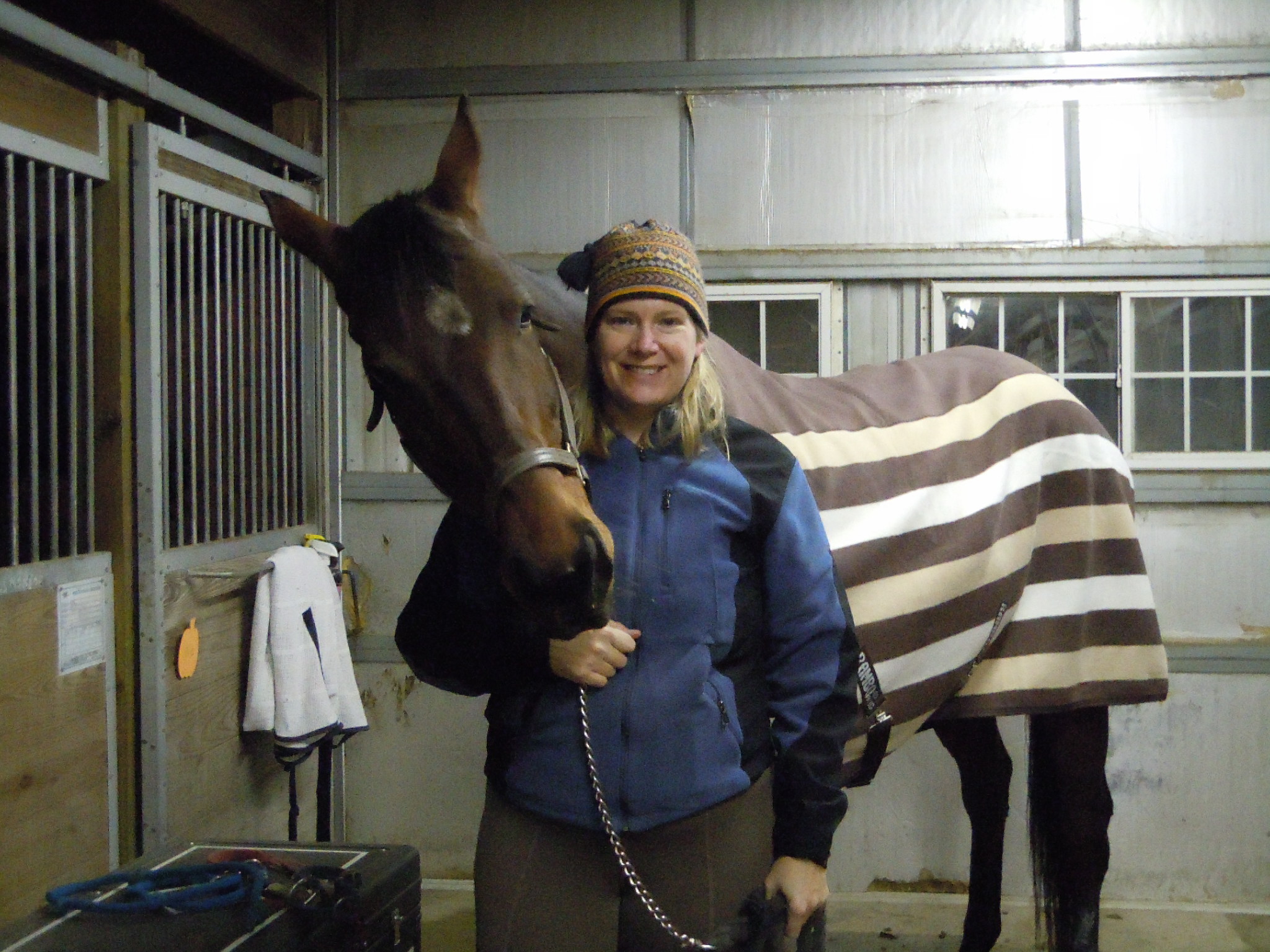
You know it's cold when your horse steals your gloves.
The thermometer on my dash read 10 degrees when I pulled into the parking lot at the barn. I was bundled up, but could still feel the wind and cold as I scurried to the door. Inside, it was much warmer – the doors were all closed, and the horses are inside.
Mads and I had a better, but uneventful, ride tonight. I have a lesson tomorrow, and focused mainly on my leg postion tonight. My work is paying off – I can feel the improvement in my position, and it’s getting more comfortable. We trotted around a lot, mixing in practice in two-point with some real work.
Mads was wearing her quarter sheet, which I think I’ll leave off tomorrow. She was feeling a little dead to my leg – not sure if it was lack of spurs or the fact that the rug has her feeling a little to comfy. (I do carry a whip, which is markedly less effective with the rug on. I rarely use it, however.) I am going to need to re-tune her responsiveness to my leg aids, though.
It felt much cooler after our ride. I dove back into my coat, and hurried to untack Mads and get her blanket back on her (but not before rubbing it all over with a dryer sheet. The static electricity is driving us all nuts!).
Mads was still a little chilly, though, and borrowed my gloves. Silly mare.
Victory! Albeit a small one, but I don’t care, I’m taking it. My week of hip-flexor torture is paying off. In last night’s lesson, my leg and seat position was much better. My leg was hanging correctly from the hip – toes in and making full contact with the horse – and best of all – it didn’t hurt. I wasn’t overloading my ankles with weight while at the same time twisting them inward (that really hurts!)
Interestingly, Christy asked me if I had dropped my stirrups a hole. Huh, I didn’t think so, and verified that no, the stirrups were on the same hole I usually ride. My leg sure did feel different though, and I suspect it looked a bit different to her, too.
I also got to test the strength of my new position. Mads spooked sideways and for a second I thought it was going to evolve into a bit more of a spook. But I was solid in the saddle – rock solid in fact – and was able to ride through it nicely. Though my heart was pounding afterward and my legs momentarily were jelly, Christy assured me that I rode it well and never looked like I was having a problem.
Today I’m taking a day off from riding, and I’m glad. The muscles that I’m retraining in my legs are exhausted. I felt this yesterday, when Christy and I met for an early afternoon ride. We had the arena to ourselves, the air was cold and crisp, Mads was really forward (I left her quarter sheet off, to encourage a little extra spunk). One problem. As we were trotting around warming up, before I was even asking Mads for anything more than a little stretch here or flex there, my legs were tired. Really tired. At first I thought that I’d get warmed up, and I’d be okay. But “okay” wasn’t forthcoming.
As we were warming up, before we even moved off into a trot, Christy – in her weird, mind-reader, prescient way – was talking about a book about equine physiology she’s considering adding to her library. Among other things, she’s interested in learning the physiology of muscle development and how to build equine muscles correctly. Any sort of muscle development requires that the muscle be overloaded. Soreness – a result of minute tears in muscle fibers (“microtrauma”) – is part of the process, an indicator that you are in fact working – and stressing – the target muscles. If it’s not getting a bit sore, you’re not using (and developing) the muscle. I’m no sports physiologist, but I’m pretty sure my body was telling me to give it a rest. It was a short and unfulfilling ride.
The discussion of muscles got me thinking about Friday’s ride, during which Mads read one of my aids (pushing with my inside hip flexor) as a canter cue, when I intended for her to just bend. I’ve long been gently bending this light and responsive mare at the trot simply by pushing gently with a hip flexor, making kind of a scooping action with the seatbone on the same side. It’s a small aid (or, at least, it is when I use it as described. It can be much stronger) and when I do it on the long side of the arena, I can bend Mads gently one way, then another, and then back again, keeping contact with her mouth steady and unchanged.
So why was my subtle cue now eliciting a canter? Well, it probably has everything to do with my new, improved leg position. If I’m riding in a correct position, more of my leg is against the horse. In my old toes-out postition, my leg wasn’t in much contact with Maddie’s side – really, just my heel and upper thighs. Now, however, when I ride with my hip angles open, my whole leg rolled (for me) inward, and toes pointing forward, my entire leg is in contact with the horse. So that subtle cue I had been giving was amplified.
Just one more thing to think about as I rebuild my seat. I have to re-define my aids, as well.
As you know, I’ve been working on improving my position in the saddle. To gear up for riding without stirrups at a pace faster than the walk, Christy’s had me working in the two point postion. Correctly. You see, until this week, when I hopped up into two point, I just lifted my tush out of the saddle and off I’d go. Turns out this isn’t the right way to do it, as I discovered this week. There’s more to the two-point than simply tipping your butt up out of the saddle.
In my lesson yesterday, Christy had me working in two point. And shortly after we started, I started complaining of nasty pain in my ankles. The muscles in my lower legs were en fuego. Which ain’t right. So Christy suggested that I work on moving the stirrup around on my foot – forward, backward – while in two point.
I stopped what I was doing and looked at her like she had ten heads.
Move the stirrup around on my foot, while in two point? Yes, she said, pointing out that I should be carrying most of my weight on my inner thighs, not my feet.
All righty, then.
I started walking around, trying to figure it out. Hands braced on the pommel, I posted while Mads walked, trying to get a feel for lifting myself from my thighs. The mare was confused but tolerant, at times stopping when things got too wriggly, and turning her head to give me a long look, as if to ask “You OK up there?” When I started to feel it, we picked up the trot. My inital challenge was keeping Maddie moving – anytime I got too unsteady (in her opinion) she’d drop to a walk. What good girl she is.
Finally, by the end of the ride, I got it. We were trotting around, with my hiney out of the saddle, and I was able to really lighten my foot in the stirrup, carrying my weight on my upper legs, not my feet.
Tonight, I was saddling up as Christy was getting going on her new boy, Remy. It was close to feeding time, and , my girl Mads was antsy. We got going, limbering up at the walk, while chitchatting with Christy. Then it was time to work. I hopped into two point, giving Mads plenty of rein to stretch. Round we went. My thighs were on fire. I was doing it right.
Panting after a few laps, I decided to relieve the stress on my legs by posting. I picked up more contact, and started shallow serpentines, bending Mads right and left from my seat. Clearly, my aids are a little confusing, because Mads – who was already nice and forward – stepped into a right lead canter.
Crap! I didn’t ask for that, and I’ve always been told that you don’t let horses get away with decision-making. I started to half halt her, when from the other end of the arena came the command, “RIDE IT!” Christy was keeping an eye on us, and I know better than to argue with her. Down my butt went into the saddle, and ’round we went. We kept going until by mutual agreement we had had enough.
Afterward, Christy reminded me that part of riding entails riding the horse you have at the moment. When the horse is forward and sensitive, you ride that that horse. Don’t pick fights you can’t win. Set yourself up for success.
That nice little spontaneous canter was an unexpected gift from Mads – it was a fun confidence builder, and a reminder of the “ride the horse you have” rule.
George Morris’ voice is still ringing in my head from Sunday’s clinic. One thing he said that really resonated with me was this: “The first time you do anything, it’s difficult. Eventually it becomes easy. Then it becomes habit. Finally, it becomes beautiful.”
I’m clinging to those words now because I’m in the process of making some adjustments to my seat, and building the requisite muscle memory. The changes are hard for me – I’m working on rolling my legs inward from the hip – stretching through my hip flexors – to allow my leg to lay more fully and correctly against the horse. My habit – and conformation – make this difficult. It’s easy for me to roll my whole leg outward, knees and heels together, toes pointing 180 degrees apart, like a ballerina in first position. Unfortunately, I do not aspire to be a ballerina.
So I’ve been working on opening my hip flexors, and rolling them inward, which (should) also press my knees into my saddle blocks, and bring my toes forward.
Ah. My toes. Woe is my toes. Left to my own devices, I’d let them flop out, like a car with its doors hanging open, the back of my heel bumping against the horse. Too bad that looks seriously ugly, and doesn’t work well when wearing spurs. You see my problem.
So right now, I’m doing a few things. I’m spending more time in two point, and I’m dropping my stirrups at the walk, both of which help me align the hips-knees-ankles and sink into my heel. I have to say, however, it feels like hell now, even when Christy pipes her approval from the middle of the ring. My muscles are on fire. My flexors, they’re a-flexin’. And the whole thing feels discombobulated to me.
Hard, easy, habit, beautiful. Right now, this is hard. Boo.
I did have a nice little piece of encouragement last night, though. I got on a friend’s horse who was a little to fresh for her tastes. He’s green, and wanted to go around with his head up, braced against the bit. I had flashbacks to riding Jag as I was just re-learning to ride, before either of us had any sort of dressage training. I dug around in my video archives and yep, sure enough, found some video of a braced, inverted trot. Nice.
So, back to last night. I’m a better rider than I was lo those three years ago (thank you Jesus, and Christy) and immediately took a hold on that bracing mouth, and started to ask him to soften. I pushed with my inside leg, into the outside rein, and even though this horse isn’t the best at bending, I got some decent bend and softening. We worked a bit both directions, and then, at the walk, I focused on getting him to soften and relax. He was a quick study, and started to figure it out by the end of our short ride.
I remember well the days when I wondered if I’d ever, ever, ever be able to bend a horse, or react quickly enough to give when the horse softened into the bit. It seemed sooo hard when I first started working on those skills. Last night, I realized that those have become habit. They are not beautiful (yet) but they are habit. Bending and softening and using the outside rein are built into how I ride. That gives me hope – much needed right now when things feel so awful!
When a couple friends invited me to audit a George Morris clinic with them, the first thought that popped into my mind was this: “What would a dressage rider get out of auditing a George Morris clinic?”
What a stupid question that was. Fact is, any rider can learn from George Morris. Any.
While much of the clinic’s focus – upper level jumping – was far over my head and well out of my realm, I was struck at the emphasis GM put on the fundamentals – many of which are echoed by Christy during my dressage lessons. Take the outside rein, for example. My struggles with developing honest contact and using the outside rein to bend are well documented. And I do – I really do – understand how it works. But seeing the outside rein in action today was illuminating.
In one exercise, the riders had to jump an in-and-out, and then turn and go to a big oxer in four or five strides. GM talked the group through how one walks a course and plots strategy. In a jumpoff, saving one stride saves micro-seconds on the clock, and in most cases, would be preferable. Horse after horse came through the course, and as they turned, it was easy for me to see which had been turned more correctly – bending into the outside rein – and which had turned because their heads were hauled around. Horses that had executed a more tactful, well-organized turn were markedly better balanced, taking a true line to – and over – the jump. GM asked all of the riders to halt almost immediately after the jump, as well – and those that were well balanced before and over the jump were able to halt with style and accuracy. Many of the others had to avail themselves of the arena wall to halt. The key to executing that critical turn with grace? Proper bending into ye olde outside rein. Importantly, however, GM stressed the importance of holding onto the outside rein and maintaining contact, even when traveling in a straight line. “Straightness is the result of balance between the inside leg and outside rein, ” he told us.
GM addressing the group in the first clinic session
All throughout this exercise (and many others) GM repeated the “outside rein” mantra, while also reminding riders to close their fingers and take a feel on their horses’ mouths. Elastic contact was another principle that was repeated throughout the day. GM emphasized the importance of getting the horse on the bit – and of doing so correctly. “Contact isn’t just pulling the rein. It’s pushing. Push first, then take rein and bend,” he said. “Push-take-bend.” He went on to emphasize what dressage riders call “riding back to front” – generating push from the hind end, over the back, and through the reins to develop honest, forward and elastic contact. Elasticity of contact was also stressed. “Softness comes from give, not from holding,” GM told the group. Develop elastic contact by softening when the horse gives. He encouraged all riders to soften their elbows, while keeping their fingers closed.
To help everyone get their horses onto the bit, GM started the sessions with suppling, stating that it’s important to supple the whole horse, not just the neck. Riders rode shoulder-in, shoulder-out, haunches-in, haunches-out, counter canter and a variety of circles and serpentines to bring their horses onto the bit (while making correct use of the inside leg and outside rein.) In the second session, he got on one of the horses and within minutes had the big jumper moving easily and what the dressage world would call “through” – fully connected to the bit and over the back. According to GM, “A horse bends from the ribcage. This new bending at the neck I see everywhere…I don’t know where this came from, but it’s WRONG!”
During the clinics, GM reminded riders often about pushing the horse to the bit with the legs, maintaining contact and bending into the outside rein, especially as the exercises got more demanding. At the end of the last session I watched, the riders were asked to jump a vertical that was set above 4″. They had to gallop to it, and then, because it was set almost to the corner of the arena, they needed to immediately turn or stop. GM was asking them to stop. Now, all of these riders were using automatic releases – but GM still issued frequent reminders about maintaining feel to and over the jump, which was undoubtedly necessary if in order to maintain communication in order to make that halt so soon after galloping to and then clearing that big vertical.
On perfection
A few times during the clinics GM stopped to explain his insistence on perfection. “I’ve had great successin this business by being a perfectionist,” he told the group, repeating the old adage, “Perfect practice makes perfect.” On the subject of practice, GM noted that the first time you do anything, it’s difficult. Eventually it becomes easy. Then it becomes habit. Finally, it becomes beautiful. In order to get there, he advocates a specific approach to training and practice: Explanation-Application-Correction-Practice. The new skill is explained (and demonstrated if necessary.) The rider gives it a try. The trainer makes any necessary corrections. The rider practices the skill correctly.
It’s clear that GM is an intensely competitive guy, even today. Throughout the day, he lamented the watering down of courses, especially with respect to the controversial removal of liverpools from top-level events. “That’s catering to spooky horses,” he snorted. “If you can’t jump a liverpool, you shouldn’t be there. (He then made sure that every rider in his clinics could jump a liverpool, focusing specifically on educating horses on spooky jumps).
“Good enough” isn’t good enough, he stressed. “Getting through the day isn’t the objective. The goal is quality. Excellence counts.”
Most of the horses in the clinic were supremely fancy warmbloods. However, the the two boldest jumpers in the later, more advanced clinic, were both Thoroughbreds. They never as much as looked at a jump, clearing each with enthusiasm and answering every question asked of them. “Put your stick away,” he told both riders at certain points, as neither horse needed any reinforcement. “I love Thoroughbreds,” GM said more than once.
George Morris schooling riders on how to educate horses to spooky jumps:
This weekend I had the opportunity to have my riding position analyzed using an Equicizer from Equisense systems. The Equicizer is endorsed byformer Olympian and general dressage goddess Jane Savoie, and is a sensor-loaded dummy horse that, when mounted, reveals how even (or not!) a rider’s position is. Everything from leg pressure to seat position to the weight one takes in the reins is measured and fed back to the rider.
I will be the first to tell you that I have a variety of issues, so I eagerly clambered aboard for my session. And wow, it was revealing .
Right off the bat, the Equisense trainer had me make a significant change to my seat – opening my hip flexors and changing my hip angle. I’ve been having some issues with my knees coming forward, and I had the same problems on the Equicizer. But after adjusting how I was sitting on the horse by opening my hip angle, the problem went away.
At the outset, my seat was also slightly uneven. I was putting more weight on the right seatbone. The trainer instructed me to push my left hipbone toward the horse’s right ear. This adjustment balanced my seat perfectly. It didn’t feel perfect to me, however – it felt very much like I was pushing that left hip forward. The trainer advised me that my ability to feel this was good – to make this correction permanent, I’ll need to be aware when mounted, and start building the muscle memory needed to make this adjustment permanent. Happily, throughout my session on the Equicizer, I was able to maintain that balance, even through changes in the speed of the simulated gaits.
An apology to Maddie
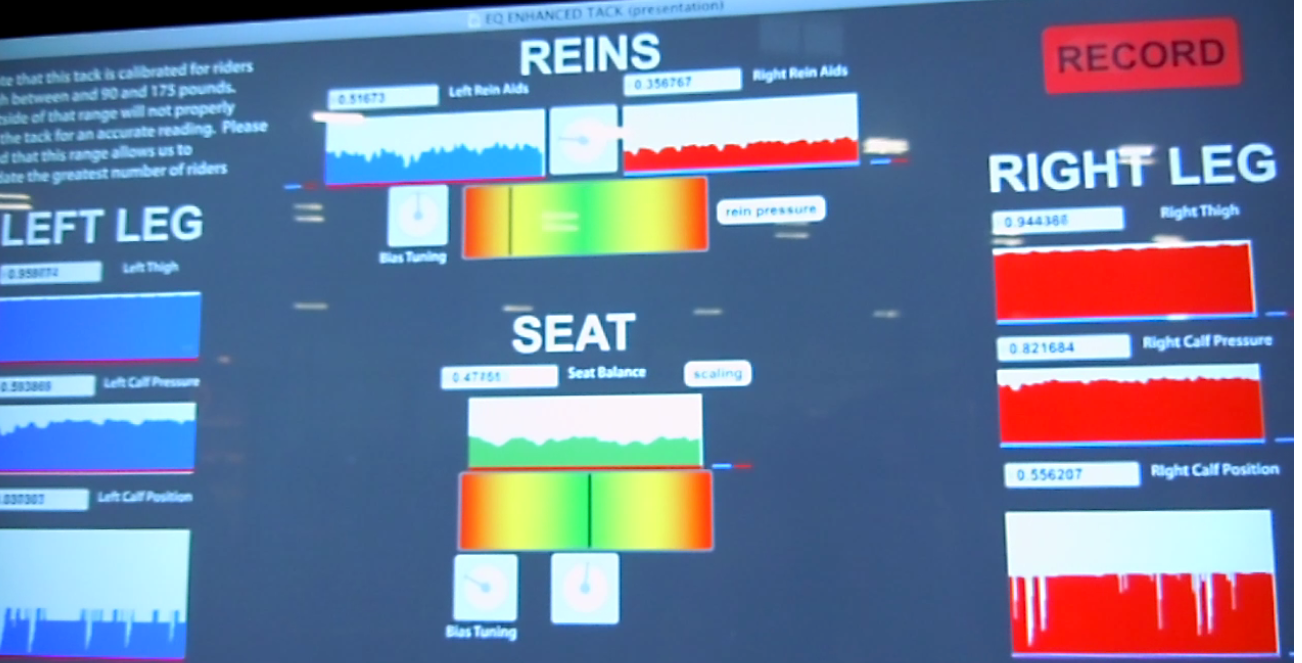
Without a doubt, the most revealing part of the experience was what I learned about how I hold the reins. Right from the outset, I was holding a lot more weight in the left rein, even though they felt dead even to me. This is illustrated in the image at the top of the post – if you look at the top of the image, under “Reins” you can see that the red graph showing right rein pressure is far different from the corresponding blue graph for the left rein.
The trainer worked with me on increasing and decreasing the degree of contact I carry in the reins from my shoulders, moving my shoulder blades back and forth. She then isolated my right arm and shoulder, asking me to bring that shoulder blade back. As I did so the sensors indicated that the pressure I was putting in each rein was almost even. She put the Equicizer into motion, and things went haywire again. Slowly I was able to even out the rein pressure. But it didn’t feel even to me – at all. Throughout the session, I was feeling more weight – a lot more – in that right rein. The muscle memory training mentioned previously will come into play here, as well. In the meantime, I owe a certain big bay mare an apology.
After some effort, finally, more even rein pressure
Unbeknownst to me I’ve been really hanging on that left rein, even when things felt even or a bit light. In reality, I suspect there’s been a lot more pressure on that rein, and the mare has been responding as any horse would – by returning the favor, and hanging back. When I’ve managed to do the exercises Christy suggests (dropping pressure on the left rein intermittently while driving the mare into the right rein with my inside leg) we get the nicest, most honest bend. So the big take away here is to focus on evening up the balance in my reins, which *should* reduce the problems I’m having with left bend. Tonight, when I get back on the mare, I’ll have a specific plan. I’ll start by dropping my stirrups, paying attention to my hip angle and letting gravity stretch my legs. I’ll pick up my stirrups, and will maintain that open angle, avoiding my old posture with tilting pelvis and arched back. And when we’re working with what I perceive to be even contact, I’ll be conscious of reducing my left rein pressure, and observing that that change elicits in the big mare.
Here’s some commentary from Jane Savoie – who endorses the Equicizer – and a look at how it works:
Mentally, I was born to be a dressage rider. Okay, that may be over stating things a bit, but there’s no question in my mind that this is the right sport for me. Details, mechanics, cause-and-effect – are all appealing to me. And I’m not an ultra competitive person that wants to take shortcuts to win. I really geek on good fundamentals and learning to do it right.
Mentally, however, I’m also working on my confidence. My last ride on Jag before I retired him ended up in a high speed crash landing. I got to feel the speed that made him a stakeswinning sprinter … and then I got to know what it feels like to be dumped on a mounting block. (In case you’re wondering, it doesn’t feel good.) I was in a cast for six weeks after that episode, and it’s still with me.
Enter Maddie, who is totally lovely under saddle but is a horse that will test you a bit. She’s more horse than Jag was, and while I don’t feel overfaced with her, I have a lot to learn with (and about) her, and she’s absolutely forcing me to be a better rider and horsewoman. She has the loveliest canter – the proverbial rocking horse rhythm, swingy and up-hill – but I still have balance issues and the transitions up especially intimidate me.
So my endlessly patient and creative trainer Christy has been focusing us on precise work at the trot. Adjustability within the gait, developing solid contact, and improving our overall balance. I’m already feeling more confident, because the better contact equates to more responsiveness. And my improved strength and balance will help me ride the transitions gracefully when we add the canter back into the mix. The trot work is giving me the foundation I need to develop quality canter transitions.
And therein is one of the things that I really like about dressage, and how Christy trains it. The building blocks prepare you for the next steps. What seemed unimaginable a few months ago is within reach today. Taking the time to get the fundamentals right is satisfying, and provides me the skills and confidence to progress.
So hopefully we’ll be seeing more of this – with a less ugly t-shirt/saddle pad combo – soon:
We had a good lesson tonight, which saw another two firsts – we started to work in a slightly higher frame, raising Maddie’s poll. And we also had the beginnings of a stretchy trot! Things were good right out of the gate – it was chilly and Maddie was more forward from the get-go. She felt great – light, responsive, and on the bit. I love how supple she’s becoming – I can bend her gently while trotting simply by tightening one hip flexor. This is useful, because it enables me to quickly flex her this way and that, while staying out of her mouth. I can also bend her pretty quickly into the outside rein if I need to re-establish contact.
So things were looking good straight away. Even warming up, Mads was steady, even and enthusiastic, before I even asked for much.
Christy took advantage of the nicely forward horse, and we worked on adjusting within the gait, and especially on covering more ground with our “big” trot. We used the short sides to rebalance, using half halts to shorten Maddie’s stride. Then, on the long side, Christy had me focus on increasing the scope of my post, working in a slight pause at the top of my post. Doing so, according to Christy, gives the mare more time to cover ground. I think we’re getting close to an extension. Dare I hope?
Developing a reaching, ground covering trot
Christy also had me work on shortening my reins just a bit (I have a bad habit anyway of riding with them too long) and raising Maddie’s front end. We’re not simply cranking her nose in – I’m working from my seat, and working to create a more uphill frame. This was the first time in recorded history that we’ve looked this pretty:
Good mare!
Maddie fussed a bit as we worked uphill, and Christy advised me that I’ll need to pay attention to letting her stretch on my terms. She also reminded me that this work is hard for Mads, who isn’t used to carrying herself this way. I’m going to be taking more weight in the reins – and I’ll need to hold it. And I’ll have to work more stretch work into our schooling, to reward and rest my hard working buddy. So, we started to practice stretching at the trot – again, something totally new.
This was a brilliant lesson, and a great confidence builder, moving me out of my comfort zone in terms of riding more forwardly, and in terms of stretching. I was reminded of another friend who when working on stretching her mare at the trot and canter was told to “be vulnerable.” That’s certainly what it feels like to me… but that stretch work feels pretty good.





 Collecting Thoroughbreds