The end of the week

After three great rides, I was hoping to keep the momentum going but Derby was feeling the effects of the stepped up work ( at least that’s what I’ve concluded, and I had overdone things in a workout earlier that day and had almost zero in the tank.  Our work was OK, and we got the canter both ways, but Derby was resistant and registered his discontent with a little buck.   Friday the horses were back outside (the icky weather kept them inside for a couple days earlier in the week) and he had the day off.

We started today with a set of new shoes, but Derby was still a bit uncomfortable for the farrier, and I had to free longe him to loosen up his back end so he’d tolerate getting his hind feet trimmed.

Our ride – my first on my own since the clinic – was pretty good.  I worked on lateral work, especially leg yielding the trot, and did some canter work both ways, and his attitude was much improved compared to Thursday’s as well.  Overall the contact was pretty good, as were the quality of the gaits.

After we rode, I put him on the longe, for the prescribed longe work.  He was swapping leads pretty badly earlier in the week, but today I got good quality work both ways.  I do hope we’re well along the road to recovery and loosening (and strengthening) those big muscles.

Mind Over Matter? Maybe?

I’m not sure why this is happening, but I’m riding better now than I have in a very long time, maybe ever.   And the fact that this is coming after the horse and I both had two weeks off is especially confounding. But it’s undeniable.  We’re better. The horse is forward, the contact is better, the gait quality is better, and – amazingly – I’m doing a pretty good job at sitting my transitions, and the transitions (especially upward to canter) are prompt and greatly improved.  To wit:

Two weeks ago:

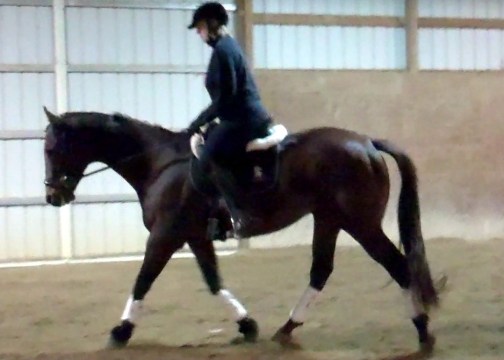
Respectable trot, in an intro/training frame

Last night:

His face is nicely vertical, he's tracking up and his back is up. Much better. Best of all, Derby is offering this, and I'm taking it (instead of throwing the reins away and dumping him on his forehand.)

The canter work is even more significantly improved.

Two weeks ago:

This effort is probably described best as "trying not to fall off the damn horse."

Last night:

I'm so proud of us. Round, good contact, quality gait, and I'm sitting nice and tall. Go us!

I’m not sure why we’re suddenly producing better quality work – and to this degree.

– It has been cool and breezy, and a little wind under his tail might be propelling the Derbster forward.

– Along the same lines, I’m wearing larger spurs to better make my point, and Derby, to his credit, is getting good at saying “Yes, Ma’am!”

– We’re in a different bit and he is definitely taking stronger contact on it.

– I came home from the Dover clinic motivated and educated

– Christy is also similarly motivated and told me “It’s time to demand more…”

– The vet says I gotta do it.

I’m sure these are all contributing factors, though none explain my new found ability to sit my transitions.  I guess I’ll quit ruminating and just take it.

So tonight Derby really worked.  We started with the longing program prescribed by the vet, and then had a lesson about 45 minutes later. We took advantage of the empty arena to really encourage Derby to move out, both at the trot and canter.   Leg yields and trot quality were the focus of the first half of the lesson.  Christy had me ride the arena like a rectangle on the quarterlines, cutting straight across the short end and yielding out on each side.  As we went through the exercise, Derby got more and more connected, which really is no surprise, given that I was half halting him through every corner, and again as we started the yields.  Feeling the contact get stronger and his back come up up up was really cool.

For the canter work, the aim was to ride more forwardly and let Derby roll around the arena.  However, we were both starting to run out of gas toward the end.  We did get some nice quality work, though not as big and forward and rolling as I had hoped.   We’ll give that another shot tomorrow!

After the ride I made a big fuss out of Derby, plying him with carrots, cookies, peppermints and an alfalfa mash.  I think we’re friends again (he wasn’t thrilled when I saddled him up apres longing) and I’m looking forward to tomorrow night!

The Prescription

Crappy eq notwithstanding, Derby is going more reliably round, forward, and on the bit.

As I mentioned in yesterday’s post, Derby is suffering some latent stiffness and muscle pain stemming from both the abscess and the fact that he really needs more conditioning, especially with respect to his hind end and his top line.  At the moment, some muscles in his hind end are quite tense and tight, causing him to move stiffly, starting from his hips, and evidenced by shorter strides, and a back that doesn’t swing.  He’s particularly reluctant to move out on his right hind, and Dr. Nicky said she suspects that he’s still off from using his hind limbs asymmetrically when he had the abscess. She prescribed Robaxin along with a program of longing and riding with the specific aim of stretching and strengthening those muscles.   So, even though he’s not moving perfectly, I need to get on and really ride.

This is what I need to really shoot for - getting him to step up under himself, while maintaining roundess and contact, to keep him over his back. This requires multitasking on my part.

The imperative from the vet and the lingering effects of the Dover clinic have galanized me, and Christy, who is no longer inclined to cut me any slack.  The lesson tonight worked a lot on leg yield and canter transtions, which were especially sticky to the right, requiring me to sit up, ride and require equine compliance and cooperation.

Overall, I’m happy with our work tonight.  The trot is more reliably round and forward.  I’m getting better contact, though I may have to give some credit to a softer bit – Derby went very nicely in a fat KK, switching out from the thinner Myler comfort snaffle.   And after a few attempts, I got a nice, immediate upward transition going right.  That took some doing – that’s the lead we’ve been having difficulty with, most likely due to the abovementioned lameness and conditioning woes.  We had no such issues going left – Derb picks that lead up right away.

And the trot is better, though in this video, you can see in Derby’s tail carriage (tense, held out) that he’s a bit uncomfortable. I hate that he is, but am determined to minimize this uncomfortable period by rigorously following the vet’s instructions, (and feeding lots of carrots and cookies to make up for it in the meantime.)

Channeling Robert Dover (or trying to, at least)

I have nine pages of notes and hours of video from the weekend’s clinic with Robert Dover, hosted by Wyngate Equestrian, and I really will try to synthesize all that info and share it with you.  For now, I’ll stick to just a couple key things I took away from the experience.

First and foremost,  Dover focuses on the basics.  He tested almost every rider’s connection with their horse, and proceeded with the lesson based upon what he observed during the exercise, no matter what level the horse and rider were at.  One rider, who was mounted on one of the most fabulous horses in for the clinic (and that is really saying something, folks, there were truly some world-class animals there, including one that had been shortlisted for the Pan Am Games) that was purportedly schooling all the FEI work wound up working on getting the horse through and into the bridle honestly!  It was an astounding lesson, from the standpoint that someone at that level could have such fundamental weaknesses.  And this rider wasn’t alone.  Another GP rider had similar issues with connection, and a third rider who was competing at fourth spent most of her lesson working on bend.

It was fascinating watching Dover work with these three in particular, because I really wasn’t expecting to see people with issues to which I can really relate.  The difference in the riders from the beginning to the end of their lessons was amazing, and one rider must have done extra homework, because her ride the following day was truly extraordinary, drawing applause from the auditors, myself included.

In addition to his emphasis on the basics, Dover also emphasized perfection. “Walk perfectly,” he said dozens of times, going on to say that if your horse wasn’t through and on the aids at the walk, it wouldn’t be through and on the aids anywhere else.    He required riders to follow his instructions precisely, and had them repeat the movement when it wasn’t up to his standards.    As Christy noted in her first recap of the clinic, every rider rose to his challenge.  In our chat about the clinic afterwards, Christy and I both noted that the charge to expect more of you, and your horse, was one that we would be taking back to Silver Fern.

Finally, the last big take away for me was around forwardness and responsiveness.  I *know* that you need your horse to be forward and attentive, willing to respond instantly to the subtle aids that make well-ridden dressage so beautiful. Dover emphasized the fact that how we ride trains our horses, and essentially, we have to ride them like we want to ride, and require them to respond.

As I said, I have a lot more to share about the clinic, but now I need to talk about today.

Derby’s abscess seems to have healed nicely, but he’s been short on his right hind (the abscess was in the left.) I had the vet out, and while she did support putting him on Adequan and said he would need to have his hocks done at some point, the issues I’m seeing are more about weakness and tightness in his SI region. She prescribed a course of forward, correct work.  Which means that between what I learned from Robert Dover and what my vet says the horse needs, I need to make some changes.

It’s been two weeks since I really rode, so I did a short lesson to get back into the swing of things.  I told Christy to take no prisoners, and my formerly sweet trainer turned into a demanding taskmaster.  But that’s what we needed, and we had a good ride  – despite his reluctance to use his back end and step under himself, I was able to get him to do both, with constant coaching from Christy.

Because the correct work is now an absolute imperative, I’m taking lessons each night this week, and on Saturday, and will probably repeat the same next week.  I need to channel Robert Dover and get the perfect work Derby and I badly need.

Derby’s early days

In doing my research on Derby and his identity, I discovered that he was bred by Airdrie Stud, which is owned by consummate horseman (and former Kentucky governor) Brereton C. Jones.  Derby romped on some seriously hallowed ground in his early days.  Poking around on the Airdrie web site, I found a contact form, and on a whim, sent them a note, not really expecting to hear back, because they’re in the throes of the fall sales, and, well, Airdrie is a big operation.  I don’t have rights to this picture of the farm, but this will give you an idea of  the kind of place it is.  Gorgeous, isn’t it!

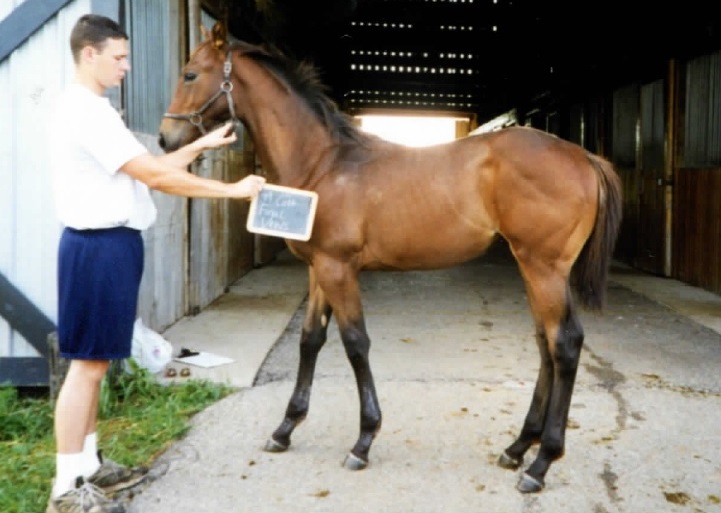
Today, I opened my email and found a message titled “Photo of Derby as a foal” from a woman named Laura, who works at Airdrie.  She had trawled Airdrie’s archives, and had found some pictures of Derby as a foal, which she scanned and emailed to me.

He was a cute little dickens!

Importantly, the photos included an up-close shot if his forehead, and there, wandering toward is left eye, is a distinctive smudge of white hairs.  This evidence closes the blooks on Derby’s identification. There were a few little doubts, but  I am now 100% sure he is, in fact, Holy Vows.

Yep, that is definitely Derby! And dang, he was a cutie.

And many thanks again to Laura at Airdrie.  A long retired, unsuccessful gelding means nothing to their business, but despite that, Laura tracked down those photos and sent them to me.  I’m really grateful. Thank you, Laura!

Robert Dover is coming to town!


This coming weekend (October 15 & 16), Robert Dover will be giving a clinic at Wyngate Equestrian in Walworth, Wisconsin.  Wyngate is where I board Jag, and I am auditing both days.   I’m especially excited about Sunday, because Christy is riding in the clinic that day.

This will be my first big time dressage clinic.  I’ve seen a couple with local trainers, and they were informative.  And the George Morris clinic I audited last year was incredible – I learned a lot even though the focus (upper level jumpers) is not in the least bit germane to my riding and my goals.

Robert Dover represented the US in the Olympics six times, and in the World Cup seven times.  He’s also reputed to be an excellent clinician and teacher, and is probably the preeminent coach in North America.  This is simply an amazing, amazing opportunity.    And yes, I’ll be taking copious notes, which will end up right here.

If you are in the area, come join me at the clinic – here’s the information about auditing:

http://www.wyngateequestrian.com/Wyngate/Robert_Dover_Clinic.html

Photo courtesy of Wyngate Equestrian and Robert Dover.

It’s just an abscess!

Generally speaking, I wouldn’t wish an abscess on any horse.  But given the alternatives to the weird lameness Derby exhibited over the weekend, I was hoping and praying for an abscess.  I’ll take gravel over stringhalt or a suspensory any day.  Happily for us, Dr. Nicky found a bruise and abscess in short order.  She was able to open it and get it draining, and Derby is already moving more comfortably.  Our immediate future involves twice-a-day soakings and handwalks.  Derby is a stellar patient, which means his prescribed treatment from the vet will be augmented with ongoing cookie therapy too.

Hand-wringing

It was a beautiful weekend, and on my way to the barn on Saturday, I got a text from Christy suggesting a trail ride.  Awesome!  But as they say, “Man plans, and God laughs.”  Because Derby came up lame.   It was pretty strange – he led in from turnout OK (though I will admit that I wasn’t watching him closely.)  I stuck him in his stall to have a private moment and relieve himself before I tacked up.  However, when I opened the stall door, clipped the shank to his halter and invited Derby to come out, he refused, which was really strange.  I cajoled him a bit and he came out, at which point I backed him three steps into the cross ties nearest his stall.

That’s when things started to go South.  As I was currying Derby, he started to stumble (for lack of a better word) and shift uncomfortably.  I unclipped him and walked him around, and he off on his left hind – and it got progressively worse.  He was striding with that leg as though he had stringhalt, snapping it up toward his belly and then forward, and when standing, he would lift and flex the leg upward.  We walked through the barn into the arena, and there, on the soft footing, things got really bad.  He looked like he was going to fall down.

Without further ado, I took him back to his stall.  His strides steadied a bit in the aisle but he certainly didn’t look sound.  He had a little heat in his gaskin, but he would bear weight on the leg (I could actually pick up both hind feet without a problem.   I called the vet, who said it wasn’t an emergency (because he would bear weight on the left leg) and she instructed me to give him 2 g of bute and see how he was on Sunday.

Derby was a bit better yesterday, walking more comfortably, though he still looks awful on soft footing.  He wasn’t doing the strange lift-and-flex routine with his left leg, though that leg will occasionally hover a bit.

His temperature and respiration were normal, and he was bright and interested in his food, until I gave him some bute paste via a syringe in the mouth.  At that point he turned tail and sulked in his stall for a good half hour.

Worryingly, there is now a digital pulse in the pastern on the left hind, and the hoof felt a little warm this morning.   The vet is coming tomorrow.  I hope it proves to be something simple, like an abscess, though the symptoms have been strange.  Fingers crossed.

Ask and you’ll receive

Nice contact, going right, in a bigger gait.

We’ve been working on establishing a better quality “default” working trot – specifically, tracking up and staying in front of my leg.  And overall, we’re doing much better work, and I’m able to generate good quality gaits  pretty much from the get-go.  There are two keys to our improvements – my staying balanced on the horse, and insisting upon a good forward response when I ask nicely.  Tonight a few other things happened – as the quality of the trot improved, I could feel Derby’s back come up nicely, and the contact really improved.  And watching the video after the ride, I can see that his mouth is a bit quieter and he’s a lot steadier in the bridle too. Best of all, however, I could feel Derby really engaging his hind and pushing forward.  That feeling of power is amazing.

Speaking of the video, here it is.  We were working on a few things – maintaining the quality of the gait, while also keeping Derby (and me) balanced and not falling inward – at one point you’ll hear Christy say “shift out” which means she wants me to get some weight into my outside stirrup and push the horse outward.  And late in the video you hear me say “Boosters!” – it’s at that point I felt Derby finally start to push.

We drilled big trot / little trot and then did some canter work that wasn’t fabulous.   I need to work on staying balanced in the transitions, and also reinforcing immediacy with Derby.  This will come.

LIttle trot. His back is up and he's holding the contact nicely.

Now I have something else to confess.  Last night I rode Tucker, the very fancy, very small (15 h) Quarter Horse.  Tuck has a ton of training and is light and responsive to his rider’s shifts in weight, balance and posture, and aids.  He was the perfect mirror for me last night, and the reflection wasn’t pretty.  It took me a while to figure out how to ride him – his short legs move a lot faster than Derby’s, and the tempo of his trot is a lot faster.  At first it made me laugh but within a few minutes, I apologized to Tuck for laughing at him, and asked him to please stop humbling me.  I want to do a few more rides on him because he forces me to stay very quiet – and makes it clear when I’m not.

Holy Vows, also known as Derby

Holy Vows, aka Derby, with one of his foals

Well, do I have some news for you.  We’ve deciphered Derby’s tattoo, and we now know “who” he is — Holy Vows, sired by Holy Bull, out of a mare named Final Vows, by Halo.

And, I learned something pretty astounding – Derby was bred before he was gelded, and he has at least two foals on the ground. I found this picture on the web of him, with his filly, last night.  I can’t believe this horse was ever a breeding stallion – he is the polar opposite of studdy, and can walk by a mare without batting an eye (or curling his nose.)

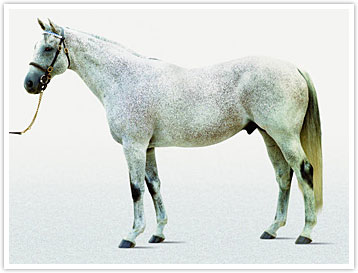
As far as Thoroughbred pedigrees go, this is a good one.  These are quality horses that have proven themselves in athletic endeavors.  Derby wasn’t successful as a racehorse – in fact, he was downright pitiful, running thrice finishing off the board in all starts and dead last in two of them – but he’s got nice conformation and movement – which his more illustrious parents transmitted.  He gets his sturdy build (and his cute face)  from his daddy, champion and Horse of the Year, Holy Bull, as you can  see to the right:

holybull

Derby’s dam, Final Vows, was a good producer, and among her progeny she foaled graded stakes winner Mighty Magee, Derby’s half brother.  Her sire was Halo, who died in 2000 and was one of racing’s most prepotent sires, siring super-stallion, champion and classic winner Sunday Silence, Kentucky Derby winner Sunny’s Halo, champions Devil’s Bag and Glorious Song, and a slew of other top race horses including Jolie’s Halo, Lively One and Saint Ballado.

Grandpappy Halo, evil but talented.

It’s a good thing Halo was a good sire, because he was also a miserable creature with an evil temper and a reputation for savaging his handlers.   Needless to say, Derby had his back turned when the genetics were being handed out – he didn’t inherit any of Halo’s brilliance, but he certainly didn’t get that temper, either.

Generally speaking, Thoroughbred bloodlines mean little for dressage.  But to me, each Thoroughbred is a living piece of history.  I followed Holy Bull’s triumphs avidly, and am well acquainted with Halo, his story and his progeny.  It’s fun knowing my boy  has these illustrious ties, even if it means nothing.