Optimism

I’m feeling pretty good about our upcoming outing this weekend.  We’ve done some good work this week, and have made some real progress on our road back to respectability.  My strength and endurance are ratcheting up, and I’m better able to carry myself.  As I take more responsibility for myself, Derby responds by moving more correctly.

What has been really interesting for me has been to watch how changes in my riding are reflected in the horse’s body language, especially his mouth.

When I’m not balanced, not fully independent with my hands, and when I’ve not put the horse together, Derby goes around “smiling” but not out of joy.  His lips are curled back and his mouth gapes.  I think it’s the horse equivalent of gritted teeth.

But when I put myself (and subsequently, the horse) together, and he stretches into the contact, the mouth is closed.

I ride Derby in a plain cavesson, for two reasons.  First, and foremost, a flash is not the solution to our problems. And secondarily, I simply don’t like the way flashes look, though I do understand the role they play in stabilizing a bit and helping to prevent a horse from crossing his jaw.  But as I said, gaping resistance on Derby’s part is a direct result of poor riding on mine.

The aforementioned cavesson, and the rest of our tack, are in the garage, freshly cleaned and soaking up some oil.  I’ll buff everything to a shine tonight, and then tackle my grimy boots.  Then we’ll be ready – really and truly ready – for our outing tomorrow. We’re going out at Intro A and B – again – but hopefully we’ll pass the test and will be declared ready to start thinking seriously about Training.


Silencing the Voices

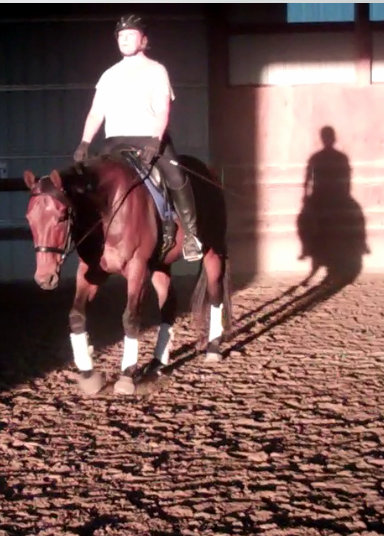
Working our free walk.

Derby has had the unenviable task recently of carting around an extra burden.  In addition to me, the poor creature has been saddled with an entire chorus of gremlins.  They live in my head and lately, every single one of them has shown up for my rides.  This was especially evident over the weekend, as I was over-thinking to the point where I would literally try to do three things at once in the saddle, and I would wind up literally screwed up – twisted and hunched and convoluted in the saddle to such an extent that Derby really should have just dumped my butt in  the sand.

This persisted into a lesson in which I didn’t ride well.  Watching the video, I cringed.  Some of the same tension – in the rider, not the horse – that I experienced at the show was clearly evident in this video.

Simply put, I was trying too hard, and ignoring some key basics, like balance, and checking in on your equine partner.  PARTNER. Not vehicle.  Looking back those videos, I was having a one-sided conversation with Derby.  And I was doing all the talking.  He responded as any rational being would – he clamped his mouth shut, and did his best to ignore all the blather.  Can’t blame him, not one iota.

So I resolved to banish the voices, and instead of trying so hard, to tune into the horse, and really feel him.  Feel his mouth, his neck, his back, his hind legs.  Feel all those things he uses to communicate with me, that I was ignoring of late.

It won’t surprise you to hear that everything improved.  Gait quality, roundness.  It’s coming back, but I have to really make a point of silencing the voices in my head, and listening to the horse instead.

Practicing discomfort

Last night was a beautiful night, and I was looking forward to riding outside.  However, the kids next door have a new toy in the form of a Carryall type utility golf cart thingy.  It’s bigger, louder and faster than your typical golf cart.   They were ripping up and down their side yard, hooting and hollering.  I decided that as much as I’d prefer to avoid this sort of thing that riding with this distraction would be good for both me and Derbs.

As I led him out of the barn after tacking up, the cart zoomed by, its occupants whooping.  Derbs spooked, levitating away from me with all four feet off the ground, to the end of the reins, snorting excitedly with his eyes bugging out.

I regained some control, and led Derby, who was now doing his “scaredy-snort” at regular intervals, to the outdoor.  Christy was riding Liam out there, and Liam was totally unconcerned.  Derby mellowed out as I girthed him up and ran my stirrups down.

Once mounted, I had to work on bringing my own focus to my horse and that moment, rather than the kids in the cart.  It took a lap or two but pretty soon we had some decent walk.  However, when we started trotting, some tension returned as the kids in the cart momentarily increased their racket.

I worked on employing the tactics Christy had used with us the prior evening.  For quite a while I struggled.  Yes, his head was down but he wasn’t on the bit, he was bracing, and he wasn’t round.  Finally, however, we got there.  Despite the racket and goofiness we got a nice round trot.

So, it wasn’t the most eventful ride, but that’s kind of the point.  Sometimes, eventful really isn’t the goal!

Fine adjustments

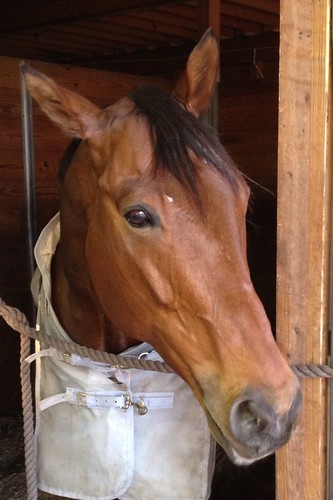
He has good reason to look confused.

My slow crawl back to respectability continues.  In my lesson last night, my endurance improved enough to do more trot work, and it was pretty decent trot work.  With Christy’s coaching, we were able to produce a nicely connected and round trot that had a little swing to it -and we were able to hold it consistently.

To get me there, Christy had me warm up by inviting Derby to stretch out and down.  Once I got there, she had me apply “back to front” aids – correcting my position and closing my legs to keep him forward, while continuing to ask Derby to stretch into the bit.  I needed a barrage of constant reminders, which to the innocent bystander may have sounded like harassment but honestly, until habits form, I appreciate the stream of commands from the center of the ring (“Check your posture! Tuck your butt, stretch and forward!”)

The “tuck your butt” suggestion is shorthand that Christy and I have developed that helps me process what she’s asking for so I can respond more quickly.   We’ve found that coaching commands that carry a visual association really help correct myself more quickly.  When I hear ‘butt tuck’ I respond by doing a few things – I elongate my spine, open my hips and check to make sure my seatbones aren’t pointed backward.   I have the bad habit of wanting to schooch back in my saddle, with my posterior almost on the cantle.  The “butt tuck” is also a reminder to me to put myself on my seatbones in the middle of the saddle.  When I hear Christy say that, it elicits a cascade of actions.

The best part of the ride was the fact that I could feel that the contact on the reins was alive and communicative.  That’s such a good feeling – you have the horse’s attention, he’s working over his back and maneuverable, and you can actually feel the inside hind leg in the reins.  Which sounds ridiculous, but for those who have actually felt that ….you know what I’m talking about.

We also picked apart a problem that evidenced itself with real clarity in the show ring a couple weeks ago, when we veered off course a bit during the sort free walk from F to E, winding up left of the target, almost at V.  In reviewing the video, Christy noticed that I had collapsed to the right, effectively pushing the horse to the left.   I started to experience that last night when we changed direction at the walk, and veered away from my intended path.  I tried to re-balance myself, but it wasn’t until Christy walked behind us and diagnosed what was going on that we could really fix what was going on.

I tend to carry my head tilted to the right.  At the walk, Christy had me sit on my seatbones, and lift my shoulders up up up, stretching and straightening my spine.  She then had me tip my head to the left, until it was straight.   Our walk improved.  However, we were still getting hung up at the trot going right.  Christy had us work both directions, watching intently.

“OK, I know what you’re doing,” she said after a few minutes.   I was leading with the wrong shoulder – twisting in the saddle. Essentially, I was almost in position to bend the other direction.    I straightened my posture once again, got balanced on my seatbones, and rolled my shoulders back, paying attention to the right shoulder (the one that wants to creep and roll forward.) Instantly, I could trot a circle without feeling like I had to work for it.

It’s amazing how these seemingly small changes and imbalances can have such a profound effect on the horse. I’m glad that we can take the time to fix these things, rather than trying to kick the hapless horse “through it.”

Should the farm (or other horse biz) be on Facebook?

Does the farm – or other equestrian businesses – belong on Facebook? I wrote this article a while ago for my company’s blog, and decided to share it here, with my equestrian friends, after a conversation I had this weekend with a fellow horsewoman. For those of you with small business, I hope this is helpful. We’ll return to our regularly-scheduled programming tonight! – Sarah

Cision Bloggers's avatarBeyond PR

Part I in a two-part series on using Facebook to promote small business.

Over the weekend, I spent some time putting together a rudimentary Facebook plan for a friend. She is admittedly not into social media, but she does understand web marketing, and is grudgingly considering establishing a Facebook presence for her organization.

Like many small business owners, she is busy, busy, busy, and she doesn’t have staff devoted marketing activities.  If she wants to do some marketing, she has to stop her “real work,” plop down in front of the computer, and get busy.

Now, some background.  My friend is in the equestrian business – she runs a nice facility for boarding and training horses that caters to people who actively compete at horse shows.  I’ve long thought that Facebook would be useful for her business – she has a good regional footprint, the local associations that run area…

View original post 701 more words

Dear Muscles: I’m Sorry.

This picture of my retiree, Jag (far right) has nothing to do with tonight’s post. I visited him and his two amigos last weekend, They were all mugging for treats. Sweet boys.

The last two weeks have been a strange and frustrating oddessy.  It started when I dropped my stirrups a hole, and had to remodel my seat (and muscles).  I had the great idea to help myself along by doubling down on the workouts, thinking that I’d suffer a bit but get over the hump faster.

I was wrong.  Very wrong.

About a week before the show, I staggered into the barn for a lesson, which turned out to be a total waste of time, due to the fact that I had pretty much exhausted myself earlier that day.  I apologized to Christy and told her I’d do my tougher workouts on non-lesson days.  She said that was a good idea, but also suggested that I back off a bit in general.

I decided to listen to her, and stopped all strenuous cardio work, because my legs just weren’t recovering.  My muscles – especially my riding muscles, felt exhausted all the time.  They were weak, and burning. When I rode, I had very little endurance.  It was ugly.

The show itself, as I mentioned was physically exhausting.  I have some new insight into my rides from Christy that I’ll share soon, but one key thing she noticed in the video of the rides is that I was double bouncing when I posted.   And that problem persisted a couple days after we got home.

While things have improved a bit this week (the double bouncing has been banished) I still haven’t been riding well.  Saturday was total mess, as a friend stopped by to meet Derby, and he was super fresh and looky, and I just didn’t have the wherewithal to deal with it.  Sunday started out the same way, so I put him on the longe. There was a lot going on that day – kids running all over blowing bubbles and riding Big Wheels, tractors and weedwhackers all over the place – you get the idea .  Derby starte off running like an idiot, but I was soon able to get him listening.  We did all sorts of transitions – walk, trot, canter, walk, halt, etc. and Derby really dialed in. He was listening well and even stayed focused during some pretty loud noises outside.

We joined Christy & Liam and Donna & Boomer outside, and to my delight, even though he was presented with some totally new sights (kids on swingset, the aforementioned toddler on the Big Wheel) he was as good as gold.

A few days ago, we talked about what was going on.  My legs still felt terrible and the endurance and strength just weren’t there. So I put more protein and more carbs back into my diet.  I took it easy for a few more days.  I added a multivitamin that is also supposed to boost energy.  I’ve loaded up on potassium rich foods.  I’ve changed up my schedule eating what amounts to my dinner at around 4 pm.

And finally, today, I felt better.

And finally, today, I was capable of a decent ride.

I’m so damn relieved.

I was finally able to carry myself, and Derby appreciated it, responding to my inside leg, softening and rounding.  As the lesson went on, my muscles started to fatigue but they weren’t shutting down, there was no burn.  It was a definite step forward.   And the quality of our ride really improved.  Nice transitions, a little nice canter.  And most important, a good connection.  Christy had me think about feeling his mouth in the context of the contact asking me at various points what I thought, and what I felt, and challenging me to remember what it feels like when there’s contact but the mouth is silent, because the horse is braced against the bit. “You hate that feeling,” she said. “Remember it. You hate that.  You don’t have control when he’s like that.”

I’m eager to get back out there tomorrow.  We’re aiming at another schooling show – and some redemption – at the end of the month!

The physical aspect of tension

Medium giraffe walk. Methinks, after reading a post from a friend, that I didn’t spend enough time working the horse after he relaxed.

I had an ah-ha moment this morning reading the first post on a new blog, authored by a good Collecting TBs friend, Annette. She’s a frequent commenter and is a more advanced and experienced rider.  She and her OTTB Tuscon are working at levels that Derby and I only dream of. However, Tuscon, a former eventer, is a real go-pony, and Annette is quickly amassing quite a bit of experience in dealing with equine tension.  After some hounding from me (admittedly selfish) she has unveiled a blog and her first post is about tension. Her approach is actually very similar to what Christy advocates – be sure that you’re biomechanically correct, and not impeding the horse with your seat, and then (in a nutshell) sit up and ride.  I know for a fact that I’m still struggling with the position, as I still tend to list forward a bit in the saddle, closing my hips, which Derby interprets as a foot on the brake.  And I know that I need to be more assertive as a rider, asking nicely for something and then correcting when I don’t get a “yes ma’am” response.  That would be the sit up and ride piece.

But what I hadn’t considered at all, whatsoever, is the role physical muscle tension plays in building overall tension in the horse. Instead, I’ve been thinking (from an admittedly very human standpoint) that the problem was mental (oh, he’s not paying attention; oh, he’s distracted etc.), when in reality it seems that physical muscle tension is a contributor to mental tension and that you need to really think about muscle relaxation as a goal, rather than just “getting the horse’s attention” which is how I had been thinking about this. Because I have definitely stopped riding after getting the horse relaxed, only to have the tension return – that’s exactly, precisely what happened to me at the schooling show two days ago.

Ah-ha, right?

So I am memorizing this line from Annette’s post:

“…For a horse with innate, uncomfortable muscle tension, walking and standing around makes things worse rather than better. The tension is still there, and the muscles keep getting tighter. Working the horse to the point the muscles relax for lack of ability to really hold tension is a good starting point to getting the horse feeling mentally more relaxed.”

Here’s Annette’s full post: On Innate Muscle Tension and Horses. It’s well worth the read.

Thank you, Annette!

First Show: Energy, Tension & Inattention

We had some great energy, coupled with some tension that I didn’t manage well.

Well, the first show for the year is in the books, and it was a great learning experience.  My rides were scheduled for early afternoon, but were pushed back when a huge thunderstorm rolled in, dumping a ton of water on us and delaying the show for a couple hours.  After that, the schedule went to hell, as a lot of people scratched. Instead of simply rescheduling the rides, we had to listen to for our names over the PA system – they were calling 4 riders at a time.  When you first heard your name, that meant you had about 30 minutes before your ride.

Energy was not a problem.

It started raining again as I mounted up for my first ride, and despite the fact that I had walked Derby around the show grounds twice in the morning, before the storm, I had a very tense, jiggy-horse walking over to the ring and going into the warm up.  Energy was not a problem – Derby was really forward but not scarily so. However, he was not at all tuned into me, and I really struggled with his tension – and inattention.

Derby’s neck was like a board and my half-halts were not going through at all.  I worked some transitions, trying to get him dialed in, and really could have used more time because the warm up was 50 kinds of ugly.  Thinking “It is what it is,” to myself, we headed for the ring. The first test was Intro A, which doesn’t require a halt at X upon entering the ring.  That was a good thing for us yesterday, because I’m not sure it would have happened.

Right bend? Nah, I prefer mugging for the camera.

I really tried to allow him to stride out and go forward, which I did achieve at points, but I was not able to ride precisely or emphatically (?) enough to deal effectively with the tension.  For most of the ride, Derby’s ears were pitched straight ahead.  His attention was riveted elsewhere and my aids were not effective enough to soften him.

We got though the test and headed straight back to the schooling ring.  I redoubled the emphasis of my aids, sticking the spur into his side with some real – shall we say – vigor.  At that point the message did get through and he started to soften and respond to my aids.  We got some better work and spent about 10 minutes working on relaxing and transitions.

Since my next test was originally scheduled an hour and 10 minutes after my first, I took Derby back to his stall to chill for a few minutes.  The horse I had when I pulled him out and mounted up for our second walk to the ring was entirely different.  He was relaxed, ears flopping, and we walked quietly to the warm up.

Our second warm up started out really well. Derby was relaxed and listening but still had really nice energy.  The half-halts were starting to work, he was keeping an ear turned back toward me, and I was getting some marvelous, round trot from him.  I did some transitions within the gait (little trot/big trot) and was totally excited by the awesome gaits I was getting when I let him roll.  Here, finally, was my show-ring trot.  It felt great and I was totally looking forward to redeeming ourselves.

But then, inexplicably, the tension returned.  I don’t know what happened, because there was no real change in weather, and the other horses in the warm up were all being totally cool – no one was melting down.  But suddenly my nice, relaxed, floppy eared horse vanished.  The head came up, the ears were immovably forward, and the neck became rigid, with the muscles underneath bulging.

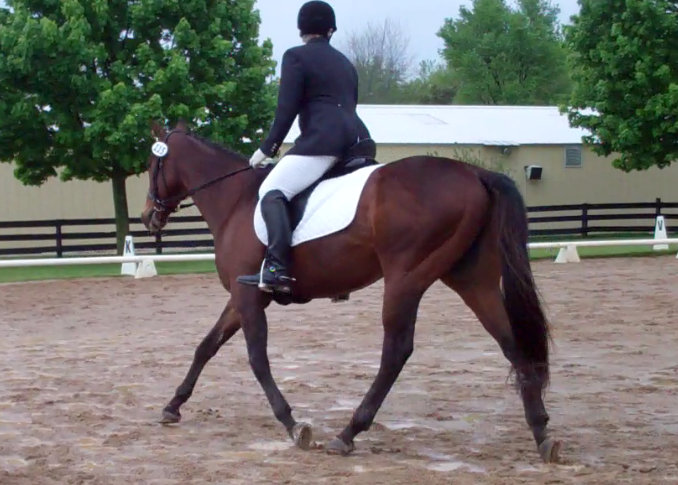
Working trot, giraffe-style.

Crap, crap, crap.  I went back to transitions, which had gone to pot.  I tried some spiral-in/spiral out, and had a few hopeful moments as I struggled to keep my right leg draping around the horse, inviting him to wrap around it.  But the hopeful moments were fleeting, and I was pretty much back to where I was before the first test.  We walked, I tried some free walk, which is something we’re getting pretty good at, but nope – to free walk you need an honest connection, and when I invited him to stretch, I got no response, because I had no connection.

The second test was no better than the first, with one exception – I did actually manage to get him to soften and round a bit on our trot circle to the right.  However, we committed a variety of sins against geometry, wove drunkenly down the centerline and played a little hokey pokey (put your right haunch in, put your right haunch out …) at X.

The test scores (60 and 59.5) were, in my opinion, inflated – even by schooling show standards.  And the commentary was what I expected, nailing us for tension, lack of harmony, the rider’s ineffective aids and fairly astounding inaccuracy.

But, there were a few wins.  I was happy that Derby did have some relaxed moments, and happy that I was able to do a little effective schooling.  I need to get much faster at developing and deploying my own responses and corrections, certainly, but the fact that I was able to figure some stuff out is encouraging.  I’m happy that during those few nice moments in the warm up I was able to produce some fancy gaits.  And best of all, at no point in the day did I feel scared or intimidated.  Annoyed, yes. Frustrated, yes.  But skeered?  No.  And that’s coming from my growing confidence is Derby, who really is a very good boy.  His biggest problem is his pilot!

Planetary alignment? Whatever. I’ll take it.

If you noticed a shift of the Earth’s axis around 7:30 pm (CST) this evening, don’t be alarmed. I have an explanation. The shift you felt was a direct effect of the alignment of the planets that occurred at about the same time. In addition to the axial tilt you may have noticed, the alignment of the planets also caused Derby and I to have a very nice ride tonight.

At this point, the planetary alignment theory makes good sense, because there is no way around it, I’ve been riding like absolute shite for the last week. Actually, Christy and I kicked some theories around while grazing our horses afterward, but first, let me tell you how the evening went down.

I prodded Derby’s back and didn’t love what I saw. While he wasn’t super-sore, his back was reactive. I hemmed and hawed, and then decided to tack him up. They were in today due to thunderstorms, and if I didn’t decide to ride, we’d have a longe session instead.

I told Christy what was going on, and what worried me. I was prepared mentally to deal with the balking and backing I was starting to experience. Dealing with those behaviors is actually something I have some experience with, and Derby isn’t a scary customer. But I get uncomfortable very quickly when the horse is off. I refuse to punish a horse that is resisting due to pain. To do so is not only rotten horsemanship, it’s patently unfair.

So I leveled with Christy, telling her that he was a bit sore, and voicing my trepidation. We talked through it, and I decided to get on, and see what we had. If he wasn’t feeling good, I’d hop off.

After we walked for a few minutes, I started bending Derby on a shallow serpentine. “That looks good,” said Christy, and it felt good, too – Derby was moving easily. We picked up a trot, and after the obligatory clearing of the pipes, we did a couple laps at a snappier pace, and all was looking good. So we cut the the chase and rode the tests.

And we rode them well. Derby was round, steady, and really reaching for the contact. I went through Intro A in silence, as Christy was stunned into speechlessness. We were both thrilled. I hopped to and started Intro B. That one rode even better. Derby stayed round, was very responsive off my legs, and continued to seek the contact.

We were an entirely different horse and rider.

Now, don’t take this the wrong way when I say that it was easy. I was able to maintain myself comfortably and balanced in my new position without having to think about it. As a result, I rode much more forwardly and stayed balanced. I was able to take my foot off the virtual brake that my unsteadiness caused.

God, what a relief tonight was. I was wondering what in Heaven’s name was happening to us. We’re back on the path to respectability. And Training Level.


Reinstalling Go.

Got cookies? Yes, I see you do.

The chief culprit to my recent difficulties seems to be back soreness, so Derby has had the last few days off.  I got on last night, and we had a much better ride.  We’re clawing our way back but he’s still a bit resistant, and my riding needs to improve.  However, I do have some hope that we won’t embarrass ourselves too badly this weekend.

While the soreness was causing the resistance, Christy observed that I also have problems with my “go” button.  As in it needs to be reinstalled.   Derby does not motor along at a consistent pace – he stalls out and slows down, and this is my fault.   Maintaining pace is a primary responsibility of the horse.   So I paid attention last night and issued corrections (in the form of a good old Pony Club kick) when Derby stalled out.   He got the picture quickly and did a much better job holding his pace, requiring fewer reminders from me.

This problem isn’t solved by any short stretch – I also need to get and keep him in front of my leg when we halt because he’s actually starting backing on me which, as Christy puts it, is a serious offense and doesn’t lead to anything good.  Last night he was doing this and I booted him forward.  He leapt into a canter, and we stayed there for a while (it’s important to not shut them down when they offer a forward response, even if it is more enthusiastic than what was requested.)  And after that, we seemed (for the moment at least) to be over the backing nonsense.

So, backing issues not withstanding, we’re heading back in the right direction.  5 more days.  Awesome.