Hard, easy, habit, beautiful

George Morris’ voice is still ringing in my head from Sunday’s clinic. One thing he said that really resonated with me was this: “The first time you do anything, it’s difficult. Eventually it becomes easy. Then it becomes habit. Finally, it becomes beautiful.”

I’m clinging to those words now because I’m in the process of making some adjustments to my seat, and building the requisite muscle memory.  The changes are hard for me – I’m working on rolling my legs inward from the hip – stretching through my hip flexors – to allow my leg to lay more fully and correctly against the horse.  My habit – and conformation – make this difficult.  It’s easy for me to roll my whole leg outward, knees and heels together, toes pointing 180 degrees apart, like a ballerina in first position. Unfortunately, I do not aspire to be a ballerina.

So I’ve been working on opening my hip flexors, and rolling them inward, which (should) also press my knees into my saddle blocks, and bring my toes forward.
Ah.  My toes. Woe is my toes.  Left to my own devices, I’d let them flop out, like a car with its doors hanging open, the back of my heel bumping against the horse.  Too bad that looks seriously ugly, and doesn’t work well when wearing spurs.  You see my problem.

So right now, I’m doing a few things.  I’m spending more time in two point, and I’m dropping my stirrups at the walk, both of which help me align the hips-knees-ankles and sink into my heel.  I have to say, however, it feels like hell now, even when Christy pipes her approval from the middle of the ring.  My muscles are on fire.  My flexors, they’re a-flexin’.  And the whole thing feels discombobulated to me.

Hard, easy, habit, beautiful.  Right now, this is hard.   Boo.

I did have a nice little piece of encouragement last night, though. I got on a friend’s horse who was a little to fresh for her tastes. He’s green, and wanted to go around with his head up, braced against the bit.  I had flashbacks to riding Jag as I was just re-learning to ride, before either of us had any sort of dressage training.  I dug around in my video archives and yep, sure enough, found some video of a braced, inverted trot.  Nice.

So, back to last night.  I’m a better rider than I was lo those three years ago (thank you Jesus, and Christy) and immediately took a hold on that bracing mouth, and started to ask him to soften.  I pushed with my inside leg, into the outside rein, and even though this horse isn’t the best at bending, I got some decent bend and softening.  We worked a bit both directions, and then, at the walk, I focused on getting him to soften and relax.  He was a quick study, and started to figure it out by the end of our short ride.

I remember well the days when I wondered if I’d ever, ever, ever be able to bend a horse, or react quickly enough to give when the horse softened into the bit.  It seemed sooo hard when I first started working on those skills.  Last night, I realized that those have become habit.  They are not beautiful (yet) but they are habit.  Bending and softening and using the outside rein are built into how I ride.  That gives me hope – much needed right now when things feel so awful!

I stand — err, sit — corrected

The Equisense sensors don't lie.

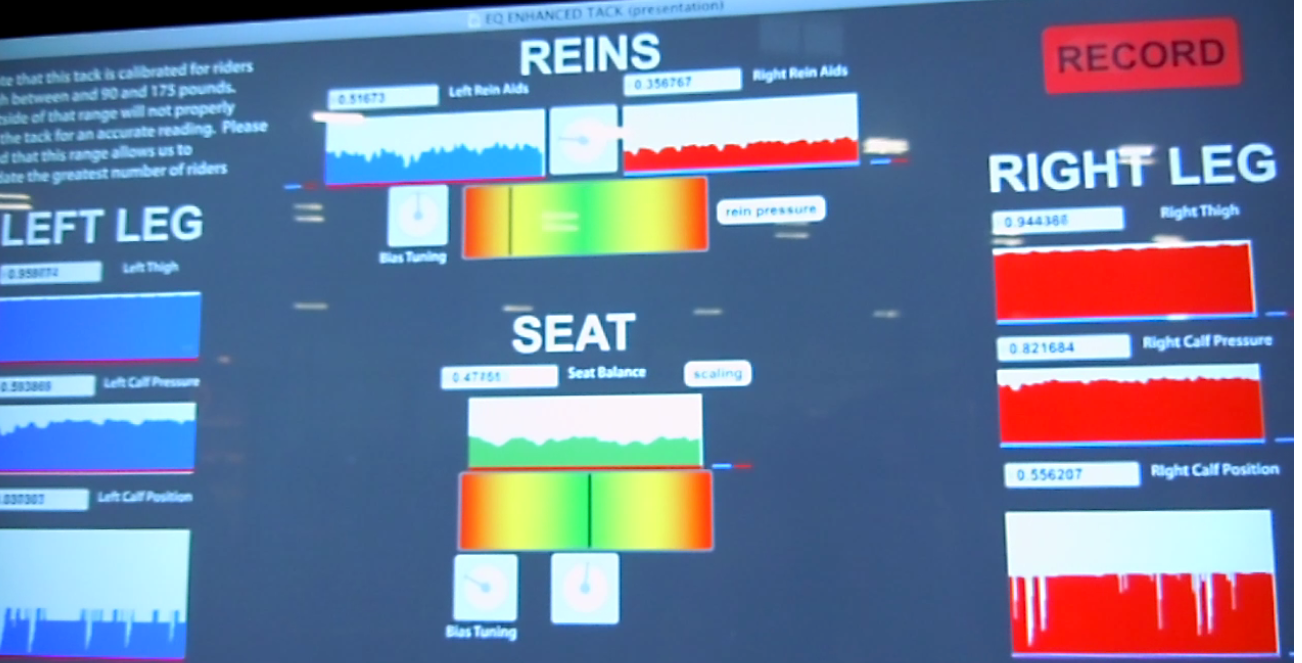
This weekend I had the opportunity to have my riding position analyzed using an Equicizer from Equisense systems.   The Equicizer is endorsed byformer Olympian and general dressage goddess Jane Savoie, and is a sensor-loaded dummy horse that, when mounted, reveals how even (or not!) a rider’s position is.  Everything from leg pressure to seat position to the weight one takes in the reins is measured and fed back to the rider.

I will be the first to tell you that I have a variety of issues, so I eagerly clambered aboard for my session. And wow, it was revealing .

Right off the bat, the Equisense trainer had me make a significant change to my seat – opening my hip flexors and changing my hip angle.   I’ve been having some issues with my knees coming forward, and I had the same problems on the Equicizer.  But after adjusting how I was sitting on the horse by opening my hip angle, the problem went away.

At the outset, my seat was also slightly uneven.  I was putting more weight on the right seatbone.  The trainer instructed me to push my left hipbone toward the horse’s right ear.  This adjustment balanced my seat perfectly.  It didn’t feel perfect to me, however – it felt very much like I was pushing that left hip forward.  The trainer advised me that my ability to feel this was good – to make this correction permanent, I’ll need to be aware when mounted, and start building the muscle memory needed to make this adjustment permanent.   Happily, throughout my session on the Equicizer, I was able to maintain that balance, even through changes in the speed of the simulated gaits.

An apology to Maddie

Without a doubt, the most revealing part of the experience was what I learned about how I hold the reins.   Right from the outset, I was holding a lot more weight in the left rein, even though they felt dead even to me.  This is illustrated in the image at the top of the post – if you look at the top of the image, under “Reins” you can see that the red graph showing right rein pressure is far different from the corresponding blue graph for the left rein.

The trainer worked with me on increasing and decreasing the degree of contact I carry in the reins from my shoulders, moving my shoulder blades back and forth.  She then isolated my right arm and shoulder, asking me to bring that shoulder blade back.  As I did so the sensors indicated that the pressure I was putting in each rein was almost even.  She put the Equicizer into motion, and things went haywire again.  Slowly I was able to even out the rein pressure.  But it didn’t feel even to me – at all.  Throughout the session, I was feeling more weight – a lot more – in that right rein.  The muscle memory training mentioned previously will come into play here, as well.   In the meantime, I owe a certain big bay mare an apology.

After some effort, finally, more even rein pressure

Unbeknownst to me I’ve been really hanging on that left rein, even when things felt even or a bit light. In reality, I suspect there’s been a lot more pressure on that rein, and the mare has been responding as any horse would – by returning the favor, and hanging back.  When I’ve managed to do the exercises Christy suggests (dropping pressure on the left rein intermittently while driving the mare into the right rein with my inside leg) we get the nicest, most honest bend.  So the big take away here is to focus on evening up the balance in my reins, which *should* reduce the problems I’m having with left bend.  Tonight, when I get back on the mare, I’ll have a specific plan.  I’ll start by dropping my stirrups, paying attention to my hip angle and letting gravity stretch my legs.  I’ll pick up my stirrups, and will maintain that open angle, avoiding my old posture with tilting pelvis and arched back.  And when we’re working with what I perceive to be even contact, I’ll be conscious of reducing my left rein pressure, and observing that that change elicits in the big mare.

Here’s some commentary from Jane Savoie – who endorses the Equicizer – and a look at how it works:

Why all the trot work?

Mentally, I was born to be a dressage rider.  Okay, that may be over stating things a bit, but there’s no question in my mind that this is the right sport for me.  Details, mechanics, cause-and-effect – are all appealing to me.  And I’m not an ultra competitive person that wants to take shortcuts to win.  I really geek on good fundamentals and learning to do it right.

Mentally, however, I’m also working on my confidence.  My last ride on Jag before I retired him ended up in a high speed crash landing. I got to feel the speed that made him a stakeswinning sprinter … and then I got to know what it feels like to be dumped on a mounting block.  (In case you’re wondering, it doesn’t feel good.) I was in a cast for six weeks after that episode, and it’s still with me.

Enter Maddie, who is totally lovely under saddle but is a horse that will test you a bit.  She’s more horse than Jag was, and while I don’t feel overfaced with her, I have a lot to learn with (and about) her, and she’s absolutely forcing me to be a better rider and horsewoman.     She has the loveliest canter – the proverbial rocking horse rhythm, swingy and up-hill – but I still have balance issues and the transitions up especially intimidate me.

So my endlessly patient and creative trainer Christy has been focusing us on precise work at the trot.  Adjustability within the gait, developing solid contact, and improving our overall balance.  I’m already feeling more confident, because the better contact equates to more responsiveness.  And my improved strength and balance will help me ride the transitions gracefully when we add the canter back into the mix.   The trot work is giving me the foundation I need to develop quality canter transitions.

And therein is one of the things that I really like about dressage, and how Christy trains it.  The building blocks prepare you for the next steps.  What seemed unimaginable a few months ago is within reach today.  Taking the time to get the fundamentals right is satisfying, and provides me the skills and confidence to progress.

So hopefully we’ll be seeing more of this – with a less ugly t-shirt/saddle pad combo – soon:

Forward … and upward

Tonight I rode the mare more forwardly, but we still weren’t forward enough.  Our ride was better and we had fewer of the problems I enumerated yesterday, but I’m sure glad my lesson is tomorrow night.  I must work on bending Mads into that outside rein. And I need to develop a better response when I ask for “forward, NOW.”

One interesting thing did happen tonight, and unfortunately, I didn’t have anyone standing around with a video camera, because I sure would have liked to see what was going on.

As I was asking Maddie for a bigger trot down the long side, I continued to flex her slightly right and left, asking for a tiny bit of give.  Then, along the short side, I would half halt her, and ask her for a little trot.  The goal of this is (among other things) is to work on our adjustability within the gait.  But down one of the long sides, I felt a few things happen.  I felt her back come up. And then I felt like I was going to be bounced off.  The trot had a lot more motion than the regular working trot does.
Ah-ha, I thought to myself.  This is the big trot with more suspension.  I adjusted my post, spending a little more time in the air, matching Maddie’s stride. This made the trot a bit easier to ride – but it was still a challenge.   As we came into the short end of the arena, I half-halted, bending into the corner. Her back was still up, but the stride shortened. Interestingly, the motion I felt at the big trot – probably increased suspension – continued at the little trot.  A quick consult with Christy afterward suggests that we were starting to collect a bit.

I’ll have a camera at my lesson tomorrow. I’d really like to see exactly what we’re doing – especially if we’re starting to collect.  That would be news indeed.

Hanging out in her pj's

No energy = no contact = it all goes to hell

A nice hug from the mare. She really is a good girl.

Last night’s ride was fun but not terribly satisfying, though, as you can see, I got a nice hug out of the deal.   Christy was schooling her baby OTTB Remy, and Stef was working Oliver.  It was nice to have good company!

But I was bedeviled by the problem I mentioned a couple days ago – getting Maddie off my inside rein.  We circled, we serpentined, we did figure eights.  And for the most part, the contact was crap and it showed in the ride.  I gave on the inside rein, releasing it when she hung, and that helped, but it didn’t fix the problem.  The real problem, I knew, was that she wasn’t fully bending into my outside rein.

We continued on, and toward the end of the ride, Mads started to exhibit what I call “pony brain,” which is a euphemism for an onset of fussiness toward the end of the ride.  I closed my legs, tapped her with the whip a couple times, and sent her forward.  She didn’t work that hard. Pony brain isn’t acceptable.  She bought herself some more work.

When pony brain or other distractions set in, that’s when I really sit up and ride.  I have to be more assertive with Mads in order to keep her focused and forward.  Sometimes, it’s a little scary for me to take charge when she starts to develop an attitude.  But I know from experience that the correct – and safer – thing to do is to hike up my big girl pants and ride.  The worst thing I could do would be to get off.  That would be unequivocally rewarding bad behavior.

So, I sat up and rode.  And in those last minutes, we had some decent moments.  In fact, a video of those last moments shows some decent work, including a few respectable steps of leg yield at the trot.

I thought about this a lot, then went back and watched the video.  It’s not pretty but I found the problem.  I wasn’t riding Maddie forward.  For most of the ride, she was doing the laziest school horse jog.  No wonder I couldn’t develop good contact – I wasn’t generating any energy for the most part and she wasn’t “through” and working over her back.  As a result, she was going through my outside rein, leaning on the inside rein, and all sorts of other nonsense.  I need to drive her forward into the contact.  I need to get a decent working trot!

The video of us barely trotting:

I’m off to the barn to ride — really ride — the mare.