Mind Over Matter? Maybe?

I’m not sure why this is happening, but I’m riding better now than I have in a very long time, maybe ever.   And the fact that this is coming after the horse and I both had two weeks off is especially confounding. But it’s undeniable.  We’re better. The horse is forward, the contact is better, the gait quality is better, and – amazingly – I’m doing a pretty good job at sitting my transitions, and the transitions (especially upward to canter) are prompt and greatly improved.  To wit:

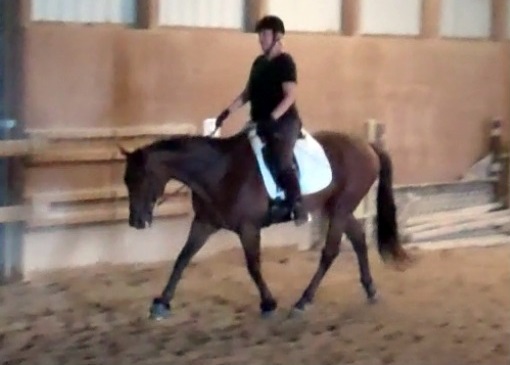
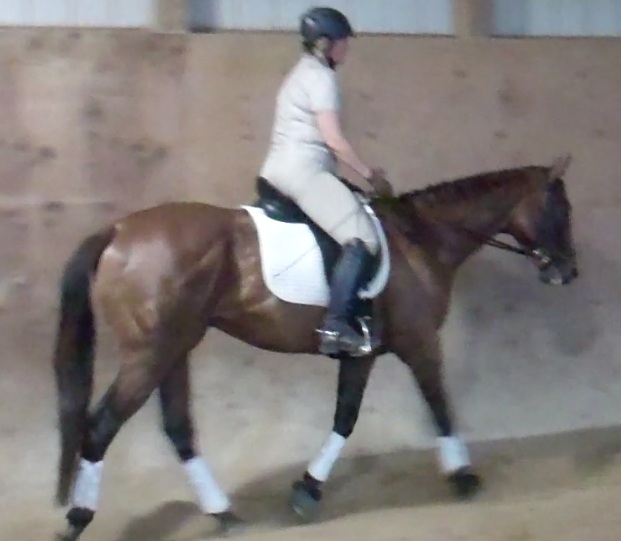
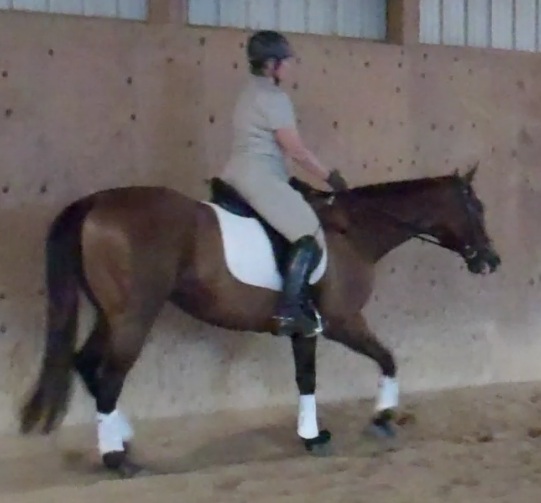
Two weeks ago:

Respectable trot, in an intro/training frame

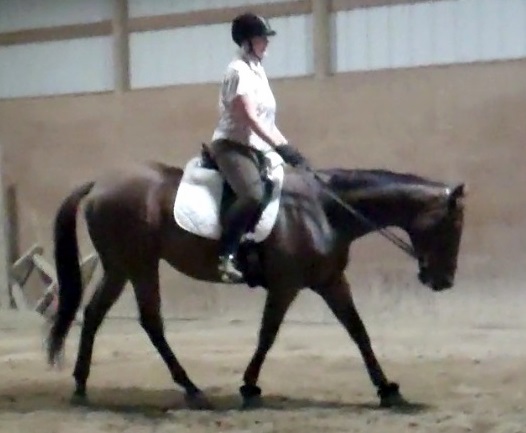
Last night:
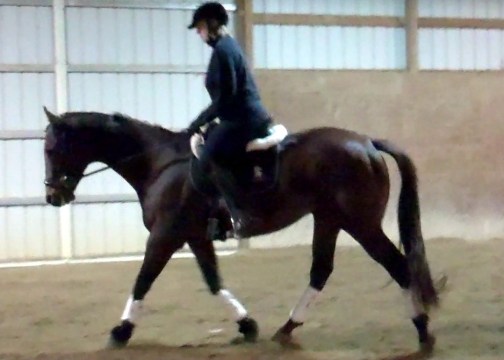
His face is nicely vertical, he's tracking up and his back is up. Much better. Best of all, Derby is offering this, and I'm taking it (instead of throwing the reins away and dumping him on his forehand.)

The canter work is even more significantly improved.

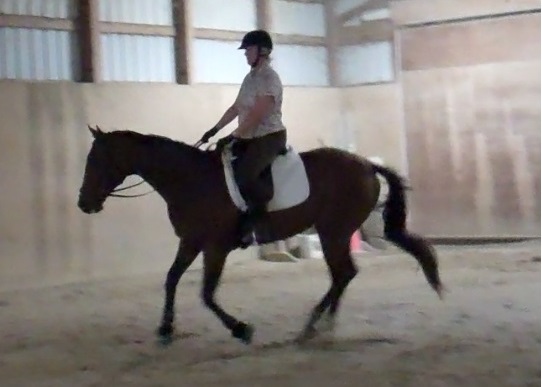
Two weeks ago:

This effort is probably described best as "trying not to fall off the damn horse."

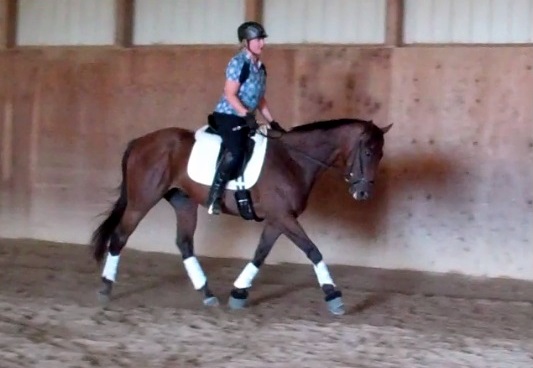
Last night:

I'm so proud of us. Round, good contact, quality gait, and I'm sitting nice and tall. Go us!

I’m not sure why we’re suddenly producing better quality work – and to this degree.

– It has been cool and breezy, and a little wind under his tail might be propelling the Derbster forward.

– Along the same lines, I’m wearing larger spurs to better make my point, and Derby, to his credit, is getting good at saying “Yes, Ma’am!”

– We’re in a different bit and he is definitely taking stronger contact on it.

– I came home from the Dover clinic motivated and educated

– Christy is also similarly motivated and told me “It’s time to demand more…”

– The vet says I gotta do it.

I’m sure these are all contributing factors, though none explain my new found ability to sit my transitions.  I guess I’ll quit ruminating and just take it.

So tonight Derby really worked.  We started with the longing program prescribed by the vet, and then had a lesson about 45 minutes later. We took advantage of the empty arena to really encourage Derby to move out, both at the trot and canter.   Leg yields and trot quality were the focus of the first half of the lesson.  Christy had me ride the arena like a rectangle on the quarterlines, cutting straight across the short end and yielding out on each side.  As we went through the exercise, Derby got more and more connected, which really is no surprise, given that I was half halting him through every corner, and again as we started the yields.  Feeling the contact get stronger and his back come up up up was really cool.

For the canter work, the aim was to ride more forwardly and let Derby roll around the arena.  However, we were both starting to run out of gas toward the end.  We did get some nice quality work, though not as big and forward and rolling as I had hoped.   We’ll give that another shot tomorrow!

After the ride I made a big fuss out of Derby, plying him with carrots, cookies, peppermints and an alfalfa mash.  I think we’re friends again (he wasn’t thrilled when I saddled him up apres longing) and I’m looking forward to tomorrow night!

The Prescription

Crappy eq notwithstanding, Derby is going more reliably round, forward, and on the bit.

As I mentioned in yesterday’s post, Derby is suffering some latent stiffness and muscle pain stemming from both the abscess and the fact that he really needs more conditioning, especially with respect to his hind end and his top line.  At the moment, some muscles in his hind end are quite tense and tight, causing him to move stiffly, starting from his hips, and evidenced by shorter strides, and a back that doesn’t swing.  He’s particularly reluctant to move out on his right hind, and Dr. Nicky said she suspects that he’s still off from using his hind limbs asymmetrically when he had the abscess. She prescribed Robaxin along with a program of longing and riding with the specific aim of stretching and strengthening those muscles.   So, even though he’s not moving perfectly, I need to get on and really ride.

This is what I need to really shoot for - getting him to step up under himself, while maintaining roundess and contact, to keep him over his back. This requires multitasking on my part.

The imperative from the vet and the lingering effects of the Dover clinic have galanized me, and Christy, who is no longer inclined to cut me any slack.  The lesson tonight worked a lot on leg yield and canter transtions, which were especially sticky to the right, requiring me to sit up, ride and require equine compliance and cooperation.

Overall, I’m happy with our work tonight.  The trot is more reliably round and forward.  I’m getting better contact, though I may have to give some credit to a softer bit – Derby went very nicely in a fat KK, switching out from the thinner Myler comfort snaffle.   And after a few attempts, I got a nice, immediate upward transition going right.  That took some doing – that’s the lead we’ve been having difficulty with, most likely due to the abovementioned lameness and conditioning woes.  We had no such issues going left – Derb picks that lead up right away.

And the trot is better, though in this video, you can see in Derby’s tail carriage (tense, held out) that he’s a bit uncomfortable. I hate that he is, but am determined to minimize this uncomfortable period by rigorously following the vet’s instructions, (and feeding lots of carrots and cookies to make up for it in the meantime.)

Two firsts in one lesson.

We got some really nice work tonight.

We had such a fun ride tonight.  Going into my lesson, I mentioned to Christy that I wanted to work on “forward” first, because it’s dang hard to connect a horse that isn’t moving.    Once I had warmed Derby up and trotted a few laps, we cantered a few times – just a lap or so, because neither of us have an excess of fuel in the tank.  However, Derby still wasn’t in front of my leg, so Christy had us work on some exercises to get us there.

First, on a circle, she had me do trot-walk transitions, only walking two strides before picking up the trot again.  Initially, the transitions were mushy – indistinct and not prompt.  Christy had me remedy this by *requiring* a crisp, “trot NOW” transition.  Derby replied enthusiastically on our next attempt, stepping straight into a canter.

Not the prettiest moment in equitation, but I like how he's stepping up underneath himself.

Okay, so our first walk-canter transition was an accident, but it felt awesome.  I allowed Derby to roll for a minute, because an enthusiastic forward response is a very good answer.  The last thing I needed to do at that moment was to jerk him in the mouth and punish him.    From there, quickly tallied our second “first” of the evening.  Christy had us do trot-canter-trot-canter transitions, with just a few strides of each gait – and Derby responded with alacrity.  And after that, the overall quality of our work improved.

Best of all, we were able to get the transitions both ways. I still need to work myself into balance going right, but I’m able to get there, and able to generate good work that direction.

To wind the ride down and let the horse stretch (he’s been stuck in his stall for the last two days due to torrential rain and thunderstorms) we just trotted some laps – but I was asking for a big, reachy trot and also asking Derby to work over his back.  Building top line is still a top priority, and this is a good way to do it.  I was happy with his responsiveness and overall, it was a fantastic ride.  We need to keep him in front of my leg but we really are making progress.  He’s a good boy!

Straighter & Better

Finally, I'm sitting up straighter going to the right.

Over the weekend, I worked hard on my balance going to the right.  As I mentioned earlier, I’ve been feeling twisted and icky going this direction, and I failed to pick up the canter going this direction in Thursday’s lesson last week.

So over the weekend, I did lots of stand-stand-post-post and standing work.  I paid attention to how my legs felt when standing, and how they laid against the horse.  I made sure my shoulders were back, my hips open.  And I stopped working so damn hard, focusing on balance instead.  And it worked like a charm.  The transition to the right was better on Saturday, and on Sunday, Derby stepped neatly into the right lead canter when I asked.  I was also able to produce a decent trot going to the right – a far cry from the inverted, braced, counter-bent hot mess I produced a couple weeks ago.

We're getting better contact, too.

I attribute these improvements to the continued focus Christy’s giving my seat and balance.  I’m definitely sitting up straighter, especially to the right – my earlier tendency was to collapse. Today, as we warmed up, I was sitting on my seatbones, with my legs entirely off the horse.  As we talked, Derby started to step out, and swing.  I kept my core soft, my hips loose, and stayed on my seatbones, sitting up straight.  I had really found the balance sweet spot at the walk.

Christy had me try to find it at the trot going right, and I think we came close – as we tweaked my position and my leg, Derby showed his approval by moving more easily.  And as a bonus, I started to get a really strong, steady connection from him too.   Things are headed in the right direction.

The Horse is a Mirror

He has a really nice canter. It will be nice when I can ride it effectively.

The canter transition is definitely improving.   Derby is responding quickly, and to the left, at least, I’m fairly well balanced and he steps right into  the upward transition.

I’m still struggling with my position when going right, and this was clear when we changed direction.  Our failure to pick up the right lead was undoubtedly my fault, not the Derbster’s.  This was one of those “the horse is the mirror” moments.  Derby has no problem picking up the right lead canter. It’s not a training issue.  The problem arises when I’m unbalanced and it feels off. At those moments Derby says “Nope.  It’s better for all concerned if we keep trotting.  You get your act together, and we’ll canter.”  I really can’t blame him.

So Christy had me work on getting a good connection and improving our trot going right.  We started out with focusing for a minute on my control of Derby’s shoulders.  Doing developed some steady contact, and then added a little leg yield and the trot really improved.  I could feel Derby’s back come up and best of all, he really stretched into the contact.

Piece by piece we’ll put this back together!


This too shall pass.

On some days, riding is empowering.  On others, it can be infinitely humbling.  Tonight, as I bumbled around in my lesson, it definitely was one of the latter.  My position is feeling good, my balance has certainly improved, but a lot of other things have slid.  And they all begin with good contact, which comes from generating power behind and catching it in the reins when the horse stretches forward into the bit.

Needless to say, Derby generates about as much jet wash as a butterfly flapping from daisy to daisy. He creates little to no cosmic disturbance.   So tonight we worked on resetting the gauge on the working gaits.  We rode canter transitions.

Okay.  The next time I hear some uninformed twit say horseback riding isn’t work, isn’t exercise, I swear to God I am going to drag them by the collar to the barn and plunk them down on my saintly horse, and have them ride trot-canter-trot transitions.  Without bracing on the reins, while sitting softly in the saddle and not gripping with the legs.  In other words, holding one’s self up with one’s core.  It is hard work and my Lord, we have a long way to go.   I rode like the proverbial “soup sandwich.”

But it was really fun!  Half the time I wasn’t listening to Christy (sorry, Boss) because my inner voice was saying “Dang, he has a niiice canter.” As we did transitions, Derby started to really pick up his feet and roll, and he became a lot more responsive.

So this needs to be the new normal.  I know these moments of flopping incompetence will pass.  Probably not soon enough for my tastes, but soon enough we’ll start achieving some harmony and some grace.

And some power!

One week, redux.

My improved poster lets Derby move more freely

I’m continuing to pick at my position and posture with Christy, but the quality of our rides continues to improve. On Monday, Derby and I unveiled the “new us” to Christy, and she was very happy with the significant progress she saw.  The improvement in forward and energy is evident when compared to my work prior to the show last month (“One Week.)

I still have a ton of work to do, but I’m struck by how my position influences the horse.  Really, it’s probably no surprise.  These animals can feel flies land on their hides.  The shifts in weight and balance that we riders think are subtle probably aren’t, in reality.

Now that I’m better balanced, Derby is moving forward much more freely.  And without a lot of help from me, he’s also moving uphill.  I tell you, once I get my act together, I’m going to have some fun with this sweet, lovely horse.

Christy shot some video so I could see how we’re doing, and one thing really jumped out at me.  While I sit fairly nicely circling left, the same cannot be said going right.  I am reverting back to the tendencies I exhibited earlier on Maddie – weighting one rein more heavily (the left one) and sitting crookedly (and unevenly) in the saddle.  This video doesn’t lie.  You can see me start to lean forward and close my hip when I change directions.

This unfortunate shot sums up what we started to tackle in tonight’s lesson, in which we worked on overall balance and took aim specifically on correcting my crookedness.  I have my homework for the weekend, and I hope to report good progress within a few days.

I'm starting to collapse.

Bit by bit by bit

Almost square at the halt. Almost.

Tonight I rode one of the tests for the first time, and my first run-through illustrated perfectly (for me at least) the purpose of the tests, namely, testing the rider’s abilities to execute a series of movements – many of which complement each other – smoothly and in an organized and deliberate fashion.

Do you hear that, Self?  Organized and deliberate.

While we had a few decent moments, the downward transitions were a bit of a mess.  Okay, “bit of a mess” is being generous.   They were fifty kinds of ugly, truth be told.

I’m sitting here reviewing my videos (thank you again, Christy, for being so adept at grabbing video as you teach!) and I just discovered a key problem.  My transitions are too abrupt.  I’m not thinking “smaller trot, now smaller, now smaller still, walk!” as I go into the transitions.  And by smaller trot, I mean *half halt* half halt*half halt.  This sequence shows what happens when I transition too abuptly.   Here goes:

Going into the ugly tranistion. Our trot isn't terrible though he could be rounder and more active. But for us at the moment, this is far from our worst.

The ugly transition, in progress. I've started to halt,with no half halts or core engagement to be seen, and I've given Derby about 5 miles of rein.

 Lovely. But wait.  There’s more.

Full on ugly. Gaping mouth, hollow back, and he's on his forehand.Yuck!

How to rectify ugly? Hold the reins and get busy with your inside leg - at least, you can see this approach starting to work for me here.

In literally the next few milliseconds, Derby's back is up, and his mouth is closed. Cue Heavenly host strumming on harps.

Okay, so that save is nice but it doesn’t do much for me in a test, where transitions are scored.  I’m sending a link to this post to Christy and I am sure we’re going to drill this tomorrow.

There were some bright spots in tonight’s ride.  I got some of the nicest trot to date from Derby.  His back was way up, and it felt wonderful.  All of our current problems can be laid squarely on my doorstep.  Derby is a sweet, willing horse and tries hard.   I like him more and more each day and am really looking forward to our journey together!

The core of the problem

Our first lesson in more than a month

As you’ve probably surmised due to the infrequent blog posts, the last few weeks haven’t been too exciting.  I’ve been working hard on rebuilding my riding muscles and regaining my seat, and at the same time, I’ve been gradually stepping up the work Derby is doing.   I’m now doing 30-40 minute rides, with about 10-15 minutes of trotting.   For the time being, building our fitness is my main priority.

Now that we’re doing some decent work and are able to sustain our efforts for a little while I decided that it was time to re-start lessons with Christy.  We are thinking of going out to a schooling show mid-August just to get Derby out and about.  We won’t be ready for anything, really, and will probably do a walk-trot test.  But I don’t want to embarrass myself, and I’ve been worried about the quality of our walk.

Derby would prefer to shuffle slowly, and I’ve been working on improving his tempo and energy.  He’s doing much better lately but we lose that energy and rhythm, I’ve noticed, when we circle or serpentine.

As we talked, I sat easily, with loopy reins, and Derby walked – a nice, swingy walk with good energy.  Christy had me gather the reins, and immediately Derby’s stride shortened.  From there, Christy had me keep my legs off Derby, instead, opening up my hip angle, sitting up straight and inviting a bigger stride.  It worked.  Derby went from a stodgy little walk to a nice swingy one.

A nice walk

Christy’s eagle eye had noticed something.  When I gathered the reins up, I leaned forward – very slightly – but it was enough to close my hip angle, causing Derby to shorten his stride.    We experimented with this a little bit, and when I mentioned the difficulties I had maintaining tempo when asking for bend on circle or serpentine, she watched carefully as I asked Derby to bend with my inside leg.

Sure enough, she spotted it.  Whatever I was doing with my inner leg was causing me to close my hip angle.   We figured it out – I was reverting to old habit of curling my heel up when applying my leg.

I've closed my hip and Derby has shortened his stride.

The difference in stills from the video Christy snapped is stark. Derby’s head has popped up and his back is hollow.

From there Christy had us move to trotting, reminding me to post hips to hands, keeping my hip angle open, and engaging my core muscles.    When I followed her instructions, Derby responded immediately, rounding and relaxing, chewing the bit.

But the second I stopped riding,  Derby hollowed and his head came up . “Core!” Christy called in my direction.  I re-engaged my core and opened my hips and the gait quality improved.   Christy reminded me that Derby is very much a “seat horse” – he’s sensitive to the slightest movement of the rider  This is both a blessing and a curse, she told me.  Once I get control of my body and my aids, I’ll be able to influence Derby very subtly.  It’s going to take some work to get there, though!

Related reading: http://www.balancedrider.com/blog/2011/07/11070601.htm

Stretch goals

Finally! I'm staying out of his way, and presto - the back comes up. Good boy!

Stretchy trot is not a movement I’ve practiced much or ride well.   But as I’ve noted previously, I need to make a point of riding Derby over his back, and stretching into contact, in order to start building correct muscle, fitness, and his top line.  I’m also trying to build my riding muscles back up and improve the independence of my hands.  We focused on these issues in my lessons later this week.

A nice albeit fleeting moment from our lesson 6/22

On Wednesday, Christy had me pick up from my earlier ride on Atlanta, and focus on moving the horse around with my seat, while also keeping my hands quiet.   We had some nice moments but really, the ride was mostly about me trying to get my act together, and continue to figure out what makes Derbyhorse tick.

She had me start by asking Derby to relax and give his neck at the walk.  We then moved into some trot work, starting out on a loopy rein.  I’ve discovered that I have to stay out of Derby’s face, and instead use my seat and leg aids – especially an active inside leg – to generate the results I want.

Which is easier said than done for me at the moment.

Tonight’s ride was better, chiefly because Christy had us do a new exercise that worked really well.  I started out  trotting on a loopy rein, exaggerating the loop to keep my hands entirely out of the picture.

Christy then had me do two things – post from a half seat, staying off his back, and simultaneously move him around without the reins – which is another way of saying “get busy with your inside leg!”

The response from Derby was almost immediate:

Derby stretches on a loopy rein.

Derby stretched down, and stayed there.  We motored around like that for a while, despite the fact that I was dumping him on his forehand.

Christy had me gently shorten the reins a hair,  and focus keeping my hands steady, telling me to think of my hands as side reins.  She also had me close my fingers, reminding me that “There’s no way for you to give with open fingers,” while also telling me to let Derby find the end of the reins and invite him to hold the contact in his stretch.

And that’s when things started to feel pretty good indeed.  Derby’s back came up a bit, and while he wasn’t moving with a big, ground-covering stride, he was holding the contact and keeping his back up – a definite improvement from motoring around on his forehand as we had been doing earlier in the ride.  We were able hold the stretch for as long as I was able to maintain the light seat, steady hands and active inside leg, which as you can see from the video below of this ride is still very much a work in progress.  And while the quality of the trot wasn’t great, in reality, there’s only so much I can do at once. I’ll start asking him for a proper working trot as I get better at holding the light seat with independent hands.  Anyway, for the sake of documentation, here it is:

The good news is that we really got the hang of stretching, and eventually Derby brought his back up, seeking and holding the contact.  I’m really pleased, because after spending the last few months watching Christy patiently build Remy’s fitness, I know that a lot of steady trot work in a stretchy, connected frame is an important building block.  And, at training level, the stretchy trot carries a double coefficient – it’s an important test of the horse’s connection.   Getting good at this is important, but I know I can do this on my own and that we’ll improve.  Tonight was just the start.