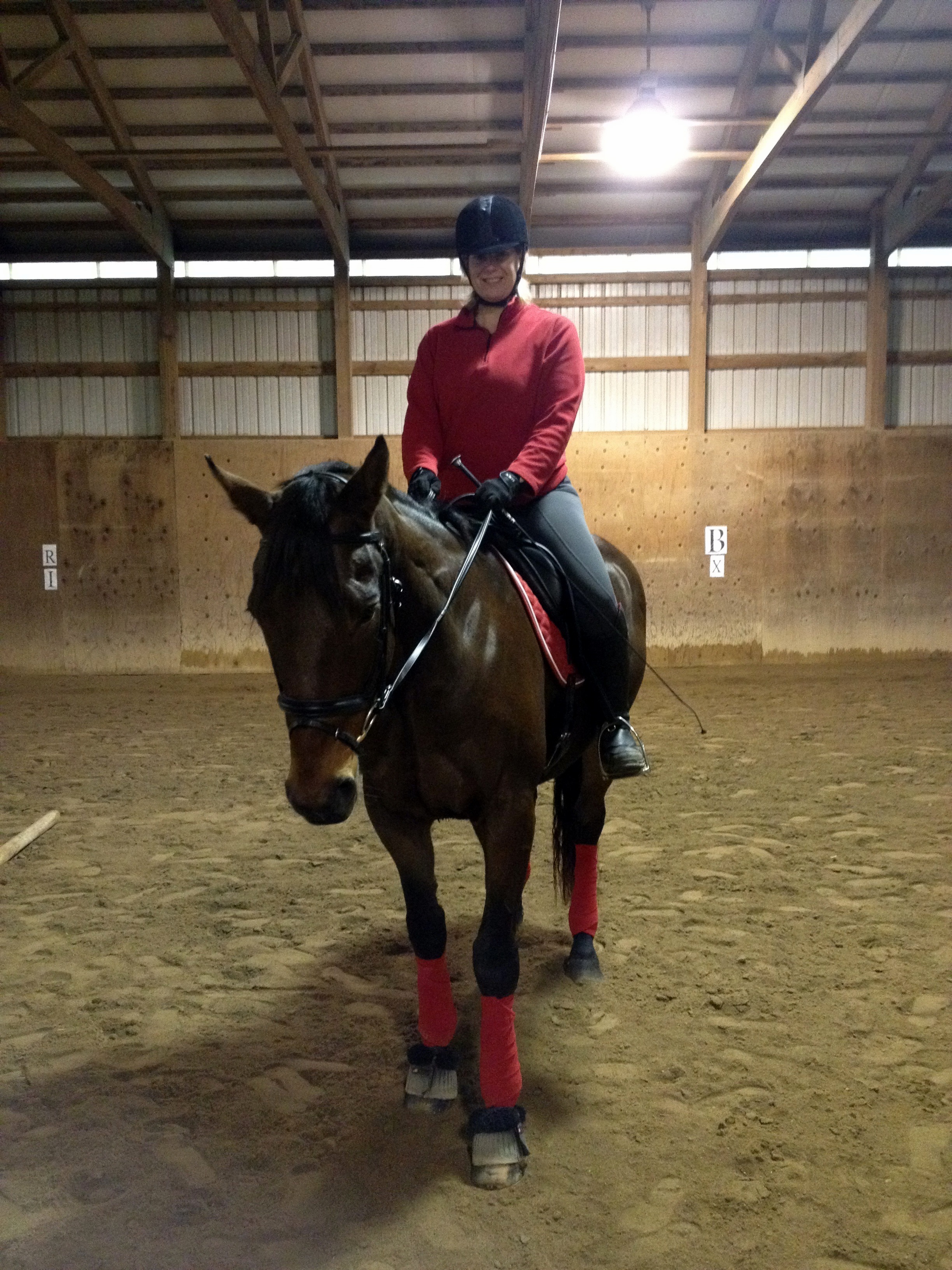
Four leaf clover

Good news, we're not broken, nor have we taken leave of our senses

I squeezed another lesson into Christy’s schedule to deal with the issues that cropped up on Monday night.  I’m happy to report that we had a nice ride, Derbs thought about looking at nothing once but we dealt with it, but that was it.

I suspect two issues contributed to my right-lead difficulties on Monday.  First, I need to do a better job of producing good bend.  I’m simply not asking for it.  I need to practice generating bend whilst maintaining my new-and-improved position – which is kind of hard for me – Christy noted that I was letting my knees creep up, effectively closing my hip angle.  Hmm.  No wonder my forward gears were petering out.  Christy observed that Derby is a ‘seat ride’ and is very responsive to little things – such as when I close my hip.  On the up side, this does give me instant feedback, so I am alerted that there’s something I need to fix.

The other issue is actually horse-related.  I’ve really upped my riding recently, and Derbs is working harder.  He was getting tired on Monday night. I need to build his fitness, and respect the fact that as I up the ante, I need to work him within that context.    We need to get those sadde pads wet.

For last night’s lesson, Christy had me ride a big four-leaf clover.  It was an ideal exercise to practice bending one direction, especially for where I’m at, because it includes moments of straightening which I needed to reorganize.  To ride the clover leaf, I essentially rode a loop in each corner.  So to start, you’d ride from A to C, turning right at C, and then turning right again at B, bisecting the arena and riding straight to E, turning right and doing a loop in that corner, turning right again at C, riding straight to A, turning right at A, doing a loop, turning right at E, riding straight to B, turning right … you get the idea.  It rides nicely and affords lots of bend/straighten/bend practice.   Rinse and repeat going the other direction.

One other thing came to the fore last night – I’ve been letting Derby sucker me into a less good-quality trot.  Christy got us back on track last night, telling me to ride like I was doing a lengthening.  “Now that’s your trot!” she exclaimed as we powered down the long side.  My challenge here is to keep my knees down and hips open, to guard against losing that forward impulsion.
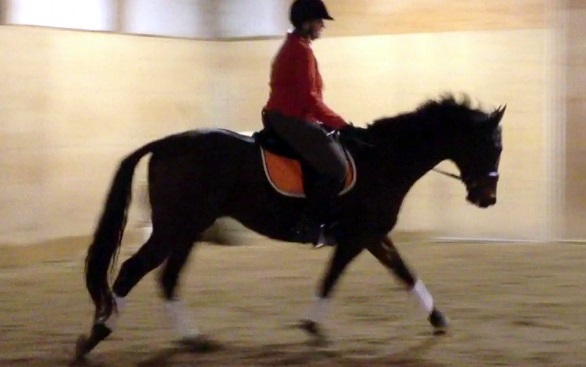
 

Wrong lead? Nah! It’s counter canter!

Counter canter! Yeah! That's what we're doing! Counter canter!

Well, tonight’s ride only went partially as planned.  I was looking forward to my lesson, and showing Christy what I’ve been working on for the last few days.  We did earn some nice kudos – the left lead canter was really good – we had a decent transition, and I was able to show Christy how I’m getting better at really riding the gait – keeping the horse forward, getting him to step out and under himself, and holding the contact and getting him to move forward into it.   We got a gold star on our homework for that chapter, but we turned around and flunked the next one.

The weirdness started when we switched direction.  I had been getting some nice work this direction recently and felt that I was making real progress on the canter depart … but tonight wasn’t the night.  I was doing something new and strange – we couldn’t pick up the right lead to save our souls.


Okay, we did get it a couple times, including an unscheduled walk-canter depart (seriously, where’s the fruitbat?) but more often then not, I was putting him onto the wrong lead with alarming consistency.

We had some decent moments. I'm pretty happy with this canter attempt.

We worked at it, and revisited bending, and Derby grew more and more resistant on the right rein.  I knew then that somewhere, something was wrong with how I was riding, and I got confirmation of that fact when Derby started to resist naughtily, spooking at a corner and refusing to to bend.  I put him on a small circle, and doubled back, inching him back towards the corner – but I was getting tired and didn’t have the strength to really kick him over.  Then he tried to pull some of the same crap on the long side.  I smacked him with the whip, sent him forward, and we did some small 10M figure 8’s at the other end of the arena, and then headed for the end where he had spooked, bending on a serpentine.  No avail, he did it again.  I turned him in tight circles, keeping his feet moving, and was furious with myself and I’ll admit it, with him.  At this point, I was almost exhausted, so after he walked and halted nicely I called it a day.   However, ideally, that wasn’t the right time to end.  I have squeezed myself into Christy’s schedule tomrrow night, and we will revisit these issues!

A Grand Prix TB

He’s my favorite kind of horse – a plain bay thoroughbred gelding.  However, once he gets moving, Sea Lord is anything but plain, or average.  You see, he’s a confirmed Grand Prix horse, and has been winning (with very good scores) under Sliva Martin.

I’m constantly surprised that TBs don’t find more favor with ammy riders.   Those that have raced are the ultimate BTDT horses – vetting, trailering, bathing, shoeing are not a problem, nor are golf carts, goats, dogs, loud speakers and crowds.  They do need to be re-trained when they leave the track – OTTBs strongly associate being ridden with running, for example, and things like standing for mounting are foreign concepts.  But TBs are fast learners and are eager to please.  A few months with an adept trainer who understands OTTBs will produce a really nice horse.  My trainer, Christy Rettger, recently detailed the progress of her current young project, and he really has transformed in the short year she’s had him.

Generally speaking, thoroughbreds are real athletes, and have great work ethics and forward gears that are conducive to higher level work.  True, they are not purpose bred for dressage – you will have to do some work and ride the horse correctly to get it through and over its back.  You can’t “fake” it with a TB like you can with a warmblood that has higher natural head/neck carriage.  But they are budget-friendly, willing and beautiful partners – I love how elegant a TB looks in the ring, compared to a heavier horse.

Anyway, this seemed like a good day to plug Thoroughbreds for dressage.  Did I mention that Sea Lord is for sale?  If you have the ability and the cash, you could be gracing a GP ring near you on this refined and elegant creature.   And if you’re in the market for your next mount, consider a Thoroughbred.  At least go ride a few.  I bet you’ll be glad you did.

Incremental improvements

New red duds for December.

I’ve been working hard since my last lesson, in which Derby was dull and the ride was generally uninspired.   Developing Derby’s forward gears and maintaining engagement and roundness in the transitions have been my primary foci.  However, as part of the working on forward equation, we’ve been doing more work at the canter.

Overall, I’m pretty happy with the quality of my homework and am looking forward to my lesson tomorrow.  Derby was good yesterday and really good today – we had some very nice trot work including some bending serpentines in which we maintained impulsion and had good bend.

In the back of my mind today was also the imperative to start working in more correct bend.  When I remembered, I rode bend going into corners, and given the traffic in the arena today, I also had to do changes in direction and line.  We did lots of circles and the quality of that work was some of our best.

Early in the ride, I put Derby into a canter, keeping transition quality in mind.  I also wanted to start doing a better job of riding the canter – holding the contact, pushing the horse into it. and also engaging his hind legs.  Today was – I think – our best canter ever.  Derbs was enthusiastic – he didn’t peter out but instead held the tempo – and I was able to sit up and ride circle that felt balanced.  I also got the horse to move out from that circle – I’m not sure I’d go so far as to call it a leg yield , but it was in that vein.

We’ve also schooled transitions ( trot / walk / trot) over the last few rides.   First I had to develop more responsiveness from Derbs – you need energy to maintain engagement.  The transitions have improved incrementally from ride to ride, as I do a better job of riding them – using my half halt and getting the horse to soften while staying in the bridle by holding the reins, engaging my core and closing my legs going into the transition.  You have to ride downward transitions forward – which is really counterintuitive for me and something I struggle with. It’s not great yet but we’re doing better, which is enough for me!


Bwahahaha. The indoctrination has begun.

I’m out to dinner with Mr. CollectingTBs. It was pouring and we were sharing an umbrella as we walked from the parking lot to the restaurant.  He kept pushing into me, and I kept stepping away.

“Stop moving!” he said as I sidestepped once again. “I’m trying to get my head under the umbrella!

“Sorry! I was moving over when you pushed me!”  I retorted.

“Like a dressage horse, you mean?” he scoffed.

My uuber non-horsey husband is learning!

Two steps backward, one step forward

I’ve had some interesting rides recently – not great, but interesting and productive.  The good news is that while our canter work lacks grace, I’m growing more and more proficient in that gait. It’s comfortable, I no longer need to work myself into cantering, and I’m starting to actively manage the gait, asking for more a more forward canter, and correcting Derbs when he breaks to a trot before I ask for the downward transition.

Getting the horse forward and into the bridle is still a work in progress.  The key here is getting Derby in front of my leg.  I know that I need to stay on this and not accept a sluggish response.   Today I felt the canter petering out, and reached back and gave him a crack with the whip.  He surged forward, I said “Good boy!” and stayed out of his mouth, letting him go on.

We had kind of a crappy ride in my lesson yesterday – Derby was dull and almost rank – he felt very resistant and we had numerous discussions – about walking, about halting, about transitions.  We abandoned work on transitions in favor of working on getting the horse forward. Christy had me reinforce my aids with whip and spurs and pretty soon, I had some good responsiveness.   But, across the board, the ride wasn’t great.

Today was much better.  Whatever was stuck in Derby’s craw yesterday was absent today.  We had a nice ride, he was nicely in the bridle, and we drilled trot-walk-trot transitions with good results – the horse stayed round and connected.  We also had  nice canter work both ways, and high-stepped over poles, staying round and without ever trying to add a stride (seriously) between poles (a symptom of his being behind my leg, I was told.)

Derbs earned himself a couple days off.  We have family coming over tomorrow and Friday.  It’s going to be warm and sunny, and the paddocks are full of lovely squishy mud that I”m sure I’ll have to chisel off on Saturday.  He’s earned it however.  Good boy!

Why? Because I can.

It’s a blurry cell phone pic but I love the optical illusion of my jacket and the fence.  Almost as much as I love Horsewear’s striped fleece, but we’re not discussing that at the moment.

When I’m there, he’s there

Within the last month or so, I feel like I’ve finally started to really, truly, legitimately have moments in which I’m riding a connected horse, back to front, in good balance – for the first time, ever. While still fleeting, I can recreate these moments fairly consistently on my own, without Christy micromanaging my every move which is what it took to get me to this point.

Well, that and a lot of riding – five to six days a week, for four years.  Along the way, I also read a variety of books, educated myself going to clinics and shows, and (most importantly) am getting myself into better, stronger physical shape.   Despite these efforts, I am still schooling training level, meaning that I’m probably lacking in the natural talent department (though Christy does note that I’ve started over three times, twice with horses that were very green to dressage, so I guess I feel marginally better.)

That said, I have progressed from simply godawful (no steering, no seat and no clue) to being able to put together a correct Intro level test, and over the last year (with Maddie) starting to delve into some more interesting things, like trot lengthenings and leg yields. I’ve also developed better feel, timing and a certain degree of instinctive responsiveness.

However, that work on Maddie – despite the fact it represents what was technically my most “advanced” work – pales in comparison to the awakening I’ve had over the last month.  And after attending the Dressage Through the Levels symposium with Steffen Peters and Janet Foy this weekend, I think I can finally elucidate what I’ve experienced.

Simply put, generating correct gaits and (at my level at least) movements is easy – dead easy – when the rider is the correct, balanced position, and the horse is connected.

Mind you, getting to that point of correct balance is a bitch, at least for me.  But during those fleeting moments when I’ve been properly aligned, I’ve felt some amazing things.  I’ve felt Derby’s walk transform from a pokey shuffle into a fluid, rolling, swingy walk with overstep.  It feels unlike any walk I experienced on Jag or Mads, and Maddie was a much fancier horse.  I’ve felt him pushing from his hind, over his back, and into my hands at the trot, and I’ve felt that trot come uphill.  I’ve had the odd lovely, quiet, prompt, balanced canter depart, and a couple days ago I felt his back come up when we were cantering, and almost fell off from surprise.  I’ve done a leg yield that felt like floating, with the horse moving away from a quiet aid.

When I’m in that sweet spot, I don’t have to even think about muscling the horse into a movement.  I don’t need to kick kick kick to get the work done – I can whisper, and he hears me. When I’m there, he’s there.   Once I’m there, it’s easy.

When I’m not there, it’s hard.  I struggle to keep the horse going and bending, and invariably, as I’m trying to muscle him into one thing, something else goes wrong – a haunch drifts in, a shoulder pops out.  I’m getting better at recognizing those moments and responding correctly by fixing what’s wrong with me, rather than trying to correct the horse.  Because when I’m out of whack, I can’t blame the horse when impulsion slows or a haunch drifts.  What he does is in response to the ride I’m giving him at the moment.

At the Foy/Peters symposium, the second day started with a session on rider biomechanics. It wasn’t quite what I expected, but was marvelously illustrative nonetheless.  Two lovely riders on lovely, well trained horses were the “victims” for this session.  I say ‘victims’ because Janet Foy instructed the riders to adopt a variety of poor postures, enabling us to see the effect unsteady hands or uneven weights in the stirrups or posting with all your weight on your toes had on their horses.   She emphasized the point that in most cases, the problem with the movement in the test was the direct result of a rider inadequacy – not the willful behavior of the horse.

So now I’m doubly aware of those easy moments that signal I’ve found the sweet spot. Challenge is to figure out how to live there, not visit infrequently.

Multitasking in Motion

I’ve been through the experience of rebuilding my seat – and requisite habits and muscle memory – enough to know intrinsically that things *will* get better.    And already, I’m finding my “sweet spot” more quickly – almost automatically even – rather than requiring a full-body position re-org to get there.  However, I was convinced I had forgotten how to bend.  “We have to work on this!” I insisted to Christy, convinced that I had lost this basic skill.

Happily for me, Christy worked us through some serpentines that suggested the real issue was the fact that I wasn’t riding the bend, I wasn’t asking for it.   But when I concentrated and rode it, I was able to do a decent serpentine with a decent quality trot.

Mind you, here’s what was going on in my head as we went into the first loop:

Leg ON more trot now hold with abs HOLD ABS half halt no REALLY half halt hold onto the dang reins for the love of all that is good and holy *ELBOWS* thumbs closed, there you go, good girl ABS ABS FOREWARD for pete’s sake CORRECT TAP TAP TAP WITH WHIP okay, that’s forward, Good boy! now inside leg to outside rein come ON use that inside leg good good straighten a couple strides new inside leg now  FORWARD ABS hold that rein….Wait, what? What’s wrong? You forgot to breathe?  Okay then, breathe!

You see my problem.  It’s hard to keep all these balls in the air, because they aren’t yet habits.  Remember George Morris’ “hard easy habit beautiful” construct?  Well, I am firmly mired in “hard.”

Christy did spot – and fix – a key problem last night.  The bend to the right was easy, and acceptable.  The left? Not so much.  I am a bit stiffer in that hip,  but a technique she gave me really helped immensely – and immediately.   Christy directed me to imagine that I was pushing that left hip toward my right hand.  That did the trick.  By lifting and pushing that hip toward my hand, I was able to give a clear and correct aid, rather than just nudging hopefully (but inconsequentially) with my leg.  Can I just say that I love the fact that I have a trainer who is this picky, and can see these little things, and knows how to communicate the fix to me in a way that it actually sinks into my cluttered brain?

We did some work at the canter, and did produce some decent work.  Importantly, I’m feeling more balanced and able to influence the horse from my seat at the canter, riding that gait, in effect, more purposefully.   This means I’m going to have to start multitasking at the canter – and riding into the transition with more balance – and more contact.  This is next on the list of concurrent tasks to manage.  I’ll let you know how it goes!

Contact isn’t a game, and it isn’t magickal.

Well, the crappy weather is upon us, and I donned my favorite cold weather britches tonight (Irideon Wind Pros), wool socks, turtleneck, fleece, jacket and stocking cap and headed out.  The horses were stuck inside for a second day, due to the heavy rains that have turned their paddocks into seas of mud.  Derby was really happy to get out of his stall, to say the least, and the rides we’ve been having lately are great motivation, even on awful nights such as this one.

The walk quality for the last couple days has been really good from the get-go – really powerful and swinging – which I attribute less to my riding and more to the fact that Derbs has been cooped up and has a lot of energy. I’m taking advantage of it, though, and am using the walk as a foundation for getting him really through and into the bridle.   The contact I’m getting is so strong, and even – he’s really pulling into the bit, and I’m feeling his back under me consistently.  Really consistently.  I’m even starting to play with lateral work at the trot – shoulder-in and leg-yield – movements that are way head of the game for us, but helpful in engaging (and strengthening) his hind end.

I attribute our ability to generate shoulders-in and leg-yields directly to the this new-found solid contact.  *This* is what a connected horse feels like! I had a few glimmers of this with Maddie, but wasn’t able to hold the feeling.  Derby and I, on the other hand, have been able to hold it together pretty well lately.

We also have a fantastic free walk – Derbs will follow the reins down to the end of the buckle, and he’ll stay there.  We’ve also experimented with stretchy trot, which is also growning pretty reliable.  I can pick him up, stretch him down, rinse and repeat to my heart’s content.

It’s such an elementary thing but I know – from my own experience and from watching the Dover clinic – that contact is fundamental.  It’s not a game, as some would have you believe, and it’s not an ephemeral state.  It’s physical, it’s feedback, and it’s truly something the rider doesn’t take.  The horse has to give you contact, and the rider has to create the environment that encourages and rewards the horse for doing so.