Bogeymen

Ferociously cold weather has kept me out of the saddle for the last few days – when it hovers near zero, the arena footing freezes, and it’s really not healthy to work the horses in those temperatures.  I did get a ride in on Saturday, which was the first ride since the craziness of last Thursday.   Annoyingly, I was jittery and it took me a while to start breathing – despite the fact that Mads had returned to her sweet self.  It wasn’t a terribly satisfying ride, because by the time I got my head together, my legs were done – the muscles I’m re-building still don’t have a ton of stamina.  I decided to quit before I lapsed back into my old, still-more-comfortable bad habits.

So I was looking forward to tonight, but the drama llama made a return.  Invisible bogeymen were inhabiting the far side of the arena.  It was pretty windy out, and the doors were banging.  The far corner of the arena apparently hid a large population of them, because Mads was bothered by that corner, cutting the turn short. I took a deep breath, steadied my position, dropped my heels down, and rode.  We did little circles all over the arena, switching direction and changing things up.  Mads kept an eye on that corner. I kept breathing, made a point of not looking at the corner, and tried to stay relaxed, even as I bent her closer to the bogeymen.  I tried to yield her out to the rail with no avail.  Not wanting to set that precedent, we moved away a bit, and I insisted on the yield, and got it.  I’ll be frank – I’m not quite confident enough to ride aggressively (as in insisting on the yield and not compromising if the horse resists) in this sort of situation, and I don’t want to pick a fight I won’t win.

Another rider was having a lesson on her steady-Eddie gelding, who was blind to the corner full of lurking gremlins.  He trotted along the rail, totally unconcerned.  Remembering how George Morris had a dependable horse give a spooky one a lead over a scary jump, I waited for the gelding to trot by, and put Mads right behind him.  First time by the corner she was better, but not 100% great.  Second time, even better.  Third time, not a look.  Good mare!  I decided to move on from all the circles and yields, and started working a little shoulder in down the long sides, half halting and doing “little trot” on the short side, and then asking for a bigger gait on the long side.  I wanted to refresh my half-halts and work on adjustability within the gait.

On the first couple passes, I didn’t get much of a response from Mads when I asked for a bigger gait.  Going into a short side with an unenthusiastic trot, I half-halted the mare and in the same instant pushed her forward, bending into the corner.  A ha!  Her back finally came up, and I felt her step smartly underneath herself.  I gave her a cluck, closed my legs, and invited a bigger gait by increasing the “air time” of my post.  Bam! There it was! The power of that gait never fails to surprise me – it’s an altogether different gear.  When I get that gait from Mads, I feel like the world is our oyster, and we can do anything.

There was one problem.  In that strong transition up to the big trot, I partially lost a stirrup – it slipped back onto the arch of my foot.  I HATE this feeling – and it’s not safe.  Normally, I correct it immediately, which for me, means dropping to a walk, because I’m not yet adept enough to move the stirrup around on my foot while going at any sort of pace, and definitely not when Mads is in “warmblood” gear and is trying to strut it like Totilas.

Okay, I exaggerate but you get my point.

So, back to my situation.  I knew almost instinctively that I had to keep going in that gait I had sought and asked for.    I had to ride her and encourage her forward, and reward her correct response to what I asked.  I rode that lovely trot for almost a lap with my foot hung up in that stirrup.  I then half-halted and asked her for a nice downward transition on my terms, and got it.  Then I fixed my stirrup. We went back to work, and she moved out nicely for me, adjusting well within the trot.

I was glad that I rode her through the sillies and was able to get some good work.  Part of the new confidence comes from my more secure position, which gets better and better – and stronger – with each ride.

A forward horse, and an unexpected gift

Maddie, giver of gifts.

As you know, I’ve been working on improving my position in the saddle.  To gear up for riding without stirrups at a pace faster than the walk, Christy’s had me working in the two point postion.  Correctly.   You see, until this week, when I hopped up into two point, I just lifted my tush out of the saddle and off I’d go.   Turns out this isn’t the right way to do it, as I discovered this week. There’s more to the two-point than simply tipping your butt up out of the saddle.

In my lesson yesterday, Christy had me working in two point.  And shortly after we started, I started complaining of nasty pain in my ankles.  The muscles in my lower legs were en fuego.   Which ain’t right.   So Christy suggested that I work on moving the stirrup around on my foot – forward, backward – while in two point.

I stopped what I was doing and looked at her like she had ten heads.

Move the stirrup around on my foot, while in two point? Yes, she said, pointing out that I should be carrying most of my weight on my inner thighs, not my feet.

All righty, then.

I started walking around, trying to figure it out.  Hands braced on the pommel, I posted while Mads walked, trying to get a feel for lifting myself from my thighs.  The mare was confused but tolerant, at times stopping when things got too wriggly, and turning her head to give me a long look, as if to ask “You OK up there?”    When I started to feel it, we picked up the trot.  My inital challenge was keeping Maddie moving – anytime I got too unsteady (in her opinion) she’d drop to a walk.  What good girl she is.

Finally, by the end of the ride, I got it.  We were trotting around, with my hiney out of the saddle,  and I was able to really lighten my foot in the stirrup, carrying my weight on my upper legs, not my feet.

Tonight, I was saddling up as Christy was getting going on her new boy, Remy.  It was close to feeding time, and , my girl Mads was antsy.   We got going, limbering up at the walk, while chitchatting with Christy.  Then it was time to work.  I hopped into two point, giving Mads plenty of rein to stretch.  Round we went.  My thighs were on fire.  I was doing it right.

Panting after a few laps, I decided to relieve the stress on my legs by posting.  I picked up more contact, and started shallow serpentines, bending Mads right and left from my seat.  Clearly, my aids are a little confusing, because Mads – who was already nice and forward – stepped into a right lead canter.

Crap! I didn’t ask for that, and I’ve always been told that you don’t let horses get away with decision-making.  I started to half halt her, when from the other end of the arena came the command, “RIDE IT!” Christy was keeping an eye on us, and I know better than to argue with her. Down my butt went into the saddle, and ’round we went.   We kept going until by mutual agreement we had had enough.

Afterward, Christy reminded me that part of riding entails riding the horse you have at the moment.  When the horse is forward and sensitive, you ride that that horse.  Don’t pick fights you can’t win. Set yourself up for success.

That nice little spontaneous canter was an unexpected gift from Mads – it was a fun confidence builder, and a reminder of the “ride the horse you have” rule.

Why all the trot work?

Mentally, I was born to be a dressage rider.  Okay, that may be over stating things a bit, but there’s no question in my mind that this is the right sport for me.  Details, mechanics, cause-and-effect – are all appealing to me.  And I’m not an ultra competitive person that wants to take shortcuts to win.  I really geek on good fundamentals and learning to do it right.

Mentally, however, I’m also working on my confidence.  My last ride on Jag before I retired him ended up in a high speed crash landing. I got to feel the speed that made him a stakeswinning sprinter … and then I got to know what it feels like to be dumped on a mounting block.  (In case you’re wondering, it doesn’t feel good.) I was in a cast for six weeks after that episode, and it’s still with me.

Enter Maddie, who is totally lovely under saddle but is a horse that will test you a bit.  She’s more horse than Jag was, and while I don’t feel overfaced with her, I have a lot to learn with (and about) her, and she’s absolutely forcing me to be a better rider and horsewoman.     She has the loveliest canter – the proverbial rocking horse rhythm, swingy and up-hill – but I still have balance issues and the transitions up especially intimidate me.

So my endlessly patient and creative trainer Christy has been focusing us on precise work at the trot.  Adjustability within the gait, developing solid contact, and improving our overall balance.  I’m already feeling more confident, because the better contact equates to more responsiveness.  And my improved strength and balance will help me ride the transitions gracefully when we add the canter back into the mix.   The trot work is giving me the foundation I need to develop quality canter transitions.

And therein is one of the things that I really like about dressage, and how Christy trains it.  The building blocks prepare you for the next steps.  What seemed unimaginable a few months ago is within reach today.  Taking the time to get the fundamentals right is satisfying, and provides me the skills and confidence to progress.

So hopefully we’ll be seeing more of this – with a less ugly t-shirt/saddle pad combo – soon:

The difference between a semi and a Maserati

Maddie and I are working hard at establishing a good connection at the trot, and doing this has required me to do a few things.  First and absolutely foremost, I’ve had to master the inside-leg/outside-rein dynamic.   Sometimes bending into the outside rein is still difficult, but I’m getting it.  And improving the use of my outside rein also means that I have to get off my inside rein.  Mads likes to hang on the inside rein sometimes, which complicates things for me, because my instinct is to hang back.  And the horse will always win that sort of argument – so avoiding it is important.  This brings me to the third thing I’ve been working on improving – my responses.  I understand that horses operate in the moment, and responding at a specific moment – whether you’re adding or relieving pressure – is key to riding successfully. Not only do you get a better response – encouraging the horse to round by giving your hands, or discouraging a behavior by driving the horse forward, for example – you also create a better horse – because every time you ride, you’re also training the horse.  The closer you can get to offering the appropriate response to the moment, the better of you’ll both be.

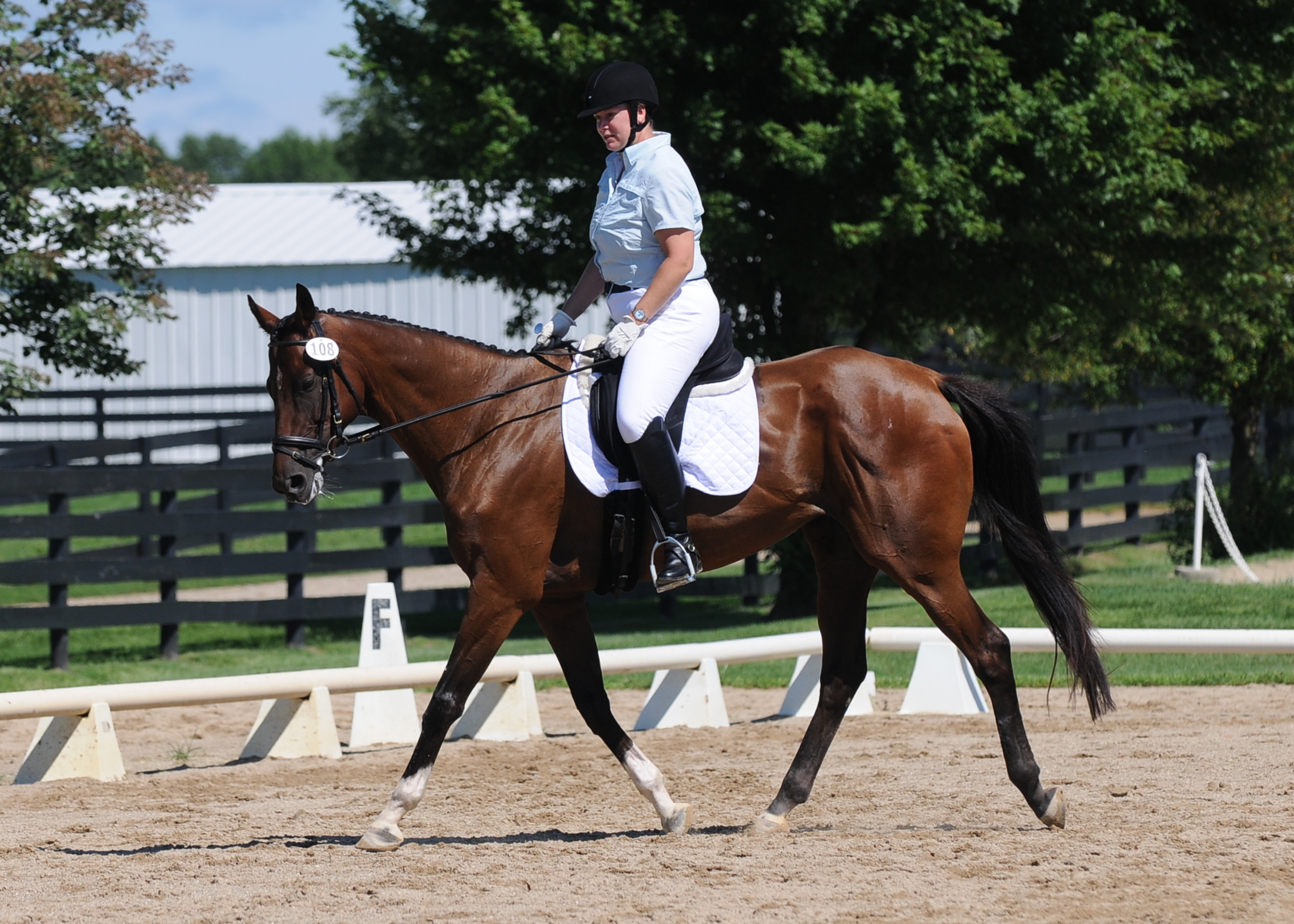
Here’s a good look at how not to do it.  This picture shows Maddie braced against the inside rein, and I’m hanging back.  Her nose is tipped inward, but there is no bend, no softness, no suppleness here.  Her right shoulder is popping out, she’s not working over her back,  and you can also see that the quality of the trot is pretty poor – I’ve put her onto her forehand, and she’s nowhere near tracking up – this trot lacks energy.   In a word, it’s  mess, and it doesn’t feel good to ride.  When we’re this disconnected, it feels like Mads is a semi on a slick road – the front part of the truck is heading one direction, and the rear end isn’t necessarily following.

So, as I mentioned, we’ve been working on developing good contact, and tonight we had it.  She was giving me really solid  contact in both reins (for the most part), which we developed using serpentines, changing the bend frequently.  Suddenly, I had even weight in both reins, her back came up underneath me, and she rounded like I had never felt her round before.   This trot felt powerful, balanced and responsive.  We had energy, and she was tracking up.  It felt like driving a sports car, because this big horse (she’s every bit of 16.3) was connected end to end – from her haunches, over her back, through her neck, into the bit, and into my hands.

“That looks really good!” my trainer Christy called from the center.  “When you come out of the corner, do a couple steps of shoulder fore, then leg yield to the wall.”  I closed my fingers on the outside rein, and tightened the muscles of my inside leg.  I pushed Mads with my left hip flexors, and she curved gently around my inside leg, continuing on a straight track down the quarter line.  Breathlessly – and still holding firmly to the outside rein – I tightened my lower leg against Maddie’s side, and gave her a little nudge with my heel.  Over we floated, without losing contact or cadence.   “Yes! That’s it!’ came the cry from the middle of the ring.  But this was one time I didn’t need Christy to tell me that we had done it right.