I had two rides on Oliver recently – one on Saturday, and one tonight. On Saturday he was unfocused and a bit tense, but I did very cruelly ride him right as the other horses were being brought in and fed, and Oliver registered his discontent by doing his best to ignore me, calling to other horses, and keeping his ears forward, pointedly not listening to me. He was a little squirrely at the beginning of the ride, but I put him straight to work, and we ended up having a decent ride, but he never truly relaxed for me. Despite his total unhappiness with my delaying his dinner, we did book one important accomplishment – I got him to spiral in and out, at the walk, in both directions. He’s beginning to understand leg aids, and best of all, I was able to get him to move alway from my right leg when circling right. So that was a definite win.
Tonight I showed up after dinner, and Oliver was back to his mellow self. We had a very nice ride, and worked on a number of things. First, as we warmed up, I worked on steering correctly – from inside leg and outside rein. He’s not perfect, but he improves with each ride. I rode shallow serpentines and figure-8’s and at the end of the warm up, he was turning nicely for me. I went back to this exercise mid-ride during a walk break, and also got good responses. This is good progress.
We also did quite a bit of work trotting. I had my spurs on tonight, and warmed up carefully, working on keeping my leg in position with my toes forward, and my foot at the girth, not curled back. I did the balancing exercises that Christy has me working on, and was pleased to find that Oliver held a pretty steady rhythm for a change, and he is also accepting more contact from me, and stays relaxed. This is also some nice progress. He used to bear down and speed up whenever his rider touched his mouth.
However, I noticed that as we worked, he started to speed up randomly, often at a moment when I was giving him little or no real input. Ha! Busted! I think he uses speeding up as an evasion, so whenever he did that, I sent him forward and kept him there. We just got a couple loads of sand in the arena, and the footing is deeper – and takes more work. He started to tire and wanted to slow down, but I kept him moving forward to make the point that the human – not the horse – sets the tempo. We did more serpentines and figure-8s while trotting, and lo and behold, the evasions stopped once he was convinced that I was paying attention.
We finished up the ride working on transitions. His downward transition in particular isn’t as crisp as I’d like to see – he really needs to transition from the seat. I started by saying “whoa” while giving him a big half halt with my seat, and closing my fingers on the reins, which increased the contact. Gradually, as he got the hang of it, I dropped the “whoa,” and for the last few, I was *almost* able to abandon the reins. Almost but not quite. However, he made good progress, and I could feel him stepping nicely under himself when I half-halted him, which is exactly the correct response to this important aid. Good boy, Oliver!
We finished up working on relaxing and stretching. He is hard (for me at least) to stretch, and he’s still not working over his back enough to speak of – getting him to stretch into the bit is the next thing on my mental to-do list for Oliver, behind relaxing, building the strength to move rhythmically and steering correctly. At this point, I’m happy if I can get him to stretch into a decent working walk – on my terms and at my invitation. He likes stretching, but does it on his own, almost rooting (and makes me wonder at times if he’s using this unbidden behavior to evade.) He relaxed, and stretched a bit, and then halted promptly from my seat. He earned his cookies tonight!
I owe a debt of gratitude to my friend Kim, who allowed me to climb aboard her gelding Frankie last night. My confidence has been wavering of late, and doubts have been creeping in which is never a good situation for a rider. Horses are telepathic creatures and mirror their riders’ mental states. A confidence building ride was needed. Frank was just what the doctor ordered.
I’ve ridden him numerous times, and he’s a good, steady character who I trust. As a second level horse, he has lots of training. However, he’s also a former school horse. He’s crafty and has all sorts of tricks in his bag for evading something he doesn’t want to do.
One thing I know Christy has in mind for our lessons is teaching me to be more assertive. We both know that I can “bring it,” really sitting up, taking control and riding assertively when I’m goaded into it by a horse that’s feeling hot, fresh or spooky. Some of my best riding has been when I’ve been seriously annoyed by my mount’s behavior, and I decide that I’m just not taking b.s. from a lower-order mammal any more. Switching into survival mode when things get too scary for my tastes will also bring out my inner ass-kicker. Which is good. These are healthy responses to equine goofiness.
But that’s not the way I usually roll. My default mode is much less demanding. Horses can steal rein length on me easily. I tend not to absolutely require them to be on the bit and round at all times. I allow them to ignore my aids, instead of responding promptly. These are but a few of my milquetoast habits. The challenge that Christy has outlined for me is to elevate my riding on an ongoing basis.
So, last night, on the relative safety of Frankie, Christy started to demand more of me, which started with requiring me to actually get (not just demand) more from the horse.
After Frank stretched and we started to go to work, the commentary from the middle of the ring was rapid-fire. “Stretch him, make him round,” Christy told me. “I’m trying!” I said, while Frank mentally tallied my number.
“DO IT NOW.” Christy commanded.
For some reason, at that moment, “balancing rein” popped into my head. I closed my fingers on the outside rein and took hold, softening the inside rein while asking for some bend unequivocally with my leg. Frank rounded, stretching into the bit.
“There it is! Nice!” Christy purred. Well, not exactly purred, but you know what I mean.
“Keep him there!”
My subconscious must have been playing Trivial Pursuit with my long term memory files, because at that moment, a favorite quote bubbled up into my thoughts: “Do, or do not. There is no try.”
That’s what Jedi-master Yoda told a young Luke Skywalker in the original Star Wars movie, as he attempted to harness the Force and I watched, goggle-eyed, from the back of a station wagon at the drive in. She’s a lot prettier than Yoda, and she doesn’t wriggle her ears when speaking to you, but I suspect Christy has a more than a modicum of wise old Yoda in her. I internalized ‘do’ rather than “try” at that moment. It’s an important difference in mindset, and it produces a different outcome.
It turns out that Jane Savoie agrees with Yoda (and Christy) on the subject of trying versus doing. In her book That Winning Feeling! Jane tells readers to eliminate “try” from their vocabularies, saying that “try” sounds like a half-hearted effort. Don’t try to do your best, she says. Do your best.
So, resolving to do rather than to merely try, we moved into a trot, and Frank popped through his shoulder, flopping his ears at me and saying “gotcha.” Christy noted that he wasn’t expending much effort and was behind my leg. “Use the whip!” she said.
It never takes too much with a Thoroughbred, and Christy isn’t advocating a beating. But using artificial aids like a whip or spurs effectively trains the horse to respond crisply when asked nicely and quietly. Those Grand Prix horses you see executing complex movements to the barely discernable aids of their riders are uuber responsive. At the higher levels, you don’t see riders kicking their horses into a gait. And the time to start thinking about developing and reinforcing responsiveness is now.
I didn’t reach back and give Frank a crack. Instead, I more or less tapped his flank, but that’s all it took. He decided that I was serious, and stepped out into a nicer trot. From there I was able to get him rounder. More purring came from the middle of the arena.
A few minutes later, I needed to grab a quick walk break. Before I could even half-halt him, Frank stopped as I was mid-post, butt out of the saddle. Why? Had he read my mind? No. I had taken my legs off when I mentally decided to take a break, and that was all Frank needed.
It didn’t feel good and I was told that particular transition was, in fact, all kinds of ugly. Christy reminded me that a good transition needs to be ridden forward into the bridle. I asked for an upward transition, kicking and clucking, and got it three or four strides after I started asking. Groaning came from the middle of the arena. I performed a crappy transition down, and earned myself a lecture on ye olde half halt.
“You know how to do this,” Christy said. “And get him in front of your leg! Get the upward transition!”
I collected my thoughts and asked Frank to round, and then walk more energetically. As I asked for the upward transition, I tapped him with the whip and got a good response.
“That’s better,” was the assessment from the middle of the ring.
We did a few more transitions. I was keeping the trot quality decent and the upward transitions became very prompt, but wasn’t getting the half halts, and my downward transitions were pretty sloppy. I knew I needed to mentally and physically ride forward into the halt. I resolved to ride forward, even with the halt in mind. We did another walk/trot upward transition, and Frank was Johnny on the spot, earning us a compliment from Christy. I posted a few strides, sat softly while keeping leg on, then half halted from my core and he walked, finally garnering Christy’s approval.
“Okay, now I want to see a canter transition,” Christy said. “Errr,” I thought, and then told myself to shut up. “Yes, Boss,” I replied out loud, mentally saluting and snapping my heels together.
We did a nice upward transition and I asked Frank for some energy at the trot. I had to get him in front of my leg. Things felt pretty good, so I held my outside rein, sat gently and asked for the canter by raising my inside seat bone, which (I’m told) invites the canter by making space for a larger stride. Frank stepped neatly into his gorgeous, uphill canter. Within a few seconds I could feel myself grinning as Frank rolled along. I was somewhat aware of Christy saying something about swinging my hips and following the motion. I did, and I felt great – balanced, soft and secure leg, responsive and willing horse. In short, I felt like a million bucks. Lots of horsemen say there’s little that a good canter can’t cure, and they’re right.
We transitioned down to the trot on my terms, and I was still grinning, and Christy was too. “That was my goal for you tonight,” she said. “Good job.”
We wound up the lesson, talking about getting me on to some different horses, in order to hone my ability to think, feel and respond to various things different mounts throw at me. Christy also thinks that this will help me realize that I’m a better rider than I think I am. Maybe she’s right – and I like her holistic approach of dealing with the bats in my belfry as well as the tactical ride I give the horse I’m riding. I’m going to make a point of pursuing rides on a variety of mounts – a few of my friends at the barn have offered me a ride on their horses, and I’m going to take them up on their generous offers for which I’m very grateful.
Cooks have a saying: the sharper the knife, the less you cry. Sharp knives are easier to handle and less dangerous than dull blades – they slice effortlessly through veggies and meat. A dull knife, on the other hand, is more dangerous, because it requires more effort of the user to achieve the desired effect. And like a sharp knife is easier to use, a responsive horse is easier to ride effectively.
This saying came to mind tonight as I was leading Maddie back to the barn after a lesson, and grinning like a fool because it had been a good ride. I told Christy that I wanted to work on my lower leg aids, namely, my ability to use my spurs accurately. I had strapped them on last night for the first time in months, and some irritated behaviors from the mare told me that I had inadvertently banged her with them a couple times. While my leg position is much improved, I still revert to my old “toes out” posture when I get tired. Developing awareness and acuity with the spurs requires me to continue to improve my leg position and stability.
So as I warmed up, I practiced deliberately putting my lower leg on, releasing, putting my spur on and releasing. However, as I did this I wasn’t getting much of a response from the mare. I was also having trouble dropping my heals and holding a good position – my hips were tight, and probably a bit tired from two strenuous rides yesterday, and my earlier ride today on Oliver. After promising Christy that I’d continue to work on my flexibility and strength, I took the spurs off.
So the lesson changed course. As we worked on my leg position and aids, which were partly successful some of the time, Christy told me that I was reverting to my bad habit of curling my heel upward, sticking it in the horse’s side and leaving it there. I focused on being more deliberate with my aids.
However, I wasn’t getting the response I was seeking. Unsure of whether or not I was eliciting a response because I guess I forgot what a correct leg yield felt like, I asked Christy watch for response while I attempted to leg yield out on a circle. I got a big fat nothing. We talked about it a bit and I told Christy that I wanted the horse that I started riding last May. Mads was so light and sensitive then, and would respond instantly to any aid. And I’ve dulled her responses.
So we started working on redeveloping a response, We started at the walk. Christy asked me to back up any requests I made of the horse with the whip, but advised me to treat any response – a head toss, a break to trot or canter, as good and to praise it, and to ride it. My first opportunity came quickly as Mads ignored me when I tightened my leg against her. I gave her a little whack with the whip and she hopped into a trot. “That’s fine,” Christy said, as I half-halted and brought Maddie back to a walk. We repeated this a few times, and within a few minutes, we produced a nice little leg yield down the quarter line!
Christy had us move into a trot. I got the mare moving in a nice forward gait with good contact. I asked for a leg yield on a 20 meter circle, and didn’t get a satisfactory response. I gave the mare a little swat, and she propped and swished her tail – and went strongly forward. “That’s fine,” Christy called to me. “You need to get her in front of your leg!”
We continued on the circle at an energetic and connected trot. “You have her undivided attention now,” Christy said as we breezed around her. And she was right. The mare had one ear back on me, and was steady in the bridle. I asked for the leg yield again, and … Maddie floated outward. There it was! I was thrilled.
I went to change directions, and as we moved off in a trot, Christy asked me what I thought of the upward transition. There was no denying it, it was pretty crappy. We half-halted and walked, and I asked for the trot, reinforcing it with a tap of the whip. The mare stepped off immediately. This was better. We tried it again, and I asked for more enthusiasm, by being a bit more emphatic with my leg aids, but not touching the whip. She went straight forward, into contact, with no head shaking or nonsense. “That’s good!” said Christy, as I let the mare trot on. “Now, how light can you make your aids, but still keep that immediate response?”
We walked, and after a minute, I closed my legs softly on the mare’s sides. She struck off in a nice trot right on the spot.
This was a seminal lesson,and an empowering one. I can fix my forwardness and responsiveness issues if I align my mental intent and my aids, and take care to reinforce my aids with whip or spurs if (and only if) necessary. I was amazed at the progress we made in one short ride. I can’t wait to get back in the saddle, and continue to hone and sharpen my aids, and Maddie’s responses. One thing I need to remember though is to stay consistent. To do otherwise is unfair to the horse. I need to ride every transition crisply, encouraging and rewarding prompt response, and reinforcing my aids clearly when needed.
The thermometer was hoovering near zero late this afternoon when I shut my laptop down, pushed back from the desk, and started to consider my trip to the barn. The second day of extremely frigid temperatures in a row, I knew that the horses stayed in today, and I suspected that the footing in the arena would be frozen. So I dug out my warmest long-johns – the thick, waffle-weave kind – and over them put a pair of too-big jeans so I’d be comfy. I added more layers – a turtleneck and a thick fleece jacket. I stuck toe-warmers in my boots, swaddled my head in a fleece headband, wool stocking cap and a long scarf, and dove into my coat. Grunting, I struggled to put on my boots, as all the layers were rendering me close to immobile. I grabbed my keys and waddled out to my car.
Upon arrival, I was pleasantly surprised to see the barn lights glowing – normally, I’m the only lunatic that goes out on sub-zero nights. However, I was in good company tonight – Liz, a fellow Packer fan and OTTB owner, was visiting Cloud. Turns out the arena footing wasn’t too bad, and she was riding.
Hmm. What the heck, I decided, pulling a sleepy Maddie out of her stall. Hanging out inside makes her mellow, if you can believe that. She dozed while I scurried around, picking her hooves, surveying the filthy, frozen mess she made of her tail (I still don’t know what she got into, and, frankly, I don’t want to know) and tacking her up. I tucked her quarter sheet around her fanny, and plopped my freezing cold helmet on my head. Happily, I had warmed up sufficiently and removed my coat – one less layer was a good thing at this point.
Mounting was interesting. In addition to feeling like a mummy, my too-big jeans kept slipping down around my hips, resulting in a poor (and monstrously unflattering) imitation of the urban-youth-pants-down-around-the-knees look. I hiked up my pants, clambered up the mounting block, and finally when the mare (and the pants) stayed put, I got on.
The arena footing was definitely iffy in areas, so as I let the mare snort and stretch, I went through my options. I still wanted a to have a productive ride. But, given the footing, the freezing air and my woeful attire, it wasn’t a good night to work hard, and focus on moving the mare forward. Still contemplating my options, I thought about a recent blog post Christy did, telling about a ride on Liam during which she worked exclusively at the walk.
I decided that responsiveness would be the rule of the day. As we warmed up, I started asking for bend from my seat, and threw in a lot of random halt transitions. We practiced (semi-successfully) staying round in the halt, and the upward and downward transitions. As we walked, I also tried to keep Maddie really busy. She has the unfortunate habit of sticking her tongue out when we walk. I’ve found that the best remedy is to keep her focused and working. I also worked on left bend, being sure to give my left rein. This went pretty well, though there were some incidents of bracing and mare foolishness. However, we got through it, and even got some nice circles and shoulder in – we had some moments of good contact and stretch, which were encouraging.
I trotted Mads a bit, not asking for much from her but insisting on responsive, right now transitions, and also asking her to stay round and stretching. We moved around as much as we could, but there were some patches in the middle of the ring that were pretty solid, and after one pass, Mads (who is barefoot) made it clear that those patches didn’t feel good, so I tried to avoid them for the rest of the ride.
To mix things up a bit, and to keep working on responsiveness, we practiced a variety of transitions – trot/halt, halt/walk/halt, halt/trot/halt etc. Mads was fairly well attuned to me and again, we had some nice moments, but she was also distracted by some barking dogs and a horse kicking the walls in the back aisle, adjacent to the arena. I got after her but not to the degree I would have had we really been working, and I was less happy with how I handled that part of the ride.
All in all, riding tonight was a pleasant surprise. I’m glad I did, because even though it was a pretty gentle ride, it was more exercise for the cooped-up mare. And tomorrow, well, let’s just say the prospects are grim. It’s going to be crazy cold tonight, and I’m certain that footing is going to freeze.
The mare is waiting, and watching.
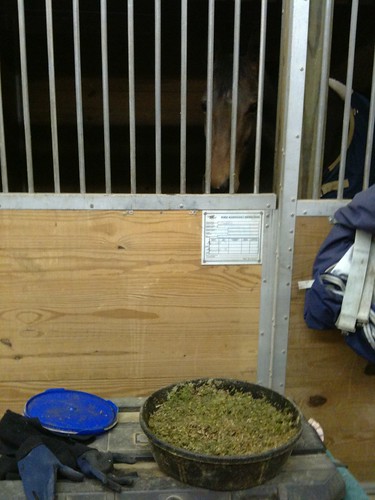
Back in the barn, I groomed Mads, put her heavyweight back on, and stuck her in her stall. She hovered near the door, ignoring her hay and telegraphing what can only be described as pathos with her tragic expression. What was her problem? Ah, well, you see, upon arrival at the barn, I had whipped up a batch of her nightly mare mush, a glorious concoction of beet pulp shreds and alfalfa cubes, soaked in hot water until soft, fluffy and steamy, and then laced with molasses. Mads needs to gain a little more weight, and in extremely cold weather like this, getting some extra hydration into the horse’s system is a bonus. That’s all well and good, but then I went and set the steaming bowl of mush on my trunk to cool. Right outside Maddie’s stall.
So close, and yet, so far away.
She stared disconsolately at the mush, inhaling the delicious fumes. I finally relented and (after testing the temperature) gave the poor starving mare her mush.
It is soooo good. At least she seems to think so.
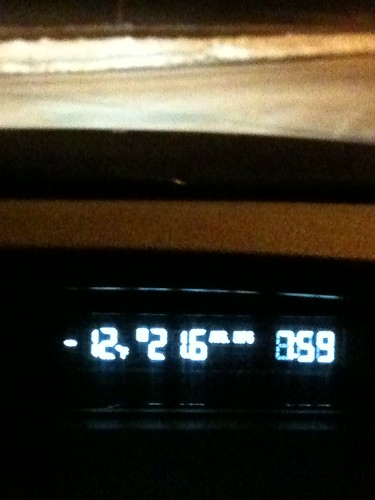
Satisfied, I headed home. I was feeling pretty good until my car told me it was -12 degrees outside. Yikes!
I'm a big fan of my new leg postion. It's a lot more secure, and things like this aren't as scary!
I took my good weekend rides into a lesson tonight, telling Christy that I had figured out where my trouble with the right rein is originating – I’m popping my right shoulder forward – so even though my hand is not.giving.rein, well, my shoulder is. Here, from tonight, in all its spectacular ugliness, is my issue du jour.
Where to start? Note the right hand (and shoulder) are far forward, and there is loop in the right rein. The outside rein. Nice.
So I focused a lot on keeping my shoulders square, pushing my left hip a bit forward (feedback from the Equitrainer a couple months ago) and not letting my right shoulder come forward. Obviously, I have a lot of progress to make in this respect. I mentioned to Christy that I felt like I was constantly breaking and fixing my postion, and she assured me that there would always be something like this to work on – it may eventually be more subtle (I sure hope so) but, as she said, if it was easy, we’d all be riding Grand Prix.
As I rode, we also paid attention to transitions. I’ve been so focused on my leg position and other issues, I’ve allowed the mare to become very sloppy – I have to work harder to get her off my leg, and make her round onto the bit. She’s fallen behind my leg, which doesn’t help. It’s hard to do much when your horse isn’t even tracking up. Christy pointed out to me that I was having to ask the mare repeatedly for upward transitions, so I dispensed with my wishy-washy-ness and started using my whip.
I would love to say we went around like this all night, but I would be lying. Besides, you've already seen the two previous pictures.
Fact is, it’s hard to ride well when your horse isn’t responsive. It’s hard to stay balanced, and keep the horse round and soft, if at the same time you have to kick the critter into an upward transition. And I recall how easy my first few rides on Maddie were – Christy had put 90 days of training on her, and the mare was ultra light and responsive. I’ve made her dull, and I need to fix this.
We made some progress tonight, getting what we call “big trot” which really just means a decent working trot, with the horse tracking up and a nice rhythmic tempo. It feels good to be riding that trot again, though I’m still not getting the gait in which I can really feel the mare pushing with the big engine in her hindquarters. But we aren’t too far away from it. And I need to make that nice “big” trot my habit. That’s the trot that ultimately is easiest to work from – which is precisely why it’s called “working trot.” It’s an essential piece of the foundation.
Toward the end of the ride, Christy assured me it didn’t look as bad as it felt (at least the last few patterns. The first part of the lesson wasn’t pretty, I don’t care what she says!) I’m looking forward to the point in the near future when I have re-installed the responsiveness buttons, and have fixed that dratted shoulder!
As you know, I’ve been working on improving my position in the saddle. To gear up for riding without stirrups at a pace faster than the walk, Christy’s had me working in the two point postion. Correctly. You see, until this week, when I hopped up into two point, I just lifted my tush out of the saddle and off I’d go. Turns out this isn’t the right way to do it, as I discovered this week. There’s more to the two-point than simply tipping your butt up out of the saddle.
In my lesson yesterday, Christy had me working in two point. And shortly after we started, I started complaining of nasty pain in my ankles. The muscles in my lower legs were en fuego. Which ain’t right. So Christy suggested that I work on moving the stirrup around on my foot – forward, backward – while in two point.
I stopped what I was doing and looked at her like she had ten heads.
Move the stirrup around on my foot, while in two point? Yes, she said, pointing out that I should be carrying most of my weight on my inner thighs, not my feet.
All righty, then.
I started walking around, trying to figure it out. Hands braced on the pommel, I posted while Mads walked, trying to get a feel for lifting myself from my thighs. The mare was confused but tolerant, at times stopping when things got too wriggly, and turning her head to give me a long look, as if to ask “You OK up there?” When I started to feel it, we picked up the trot. My inital challenge was keeping Maddie moving – anytime I got too unsteady (in her opinion) she’d drop to a walk. What good girl she is.
Finally, by the end of the ride, I got it. We were trotting around, with my hiney out of the saddle, and I was able to really lighten my foot in the stirrup, carrying my weight on my upper legs, not my feet.
Tonight, I was saddling up as Christy was getting going on her new boy, Remy. It was close to feeding time, and , my girl Mads was antsy. We got going, limbering up at the walk, while chitchatting with Christy. Then it was time to work. I hopped into two point, giving Mads plenty of rein to stretch. Round we went. My thighs were on fire. I was doing it right.
Panting after a few laps, I decided to relieve the stress on my legs by posting. I picked up more contact, and started shallow serpentines, bending Mads right and left from my seat. Clearly, my aids are a little confusing, because Mads – who was already nice and forward – stepped into a right lead canter.
Crap! I didn’t ask for that, and I’ve always been told that you don’t let horses get away with decision-making. I started to half halt her, when from the other end of the arena came the command, “RIDE IT!” Christy was keeping an eye on us, and I know better than to argue with her. Down my butt went into the saddle, and ’round we went. We kept going until by mutual agreement we had had enough.
Afterward, Christy reminded me that part of riding entails riding the horse you have at the moment. When the horse is forward and sensitive, you ride that that horse. Don’t pick fights you can’t win. Set yourself up for success.
That nice little spontaneous canter was an unexpected gift from Mads – it was a fun confidence builder, and a reminder of the “ride the horse you have” rule.
Mentally, I was born to be a dressage rider. Okay, that may be over stating things a bit, but there’s no question in my mind that this is the right sport for me. Details, mechanics, cause-and-effect – are all appealing to me. And I’m not an ultra competitive person that wants to take shortcuts to win. I really geek on good fundamentals and learning to do it right.
Mentally, however, I’m also working on my confidence. My last ride on Jag before I retired him ended up in a high speed crash landing. I got to feel the speed that made him a stakeswinning sprinter … and then I got to know what it feels like to be dumped on a mounting block. (In case you’re wondering, it doesn’t feel good.) I was in a cast for six weeks after that episode, and it’s still with me.
Enter Maddie, who is totally lovely under saddle but is a horse that will test you a bit. She’s more horse than Jag was, and while I don’t feel overfaced with her, I have a lot to learn with (and about) her, and she’s absolutely forcing me to be a better rider and horsewoman. She has the loveliest canter – the proverbial rocking horse rhythm, swingy and up-hill – but I still have balance issues and the transitions up especially intimidate me.
So my endlessly patient and creative trainer Christy has been focusing us on precise work at the trot. Adjustability within the gait, developing solid contact, and improving our overall balance. I’m already feeling more confident, because the better contact equates to more responsiveness. And my improved strength and balance will help me ride the transitions gracefully when we add the canter back into the mix. The trot work is giving me the foundation I need to develop quality canter transitions.
And therein is one of the things that I really like about dressage, and how Christy trains it. The building blocks prepare you for the next steps. What seemed unimaginable a few months ago is within reach today. Taking the time to get the fundamentals right is satisfying, and provides me the skills and confidence to progress.
So hopefully we’ll be seeing more of this – with a less ugly t-shirt/saddle pad combo – soon:



 Collecting Thoroughbreds