Joy, Pain & the Outside Rein

Today was truly a day with ups and downs, starting right off the bat with a text from the barn – Derby had been kicked.  It wasn’t an emergency, but he did have some scrapes and the location – the lower part of his chest – isn’t ideal.  The barn owner and her daughter (an ER nurse, and a nurse-to-be) did some triage and cleaned things up.  He’s tender but sound.  Happily, Derby and the other low man in the group who also gets picked on a lot are being moved tomorrow.  This is a relief to me – clearly Derby (and Remy) weren’t in a compatible group – and horses can be tough on each other.

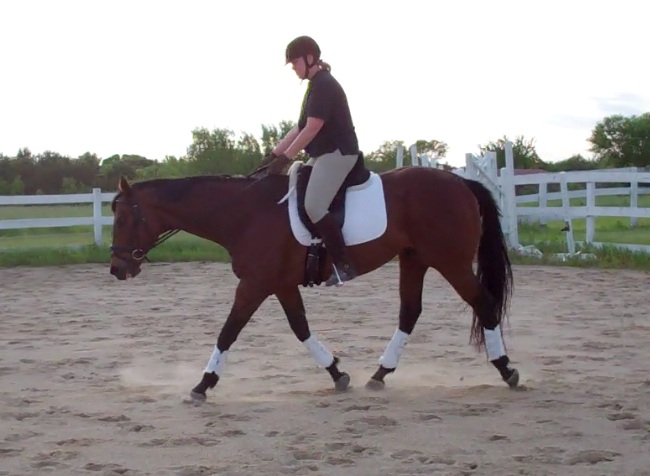
I did an easy ride on Derby tonight, wanting to be sure he was okay after his ordeal this morning, and he was.  We rode outside and he was moving well and willingly.    It sure felt better than yesterday – I had a hideous ride, due (I’m sure) to the lingering effects of the weekend.   My riding muscles were screaming, it was hot, and I think we lasted about 20 minutes.

Today was decidedly better, but I still wasn’t terribly happy with myself.  I could feel myself tipping forward, and letting my leg curl back, so I did some laps in two-point and also did a good exercise Christy taught me – standing two beats and then posting two beats, over and over.  It helps build balance and steady the lower leg.  We did these exercises with loop in the rein – I wanted to be sure that I didn’t accidentally pop him in the mouth if I bobbled.

After we had been moving around for a while, I worked on Derby’s responsiveness to my leg.  I’m still wearing tiny spurs (until my legs are stronger and steadier) but a larger pair have been purchased.   For now, I have to turn my toes all the way out and poke very deliberately if I want to put some spur on.  Which I did, when Derby declined to heed my request (delivered via the inside leg) to step his fine self over, and fill up my outside rein.  He bent outward, effectively counterbending a bit.  I turned my heel in and *poked*.  A ha!  He stepped over!

I’m being very, very careful not to nag with my aids.  My legs are either on or off at the moment – I’m trying to avoid grey areas.  And after a few pokes with the spur, Derby stepped nicelyunderneath himself, and somewhat  into my outside rein when I asked with just some calf pressure.  I say “somewhat” because Derby resists contact a bit, but I’m pretty sure it’s partially a  training issue but primarily a rider issue – he’s better when he’s 1) warmed up and 2) I really ride.

I finished the ride practicing working from my seat – steering Derby with my leg and seat aids, and halting from my seat.  It’s all a work in progress but this sweet boy is a quick study.

After I put Derby away, it was time for my lesson.   Cathy is away this week, and has handed me Atlanta’s reins.  After a rough patch this spring with sore hocks and some farrier issues, Cathy has gotten to the bottom of Atlanta’s issues, and the mare is going magnificently.  I had such fun riding her, and can’t wait to get back on tomorrow and do more.

Christy had seen my ride yesterday which I know wasn’t pretty, and asked me what we were working on tonight.  I told her that I suspected it would be more of the seat and balance issues, but once we got going  … well, things went pretty well.  It was great to ride a big, proper trot again, and while Christy agreed that my stamina has waned, she told me that my form was looking pretty good.  Hooray!  I don’t suck after all!  After hearing that, as I cruised around on Atlanta, I felt nothing but joy.

So the focus turned away from my postion, and instead to the outside rein, and moving the mare around with my seat.  We did an exercise I remember doing with Maddie, when Christy needed to get.me.off.the.inside.rein already.  She had me bend the mare to and fro, from just my seat, keeping my hands still.  Then – and tonight with Atlanta – the effect was immediate – the mares both softened and stretched into the contact, backs up and engaged.

We also did some transition work, because I forgot entirely how to ride a graceful downward transition.  By half-halting the mare as I posted, and gradually slowing Atlanta, I was able to produce a nice, smooth, relatively engaged transition. This will be a particularly good exercise to work with Derby on as he gets stronger – half halts are an area of communication we need to improve.

Speaking of Maddie ….

We got some exciting news this weekend about my former mount, Maddie.   She and Heather (her new owner) competed in their first HT this weekend – a rated show up at Silverwood.   They went out at BN (Maddie is just learning to jump) and … they won!  Heather is clearly the perfect person for Mads, who looked enthusiastic and happy in the videos I got to see.  It was thrilling watching my old girl out on XC and in the stadium.  I’m so proud of her!  Congrats to Heather on a job very well done, indeed.  🙂

Meet Derby

Our second ride, first time outside, cantering to the right

Big news, folks – there’s a wonderful new horse in my life! Meet Derby, an 11 year old OTTB that moved in this week.  I’m doing a lease-to-buy on this nice boy, and I have to tell you, I’ve fallen hard for this one.  I knew after one ride that he was the horse for me –  I felt happy and confident when I went for the test ride.    He arrived on Tuesday, and we had our first ride last night – which was totally uneventful.   The strange indoor arena didn’t phase him in the least.  Tonight we rode outside, and once again, Derby was a total star.

Working a stretch

Christy took some video of the ride, which, frankly, I’m embarrased to share with you.  I’ve been riding so inconsistently lately that my strength and balance are pretty much shot.  I feel like a flopping fish and don’t look much better!

Some nice bend

Derby also needs to get in shape.  He was on vacation over the winter, and while he’s in good condition and weight, he needs muscle.  So, we’ll spend the next few weeks doing a lot of conditioning work.  I also need to regain my independent seat and steady my leg.  Happily, this is a horse I can see myself doing a lot of no-stirrup work.  However, before we go there, I want to get Derby’s top line built, and find a saddle that I’m sure fits him well.

I’m still feeling very out of synch and discombobulated with Derby, but we have had some nice moments that leave me eager and impatient to get over this conditioning hump and get my riding legs back.

I also need to figure Derby out.  He has a lot of training but is very resistant to contact.  You can’t just push him into the outside rein and get to work.  He needs to warm up on a loopy rein.  Actually, given the current state of my riding, this isn’t a bad thing.  Riding with pronounced loop in the reins forces me to use my legs and seat to influence the horse. And once I put him to work, Derby is much better about accepting contact.  I’m pretty sure that once I get my strength and balance back, my hands will be steadier and more independent, which will help Derby too.   For now, I love the fact that this is the sort of horse that can go around on the buckle in a new environment.  He is the very soul of a good boy, and I’m crazy about him.

Cantering to the left.

Before my energy totally waned, we got some nice canter both directions, but not before I had to send Christy back to the barn for a whip.  Derby is very responsive to voice aids – a chirp will send him forward, but I’d like him to be lighter and more responsive to my legs and seat, and I’ll be making that a priority over the next few weeks.

We finished up the evening with another grooming session, hand grazing and cookies.   I’m beyond thrilled with this sweet, fancy horse.  Next ride should be on Saturday.  Stay tuned!


Humpty Dumpty Learns to Ride

Some nice trot work with Oliver

I was channeling Humpty Dumpty last night during my lesson on Oliver, and Christy had to work hard to put me back together again. But she got the job done, and Oliver produced some very nice moments, stretching into contact while almost tracking up, and starting to work over his back.

A key contributing factor to my issues last night was the saddle.  Just for fun, I rode in a Stubben Romanus – an old one.  It’s the opposite of the saddle I’m used to (a Wintec Isabell). Instead of a deep seat covered in grippy suede, this old Romanus was slick leather, with a much shallower seat.  And instead of air-filled panels, the Romanus panels feel like they’re foam-lined and filled with wool flocking.  They’re soft, and solid, and lack the shock-absorbing quality of the Isabell.

Christy’s new saddle is also wool-flocked, and she says she can feel a lot more movement in it than in her old Isabell.  I tease Christy about being the Princess and the Pea – she feels so much more than I do in the saddle.  I think she could read Braille with her butt, frankly.  The same cannot be said of me, but riding Oliver – who I’m getting to know fairly well – in the Romanus was an entirely different experience that my usual ride.  All of a sudden, I was being bounced out of the saddle at the trot.  And while Oliver has nice, solid gaits, he doesn’t produce a lot of suspension. (Yet!)  His trot is pretty flat.  I wasn’t prepared for this feeling and had to spend some time finding my balance.

Finally – with constant adjustments and encouragements coming from Christy – I started to get it together, and regained some semblance of independent hands which had left me entirely at the beginning of the ride.  Humpty Dumpty was patched up.

Something else that helped me get it together was asking Oliver to move forward.  This helped me in two ways.  First, once I got him going forward – and I was keeping him there – his rhythm improved – a lot.  If I let him go at his own pace, he speeds up, then slows down, and then spurts forward again.  Keeping him going forward is easier to ride because it cuts down on the variability in speed – and that variability makes it hard to stay balanced.  Secondly, the more forward, proper working trot is easier to ride from a balance standpoint. It’s easier to ride when you can use the momentum of the horse’s gaits in your favor.

Once I started to resemble someone with a bit of training rather than a sack of potatoes, Christy had me work on inviting Oliver to really stretch into contact, something that has been on my to-do list for a while, but I’ve not made much progress in this area.  She quickly diagnosed the problem – I’ve not been giving enough with my hands.

We’ve discussed “giving hands” before, which is another way to describe following contact, which allows the horse to stretch forward, and can also reward the horse with a decrease in rein pressure for the correct behavior.   I commented that Oliver’s unsteadiness in the bridle made it harder for me to give at the right time.
“And that’s why it’s even more important!” was Christy’s response. And she’s right, of course.  Oliver is new to dressage, and prior to Steph’s purchasing him, he was ridden in  a leverage bit with a tie down. He’ll never learn to go correctly into contact if he doesn’t get good guidance from the person on his back.  I redoubled my efforts, trying to keep my hands quiet and the contact steady.  Christy reminded me to activate my inside leg, using the spur when necessary to enage Oliver’s inside hind.

“Ride the back end, and leave the front end alone,” Christy suggested.  I envisioned side reins, and concentrated on simply holding steady contact on the reins – not messing around with softening or opening or asking for give.  I focused solely on keeping the contact quiet and holding on to the outside rein, and got busy with my leg aids.

The improvement was almost immediate.  I turned my heel inward, applied a little spur pressure, Oliver stepped neatly aside with his hind leg and his neck lengthened.

“Give give give give GIVE!” Christy commanded. “Again!”   We repeated the exercise, and I finally reacted quickly enough to get a nice stretch into contact for a few strides, after which I stopped riding, whereupon he hollowed his back and popped his head up.  You really do need to ride every stride.  We repeated the process several times, going each way.  At the end of the ride, we were both sweaty and puffing.

Oliver is figuring this out – and it gets easier as the horse develops strength and self-carriage. Oliver is just beginning to develop the new muscles necessary to carry himself correctly.   It’s fun and challenging to work through these moments with him, and he’s such a pleasant horse to work with.  It’s going to be a lot of fun to watch him develop!

Green horse, grey horse.

I got a real lesson in contrasts today, riding Oliver and Frank.  Both are total loves, and both are Thoroughbred geldings, but the similarities end there. Oliver is a green bean, but Frank knows more about dressage than me, having been trained to Second Level.

I rode Oliver first, and was hoping that I’d have a better ride than I did yesterday.  Oliver was hell-bent on testing me on Saturday, acting spooky and distracted, possibly because he had a little extra energy since the horses were stuck inside due to some awful weather.  I spent a lot of time growling at him, and it took a while for him to settle so we could really work.  Because he was being silly, I elected to get and keep his attention by doing lots of transitions and changes of direction.   In addition to being silly, Oliver also tried to convince me that he had forgotten everything he knew about transitions downward from my seat. Instead of responding to my half-halts by starting to bring his back up and stepping under himself – as he had been doing sooo nicely last weekend – yesterday he was ignoring the half halt – and the fact that my butt was planted in the saddle – and barreling on.

That would not do.

We did walk/halts (while spiraling in and out) until I got the crisp response I’d been seeking.  Then we moved back into trotting.  I started out just going down the rail, but wasn’t getting a satisfactory response.  Oliver had what Steph calls “OMG ears” and was actively looking for reasons to spook .   So I started riding figure 8’s – little ones at one end of the arena, and then larger ones, and then long flat ones, bisecting the arena down the centerline.

Things got better immediately, because I was keeping Oliver focused on me.  We worked on walk/trot/walk/trot transitions and he did pretty well.

Today was a different story.  Oliver was a total star.  We had our best trot work to date – I got him to move out, and we successfully completed laps of the arena trotting nicely both ways.  He was relaxed and just rolled along.  I also asked him more insistently to reach down, and while I wouldn’t say that he was round, he wasn’t wildly inverted.  I was proud of Oliver, and told him so!

We also had some very nice transitions from my seat, from trot to walk, and from walk to halt.  We worked on those while we also worked on steering – around the mounting block, figure-8s all over the place, you name it – and Oliver was a champ.  I was so pleased with him today!  I rewarded him with a hand grazing session (on top of lots of cookies) before I turned him back out to lounge in the sun.

After gulping some water, I went and fetched Frank.  My old buddy was feeling really good today, and surprised me by starting out at a smart pace when I picked up the trot after we warmed up.  I let him roll, hopping into two-point and getting a feel for this different feeling gait.  It has a lot more motion than the jog Frank offers when he’s feeling creaky.  He was getting a little strung out, so I decided it was time to help him out.  I started posting, took a feel on his mouth … and discovered that he wasn’t going to give it to me.  If I wanted Frank to round, he was going to make me work for it.

I was posting out of a half-seat, to stay off his back, and I increased my post, to make more “room” for a bigger stride.  I also got busy with my inside leg, engaging my core and making a point of holding my outside rein and asking Frank to soften with the inside rein.  Within a few strides, I got results.  Frank took the contact, stretched, and the trot started to feel a lot better. I tested my contact by seeing if Frank would follow my contact downward – if he didn’t, that would tell me that he was just going around with a fake headset. I invited a stretch, and got it.  I had true contact. Yay!  I could feel myself holding him between the inside leg and my outside rein. It’s been a looong time since I felt that!

This was the first ride in a log time I that I had generated proper contact.  As we went around the short side, I decided to throw in a circle to give another rider some room to maneuver.  And at that point, I got busted by the former school horse, who didn’t feel I was using my inside leg sufficiently, and ignored my inadequate request to do a 20 meter circle.  Crap!

I gathered myself and asked for another circle as we approached A.  it was ugly, because I forgot to close my fingers around the outside rein as I applied my inside leg (with more vigor this time.) Frank waggled his ears at me (I swear he did!) as he popped his outside shoulder out. Crap!

I sat myself up, made sure my feet were indeed where they belonged (at the girth, not curled back to Frank’s flanks) , held that damn outside rein, turned my left toe outward and deliberately applied my spur while also giving Frank a tap tap with my whip.   I got the “yes ma’am” response I sought, and we circled nicely, with decent contact and a quality trot.

We went down the long side, and as we headed into the short side, I gave Frank a little half-halt, to bring him more into hand.  We kept the little trot long the short side, then took a diagonal, which went quite well, since I 1) half-halted again down the short side and 2) looked where I wanted to go and 3) actually balanced the horse between my inside leg and outside rein, for a change.

We did another nice circle at C, with no shoulder popping or ear-waggling.  And then another down the long side for good measure.

I was panting and sweating – partially because I was dressed a bit too heavily, and partly because I’m in horrific shape after having been sick on and off for months.  But it felt great to really ride, even if Frank was channeling Christy and busting me when I got sloppy.  We cooled out, and then went to graze.

Two totally different horses, two totally different rides, and a completely satisfying day!

A fresh start

I believe that Winston Churchill is credited with the saying, “The outside of a horse is good for the inside of a man.”  Today was my first ride after a two week hiatus, and boy, it felt great.   It wasn’t an eventful or even particularly sophisticated ride.   But I am happy to report that my position is still solid, and I remember how to steer (with my inside leg and outside rein!)

I decided to capitalize on the time off by trying to erase the left-rein-hanging issues I’ve been having, hoping that the time off would also diminish learned responses from Maddie.   So, I made a very focused effort to stay.off.that.left.rein while also not giving away the right rein.   Going counterclockwise, I held that outside rein, kept my inside leg active, and made a point of giving the contact in the left rein continually.

Mads was clearly appreciative, stretching very nicely into contact.  I encouraged her, giving her rein and riding her in a lower frame (we both need to regain fitness), and we went around with nice contact, and more importantly, a marked lack of neck-bracing and rein-hanging.  Toward the end of the ride, I was really able to get her moving, adjusting her gait with half-halts, and alternately asking her for bigger and smaller strides.  Despite the time off, she did really well, bringing her back up and rounding very nicely.  I do love how sensitive this mare is, and wow, she really takes a half-halt well.

I’m looking forward to our ride tomorrow, and then am hoping to re-establish my routine this week, starting with a lesson on Monday.  However, the weather doesn’t look like it’s going to cooperate fully – we have another stretch of hellaciously cold weather coming mid-week.  My personal cut-off is 10 degrees – below that, I’m not interested in riding.  But those cold nights are good for groundwork, so we’ll likely have some un-mounted work on Tuesday.


George Morris: “Good enough” isn’t good enough.

George Morris clinic

George Morris suppling a horse

When a couple friends invited me to audit a George Morris clinic with them, the first thought that popped into my mind was this: “What would a dressage rider get out of auditing a George Morris clinic?”

What a stupid question that was.  Fact is, any rider can learn from George Morris.  Any.

While much of the clinic’s focus – upper level jumping – was far over my head and well out of my realm, I was struck at the emphasis GM put on the fundamentals – many of which are echoed by Christy during my dressage lessons.   Take the outside rein, for example.  My struggles with developing honest contact and using the outside rein to bend are well documented.  And I do – I really do – understand how it works.  But seeing the outside rein in action today was illuminating.

In one exercise, the riders had to jump an in-and-out, and then turn and go to a big oxer in four or five strides.  GM talked the group through how one walks a course and plots strategy.    In a jumpoff, saving one stride saves micro-seconds on the clock, and in most cases, would be preferable.  Horse after horse came through the course, and as they turned, it was easy for me to see which had been turned more correctly – bending into the outside rein – and which had turned because their heads were hauled around.  Horses that had executed a more tactful, well-organized turn were markedly better balanced, taking a true line to – and over – the jump.   GM asked all of the riders to halt almost immediately after the jump, as well – and those that were well balanced before and over the jump were able to halt with style and accuracy.  Many of  the others had to avail themselves of the arena wall to halt.  The key to executing that critical turn with grace? Proper bending into ye olde outside rein.   Importantly, however, GM stressed the importance of holding onto the outside rein and maintaining contact, even when traveling in a straight line.  “Straightness is the result of balance between the inside leg and outside rein, ” he told us.

GM addressing the group in the first clinic session

All throughout this exercise (and many others) GM repeated the “outside rein” mantra, while also reminding riders to close their fingers and take a feel on their horses’ mouths.  Elastic contact was another principle that was repeated throughout the day.  GM emphasized the importance of getting the horse on the bit – and of doing so correctly.  “Contact isn’t just pulling the rein.  It’s pushing.  Push first, then take rein and bend,” he said. “Push-take-bend.”    He went on to emphasize what dressage riders call “riding back to front” – generating push from the hind end, over the back, and through the reins to develop honest, forward and elastic contact. Elasticity of contact was also stressed.  “Softness comes from give, not from holding,” GM told the group.  Develop elastic contact by softening when the horse gives.  He encouraged all riders to soften their elbows, while keeping their fingers closed.

To help everyone get their horses onto the bit, GM started the sessions with suppling, stating that it’s important to supple the whole horse, not just the neck.  Riders rode shoulder-in, shoulder-out, haunches-in, haunches-out, counter canter and a variety of circles and serpentines to bring their horses onto the bit (while making correct use of the inside leg and outside rein.)  In the second session, he got on one of the horses and within minutes had the big jumper moving easily and what the dressage world would call “through” – fully connected to the bit and over the back. According to GM, “A horse bends from the ribcage. This new bending at the neck I see everywhere…I don’t know where this came from, but it’s WRONG!”

During the clinics, GM reminded riders often about pushing the horse to the bit with the legs, maintaining contact and bending into the outside rein, especially as the exercises got more demanding.  At the end of the last session I watched,  the riders were asked to jump a vertical that was set above 4″.  They had to gallop to it, and then, because it was set almost to the corner of the arena, they needed to immediately turn or stop.  GM was asking them to stop.  Now, all of these riders were using automatic releases – but GM still issued frequent reminders about maintaining feel to and over the jump, which was undoubtedly necessary if in order to maintain communication in order to make that halt so soon after galloping to and then clearing that big vertical.

On perfection
A few times during the clinics GM stopped to explain his insistence on perfection. “I’ve had great successin this business by being a perfectionist,” he told the group, repeating the old adage, “Perfect practice makes perfect.”   On the subject of practice, GM noted that the first time you do anything, it’s difficult.  Eventually it becomes easy. Then it becomes habit. Finally, it becomes beautiful.  In order to get there, he advocates a specific approach to training and practice: Explanation-Application-Correction-Practice.  The new skill is explained (and demonstrated if necessary.)  The rider gives it a try.  The trainer makes any necessary corrections.  The rider practices the skill correctly.

It’s clear that GM is an intensely competitive guy, even today.  Throughout the day, he lamented the watering down of courses, especially with respect to the controversial removal of liverpools from top-level events.   “That’s catering to spooky horses,” he snorted. “If you can’t jump a liverpool, you shouldn’t be there.  (He then made sure that every rider in his clinics could jump a liverpool, focusing specifically on educating horses on spooky jumps).

“Good enough” isn’t good enough, he stressed. “Getting through the day isn’t the objective.  The goal is quality.  Excellence counts.”

***

Updated: one of GM’s riders has a blog detailing her experience. Well done, Megan, it was fun watching you ride!  Here’s the link to her recap. http://thegmchronicles.blogspot.com/2010/11/chicago-clinic-is-wrap.html

A special shout-out to Thoroughbreds:

Most of the horses in the clinic were supremely fancy warmbloods.  However, the the two boldest jumpers in the later, more advanced clinic, were both Thoroughbreds.  They never as much as looked at a jump, clearing each with enthusiasm and answering every question asked of them. “Put your stick away,” he told both riders at certain points, as neither horse needed any reinforcement.  “I love Thoroughbreds,” GM said more than once.

George Morris schooling riders on how to educate horses to spooky jumps:

Why all the trot work?

Mentally, I was born to be a dressage rider.  Okay, that may be over stating things a bit, but there’s no question in my mind that this is the right sport for me.  Details, mechanics, cause-and-effect – are all appealing to me.  And I’m not an ultra competitive person that wants to take shortcuts to win.  I really geek on good fundamentals and learning to do it right.

Mentally, however, I’m also working on my confidence.  My last ride on Jag before I retired him ended up in a high speed crash landing. I got to feel the speed that made him a stakeswinning sprinter … and then I got to know what it feels like to be dumped on a mounting block.  (In case you’re wondering, it doesn’t feel good.) I was in a cast for six weeks after that episode, and it’s still with me.

Enter Maddie, who is totally lovely under saddle but is a horse that will test you a bit.  She’s more horse than Jag was, and while I don’t feel overfaced with her, I have a lot to learn with (and about) her, and she’s absolutely forcing me to be a better rider and horsewoman.     She has the loveliest canter – the proverbial rocking horse rhythm, swingy and up-hill – but I still have balance issues and the transitions up especially intimidate me.

So my endlessly patient and creative trainer Christy has been focusing us on precise work at the trot.  Adjustability within the gait, developing solid contact, and improving our overall balance.  I’m already feeling more confident, because the better contact equates to more responsiveness.  And my improved strength and balance will help me ride the transitions gracefully when we add the canter back into the mix.   The trot work is giving me the foundation I need to develop quality canter transitions.

And therein is one of the things that I really like about dressage, and how Christy trains it.  The building blocks prepare you for the next steps.  What seemed unimaginable a few months ago is within reach today.  Taking the time to get the fundamentals right is satisfying, and provides me the skills and confidence to progress.

So hopefully we’ll be seeing more of this – with a less ugly t-shirt/saddle pad combo – soon: