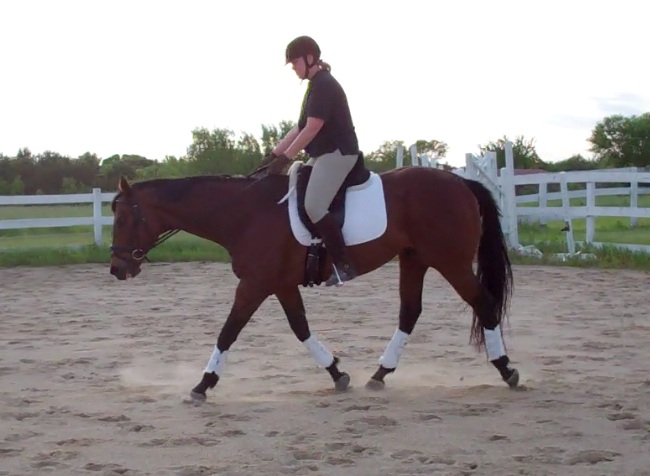
Crappy eq notwithstanding, Derby is going more reliably round, forward, and on the bit.
As I mentioned in yesterday’s post, Derby is suffering some latent stiffness and muscle pain stemming from both the abscess and the fact that he really needs more conditioning, especially with respect to his hind end and his top line. At the moment, some muscles in his hind end are quite tense and tight, causing him to move stiffly, starting from his hips, and evidenced by shorter strides, and a back that doesn’t swing. He’s particularly reluctant to move out on his right hind, and Dr. Nicky said she suspects that he’s still off from using his hind limbs asymmetrically when he had the abscess. She prescribed Robaxin along with a program of longing and riding with the specific aim of stretching and strengthening those muscles. So, even though he’s not moving perfectly, I need to get on and really ride.
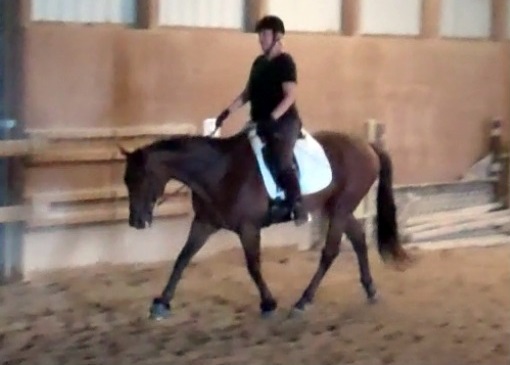
This is what I need to really shoot for - getting him to step up under himself, while maintaining roundess and contact, to keep him over his back. This requires multitasking on my part.
The imperative from the vet and the lingering effects of the Dover clinic have galanized me, and Christy, who is no longer inclined to cut me any slack. The lesson tonight worked a lot on leg yield and canter transtions, which were especially sticky to the right, requiring me to sit up, ride and require equine compliance and cooperation.
Overall, I’m happy with our work tonight. The trot is more reliably round and forward. I’m getting better contact, though I may have to give some credit to a softer bit – Derby went very nicely in a fat KK, switching out from the thinner Myler comfort snaffle. And after a few attempts, I got a nice, immediate upward transition going right. That took some doing – that’s the lead we’ve been having difficulty with, most likely due to the abovementioned lameness and conditioning woes. We had no such issues going left – Derb picks that lead up right away.
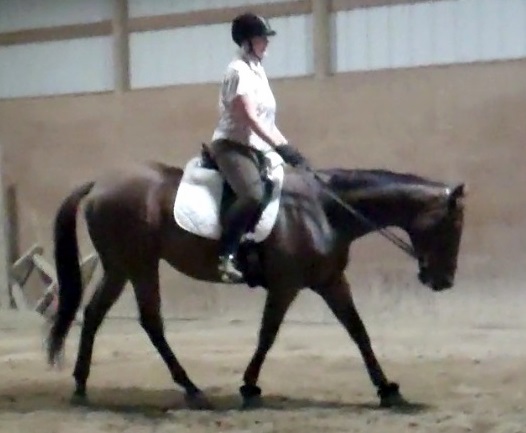
And the trot is better, though in this video, you can see in Derby’s tail carriage (tense, held out) that he’s a bit uncomfortable. I hate that he is, but am determined to minimize this uncomfortable period by rigorously following the vet’s instructions, (and feeding lots of carrots and cookies to make up for it in the meantime.)
We had such a fun ride tonight. Going into my lesson, I mentioned to Christy that I wanted to work on “forward” first, because it’s dang hard to connect a horse that isn’t moving. Once I had warmed Derby up and trotted a few laps, we cantered a few times – just a lap or so, because neither of us have an excess of fuel in the tank. However, Derby still wasn’t in front of my leg, so Christy had us work on some exercises to get us there.
First, on a circle, she had me do trot-walk transitions, only walking two strides before picking up the trot again. Initially, the transitions were mushy – indistinct and not prompt. Christy had me remedy this by *requiring* a crisp, “trot NOW” transition. Derby replied enthusiastically on our next attempt, stepping straight into a canter.
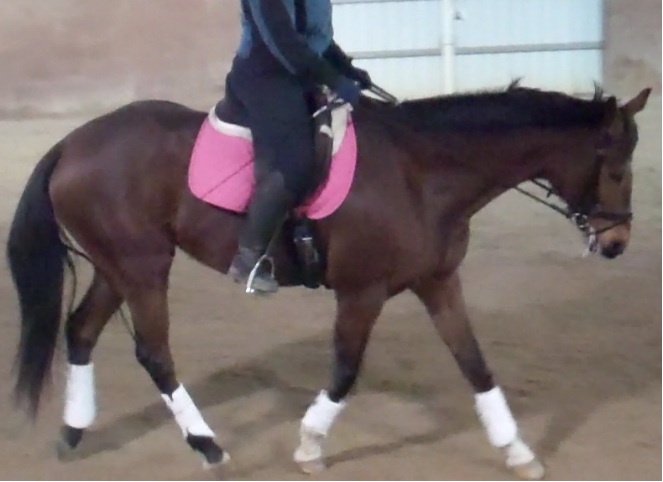
Not the prettiest moment in equitation, but I like how he's stepping up underneath himself.
Okay, so our first walk-canter transition was an accident, but it felt awesome. I allowed Derby to roll for a minute, because an enthusiastic forward response is a very good answer. The last thing I needed to do at that moment was to jerk him in the mouth and punish him. From there, quickly tallied our second “first” of the evening. Christy had us do trot-canter-trot-canter transitions, with just a few strides of each gait – and Derby responded with alacrity. And after that, the overall quality of our work improved.
Best of all, we were able to get the transitions both ways. I still need to work myself into balance going right, but I’m able to get there, and able to generate good work that direction.
To wind the ride down and let the horse stretch (he’s been stuck in his stall for the last two days due to torrential rain and thunderstorms) we just trotted some laps – but I was asking for a big, reachy trot and also asking Derby to work over his back. Building top line is still a top priority, and this is a good way to do it. I was happy with his responsiveness and overall, it was a fantastic ride. We need to keep him in front of my leg but we really are making progress. He’s a good boy!
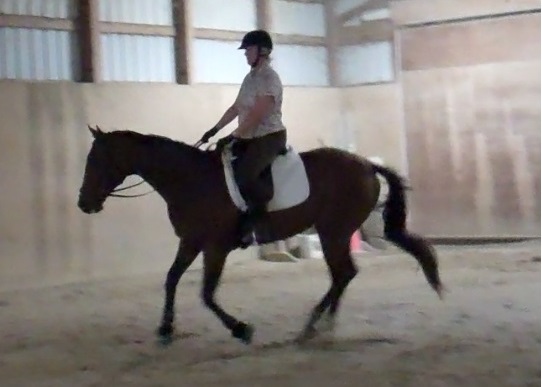
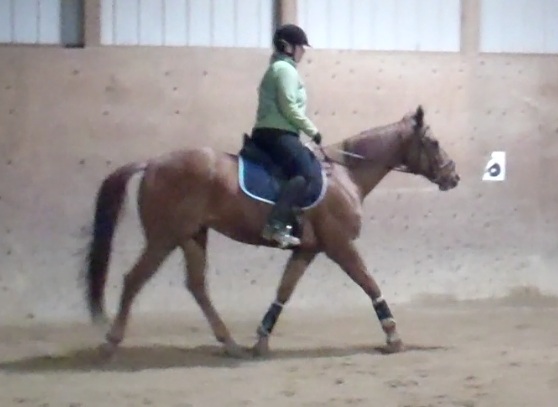
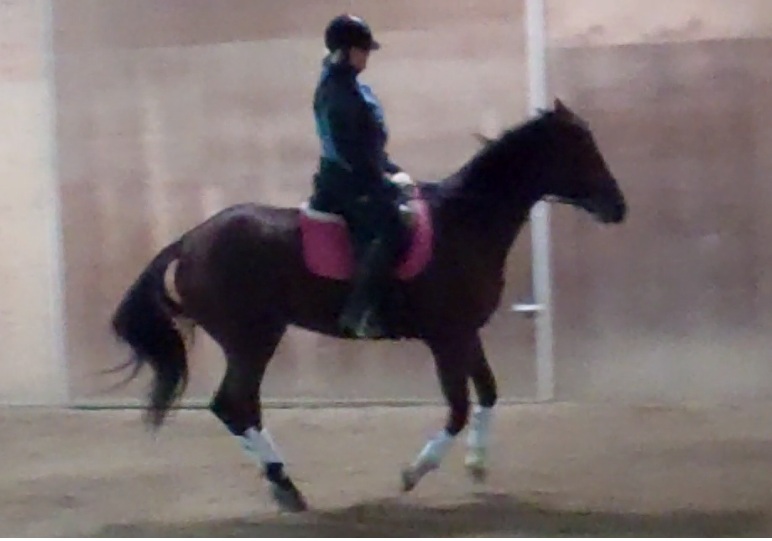
He has a really nice canter. It will be nice when I can ride it effectively.
The canter transition is definitely improving. Derby is responding quickly, and to the left, at least, I’m fairly well balanced and he steps right into the upward transition.
I’m still struggling with my position when going right, and this was clear when we changed direction. Our failure to pick up the right lead was undoubtedly my fault, not the Derbster’s. This was one of those “the horse is the mirror” moments. Derby has no problem picking up the right lead canter. It’s not a training issue. The problem arises when I’m unbalanced and it feels off. At those moments Derby says “Nope. It’s better for all concerned if we keep trotting. You get your act together, and we’ll canter.” I really can’t blame him.
So Christy had me work on getting a good connection and improving our trot going right. We started out with focusing for a minute on my control of Derby’s shoulders. Doing developed some steady contact, and then added a little leg yield and the trot really improved. I could feel Derby’s back come up and best of all, he really stretched into the contact.
The weather is getting crisp. So were my canter transitions tonight. Derby was much more responsive, and I rode them a bit better too. I didn’t do as many canter-trot-canter transitions as I wanted to – it was a busy night, but after a couple canters we had a pretty decent trot going. The connection is still lacking. I’m not sweating this at the moment. Right now, installing “forward” is key. Staying balanced and executing the transition with grace is still a challenge but it will become even easier as Derby becomes more responsive and steps into the canter when I ask him. Reducing the wishy-washiness of my aids will help greatly in this endeavor.
Lesson tomorrow night. It’s going to be a little chiller, even. Here’s hoping for a report of even more crisp work tomorrow.
On some days, riding is empowering. On others, it can be infinitely humbling. Tonight, as I bumbled around in my lesson, it definitely was one of the latter. My position is feeling good, my balance has certainly improved, but a lot of other things have slid. And they all begin with good contact, which comes from generating power behind and catching it in the reins when the horse stretches forward into the bit.
Needless to say, Derby generates about as much jet wash as a butterfly flapping from daisy to daisy. He creates little to no cosmic disturbance. So tonight we worked on resetting the gauge on the working gaits. We rode canter transitions.
Okay. The next time I hear some uninformed twit say horseback riding isn’t work, isn’t exercise, I swear to God I am going to drag them by the collar to the barn and plunk them down on my saintly horse, and have them ride trot-canter-trot transitions. Without bracing on the reins, while sitting softly in the saddle and not gripping with the legs. In other words, holding one’s self up with one’s core. It is hard work and my Lord, we have a long way to go. I rode like the proverbial “soup sandwich.”
But it was really fun! Half the time I wasn’t listening to Christy (sorry, Boss) because my inner voice was saying “Dang, he has a niiice canter.” As we did transitions, Derby started to really pick up his feet and roll, and he became a lot more responsive.
So this needs to be the new normal. I know these moments of flopping incompetence will pass. Probably not soon enough for my tastes, but soon enough we’ll start achieving some harmony and some grace.
I’ve been cramming in as many lessons as my schedule – and Christy’s – will permit. I’m glad I did, because it’s paying off. Today, riding solo, I had a solid ride and even logged a few improvements.
As I mounted up, I ran down my mental checklist. Don’t accept the wrong answer, like sluggish responses, a hollow back or an up-flung head. Correct problems immediately. Hold the contact. Use my seat and legs, not hands.
After letting Derby stretch a bit, I started more serious work at the walk. He was a bit locked up on the right side, so I worked on suppling him, flexing right and left, then bending and a little shoulder in, while staying round. Moving into the trot, things improved. Our upward transition was really nice and Derby was a lot more forward. He stayed nice and round as we motored around. I had to work a bit on roundness and connection as we did 20m circles, but we produced some good work and Derby was moving beautifully laterally.
For fun, I asked for a canter, and got a decent upward transition and a much more forward canter than I had in one of my lessons last week, in which I had to really encourage Derby to move out.
Next, we worked on some transitions, practicing halting through a working walk. The first few were ugly, and Derby’s elevated nose told me all I needed to know – I wasn’t riding him into the contact – I was giving him rein as we slowed. I tried again, holding the reins, keeping my shoulders back, and engaging my core. Better.
We finished up doing some relaxed changes of rein across the diagonal, and then some elongated figure 8’s, bisecting the arena across the centerline. I wanted to do a little work on the tight turns off the diagonal and onto the centerline I’ll encounter in the tests.
Overall, I was pretty happy with the ride, especially the fact that we were able to maintain decent quality throughout most of the ride. It’s back to boot camp starting on Monday. I’m glad I was able to get my homework for today done. While I wouldn’t call it “perfect practice,” it was an above average ride for me.
Our second ride, first time outside, cantering to the right
Big news, folks – there’s a wonderful new horse in my life! Meet Derby, an 11 year old OTTB that moved in this week. I’m doing a lease-to-buy on this nice boy, and I have to tell you, I’ve fallen hard for this one. I knew after one ride that he was the horse for me – I felt happy and confident when I went for the test ride. He arrived on Tuesday, and we had our first ride last night – which was totally uneventful. The strange indoor arena didn’t phase him in the least. Tonight we rode outside, and once again, Derby was a total star.
Working a stretch
Christy took some video of the ride, which, frankly, I’m embarrased to share with you. I’ve been riding so inconsistently lately that my strength and balance are pretty much shot. I feel like a flopping fish and don’t look much better!
Some nice bend
Derby also needs to get in shape. He was on vacation over the winter, and while he’s in good condition and weight, he needs muscle. So, we’ll spend the next few weeks doing a lot of conditioning work. I also need to regain my independent seat and steady my leg. Happily, this is a horse I can see myself doing a lot of no-stirrup work. However, before we go there, I want to get Derby’s top line built, and find a saddle that I’m sure fits him well.
I’m still feeling very out of synch and discombobulated with Derby, but we have had some nice moments that leave me eager and impatient to get over this conditioning hump and get my riding legs back.
I also need to figure Derby out. He has a lot of training but is very resistant to contact. You can’t just push him into the outside rein and get to work. He needs to warm up on a loopy rein. Actually, given the current state of my riding, this isn’t a bad thing. Riding with pronounced loop in the reins forces me to use my legs and seat to influence the horse. And once I put him to work, Derby is much better about accepting contact. I’m pretty sure that once I get my strength and balance back, my hands will be steadier and more independent, which will help Derby too. For now, I love the fact that this is the sort of horse that can go around on the buckle in a new environment. He is the very soul of a good boy, and I’m crazy about him.
Cantering to the left.
Before my energy totally waned, we got some nice canter both directions, but not before I had to send Christy back to the barn for a whip. Derby is very responsive to voice aids – a chirp will send him forward, but I’d like him to be lighter and more responsive to my legs and seat, and I’ll be making that a priority over the next few weeks.
We finished up the evening with another grooming session, hand grazing and cookies. I’m beyond thrilled with this sweet, fancy horse. Next ride should be on Saturday. Stay tuned!
A while back, I commented to Christy that I didn’t realize how bad my riding was until I had been riding long enough to realize that sad fact for myself. And while I do know that I’ve improved, I’m also still aspiring to ride a decent Training level test. Walk, trot, canter. Nothing too fancy. But a girl has to start somewhere.
And tonight I really realized where “somewhere” is for me at the moment – and it’s pretty close to square one! The good news is that my confidence is returning. The bad news is that being a wimp for the last month or so has had a deleterious effect on my ability to perceive what’s going on while in the saddle. Specifically, I’ve become woefully comfortable riding nothing trots. Dinky feels like we’re moving out. I thought I was asking Frank to step out tonight, and he was barely tracking up. Gaah. It wasn’t even a decent working trot. Oy, vey ist mir. There was one bright spot. I did get him to stretch pretty well while trotting, which is not something I’ve done much, and so the fact that I was able to get the wiley old schoolmaster to stretch was a small win for me.
Also on the up side, we cantered a bit, and it was fun, but not too pretty. I need to start working on putting the horse together at the canter. Starting with the upward transition, which needs a lot more grace and deliberation.
Oliver trotting easily, and accepting a little contact without resisiting.
I did have a fun and easy ride on Oliver tonight, too. He was a very good boy, despite the fact they were in today. (It snowed this morning.) (I know!!!) We trotted nice and easy, both ways, and did lots of transition work, because he was feeling fine and fresh and didn’t want to listen to the human. Trot walk trot walk halt stand no, you’re still standing walk and I mean walk with some purpose boy halt good boy walk trot keep trotting yep all the way down the long side past the spooky corner not a look good boy walk halt stand walk rinse repeat.
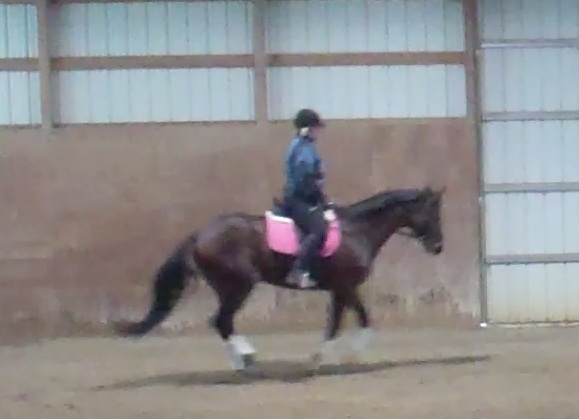
Oliver transitioning downward from my seat - I love how his back is up and he's stepping under himself. I'm staying out of his mouth.
The transition work did pay off – we had a couple nice downward transitions in which he didn’t fall onto his forehand, and instead brought his back up, stretched into the bit and stepped waay up under himself. I hate my position in this picture (nice hunched shoulders!) but included it because I’m proud of Oliver.
Hopefully, I can get back on Atlanta soon – she’s recovering from a bout of back soreness, and I’ll really focus on working the stretchy trot on her – her topline has suffered for her time off, and she needs to work over her back more – and this will be excellent practice for me.
Thank goodness for friends with nice horses and busy schedules! I’ll claw my way back to competence one of these days.
I owe a debt of gratitude to my friend Kim, who allowed me to climb aboard her gelding Frankie last night. My confidence has been wavering of late, and doubts have been creeping in which is never a good situation for a rider. Horses are telepathic creatures and mirror their riders’ mental states. A confidence building ride was needed. Frank was just what the doctor ordered.
I’ve ridden him numerous times, and he’s a good, steady character who I trust. As a second level horse, he has lots of training. However, he’s also a former school horse. He’s crafty and has all sorts of tricks in his bag for evading something he doesn’t want to do.
One thing I know Christy has in mind for our lessons is teaching me to be more assertive. We both know that I can “bring it,” really sitting up, taking control and riding assertively when I’m goaded into it by a horse that’s feeling hot, fresh or spooky. Some of my best riding has been when I’ve been seriously annoyed by my mount’s behavior, and I decide that I’m just not taking b.s. from a lower-order mammal any more. Switching into survival mode when things get too scary for my tastes will also bring out my inner ass-kicker. Which is good. These are healthy responses to equine goofiness.
But that’s not the way I usually roll. My default mode is much less demanding. Horses can steal rein length on me easily. I tend not to absolutely require them to be on the bit and round at all times. I allow them to ignore my aids, instead of responding promptly. These are but a few of my milquetoast habits. The challenge that Christy has outlined for me is to elevate my riding on an ongoing basis.
So, last night, on the relative safety of Frankie, Christy started to demand more of me, which started with requiring me to actually get (not just demand) more from the horse.
After Frank stretched and we started to go to work, the commentary from the middle of the ring was rapid-fire. “Stretch him, make him round,” Christy told me. “I’m trying!” I said, while Frank mentally tallied my number.
“DO IT NOW.” Christy commanded.
For some reason, at that moment, “balancing rein” popped into my head. I closed my fingers on the outside rein and took hold, softening the inside rein while asking for some bend unequivocally with my leg. Frank rounded, stretching into the bit.
“There it is! Nice!” Christy purred. Well, not exactly purred, but you know what I mean.
“Keep him there!”
My subconscious must have been playing Trivial Pursuit with my long term memory files, because at that moment, a favorite quote bubbled up into my thoughts: “Do, or do not. There is no try.”
That’s what Jedi-master Yoda told a young Luke Skywalker in the original Star Wars movie, as he attempted to harness the Force and I watched, goggle-eyed, from the back of a station wagon at the drive in. She’s a lot prettier than Yoda, and she doesn’t wriggle her ears when speaking to you, but I suspect Christy has a more than a modicum of wise old Yoda in her. I internalized ‘do’ rather than “try” at that moment. It’s an important difference in mindset, and it produces a different outcome.
It turns out that Jane Savoie agrees with Yoda (and Christy) on the subject of trying versus doing. In her book That Winning Feeling! Jane tells readers to eliminate “try” from their vocabularies, saying that “try” sounds like a half-hearted effort. Don’t try to do your best, she says. Do your best.
So, resolving to do rather than to merely try, we moved into a trot, and Frank popped through his shoulder, flopping his ears at me and saying “gotcha.” Christy noted that he wasn’t expending much effort and was behind my leg. “Use the whip!” she said.
It never takes too much with a Thoroughbred, and Christy isn’t advocating a beating. But using artificial aids like a whip or spurs effectively trains the horse to respond crisply when asked nicely and quietly. Those Grand Prix horses you see executing complex movements to the barely discernable aids of their riders are uuber responsive. At the higher levels, you don’t see riders kicking their horses into a gait. And the time to start thinking about developing and reinforcing responsiveness is now.
I didn’t reach back and give Frank a crack. Instead, I more or less tapped his flank, but that’s all it took. He decided that I was serious, and stepped out into a nicer trot. From there I was able to get him rounder. More purring came from the middle of the arena.
A few minutes later, I needed to grab a quick walk break. Before I could even half-halt him, Frank stopped as I was mid-post, butt out of the saddle. Why? Had he read my mind? No. I had taken my legs off when I mentally decided to take a break, and that was all Frank needed.
It didn’t feel good and I was told that particular transition was, in fact, all kinds of ugly. Christy reminded me that a good transition needs to be ridden forward into the bridle. I asked for an upward transition, kicking and clucking, and got it three or four strides after I started asking. Groaning came from the middle of the arena. I performed a crappy transition down, and earned myself a lecture on ye olde half halt.
“You know how to do this,” Christy said. “And get him in front of your leg! Get the upward transition!”
I collected my thoughts and asked Frank to round, and then walk more energetically. As I asked for the upward transition, I tapped him with the whip and got a good response.
“That’s better,” was the assessment from the middle of the ring.
We did a few more transitions. I was keeping the trot quality decent and the upward transitions became very prompt, but wasn’t getting the half halts, and my downward transitions were pretty sloppy. I knew I needed to mentally and physically ride forward into the halt. I resolved to ride forward, even with the halt in mind. We did another walk/trot upward transition, and Frank was Johnny on the spot, earning us a compliment from Christy. I posted a few strides, sat softly while keeping leg on, then half halted from my core and he walked, finally garnering Christy’s approval.
“Okay, now I want to see a canter transition,” Christy said. “Errr,” I thought, and then told myself to shut up. “Yes, Boss,” I replied out loud, mentally saluting and snapping my heels together.
We did a nice upward transition and I asked Frank for some energy at the trot. I had to get him in front of my leg. Things felt pretty good, so I held my outside rein, sat gently and asked for the canter by raising my inside seat bone, which (I’m told) invites the canter by making space for a larger stride. Frank stepped neatly into his gorgeous, uphill canter. Within a few seconds I could feel myself grinning as Frank rolled along. I was somewhat aware of Christy saying something about swinging my hips and following the motion. I did, and I felt great – balanced, soft and secure leg, responsive and willing horse. In short, I felt like a million bucks. Lots of horsemen say there’s little that a good canter can’t cure, and they’re right.
We transitioned down to the trot on my terms, and I was still grinning, and Christy was too. “That was my goal for you tonight,” she said. “Good job.”
We wound up the lesson, talking about getting me on to some different horses, in order to hone my ability to think, feel and respond to various things different mounts throw at me. Christy also thinks that this will help me realize that I’m a better rider than I think I am. Maybe she’s right – and I like her holistic approach of dealing with the bats in my belfry as well as the tactical ride I give the horse I’m riding. I’m going to make a point of pursuing rides on a variety of mounts – a few of my friends at the barn have offered me a ride on their horses, and I’m going to take them up on their generous offers for which I’m very grateful.
The last few days have been illuminating, starting on Thursday. I didn’t ride on Thursday- work was catching up with me, and I had zero energy – so I gave my lesson to one of Christy’s other students, and she rode Maddie. It has been a long time since I’ve seen Mads go and it was fun to watch – and revealing. Mads went beautifully for H. and she didn’t hang on the left rein whatsoever. That provided more conclusive proof that the issues with the left rein are operator error – and not the big mare’s fault.
So when I rode Saturday, I was resolved to practice what Christy had me work on during our most recent lesson – giving the left rein when bending or circling to the right, while being sure to hold that right (outside) rein. I worked at it – somewhat fruitlessly – giving the inside rein, while trying to keep my hands even and avoid letting the right rein get longer – but my efforts didn’t produce the quality bending I was hoping to generate.
But then it happened. I caught myself shifting my right shoulder forward – effectively giving the right rein away. Eureka! So now I know what my next personal project is – fixing my shoulder alignment. A review of some recent videos provided additional confirmation. But at least I know what the underlying cause of my difficulties, so I can take aim at fixing the issue.
Today Steph and I headed out to the barn early, to beat the rush because we both wanted to work on some things with minimal distractions. I wanted to work on making my transitions more crisp, and (of course) the rein balance info. We warmed up stretching and bending, and I really focused on keeping my right shoulder back, even with my left, rather than letting it creep forward. I did catch myself a couple times, but overall, I was pretty happy with the way things were going.
Mads gives me a nice "little trot," reducing the length of her stride, and bringing her back up, in response to my half halt
I took my nice bending and started to work on transitions, shifting from walk to trot to walk again, asking for a prompt response from the mare, while also keeping her round. As we worked, I found I found I had a nicely forward horse and so I asked for the canter, and got a a decent upward transition.
It’s easy to look good on Mads – she has the nicest, most rhythmic canter and it’s fun to ride. We haven’t worked much in this gait, and I need to work on swinging my hips, staying with (and influencing the gait.) That’s on the list of things to do.
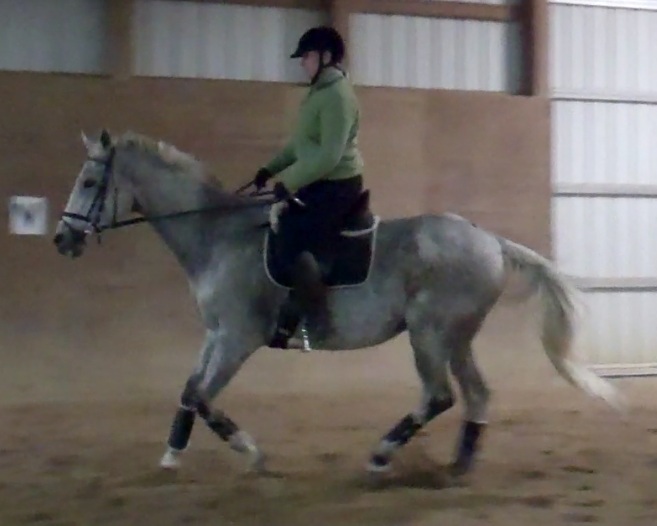
Mada has the nicest uphill canter. Now I just need to do a better job of riding it!
I was really happy with our short canter, and the downward transition was nice too. I kept her at a trot after that canter, mixing up the pattern, because Mads sometimes does start to anticipate the canter, taking it upon herself to offer it freely at every subsequent upward transition. So I redoubled the transitions, throwing in some halts, too. As much as she wanted to hop ahead, Mads was very responsive to the half halt, and I liked the quality of the little trot she gave me, though I did have to work hard with my core to hold her there.
It was a satisfying ride, laying groundwork for the next set of skills I need to improve.
(Special shout out to Steph, thanks for taking all the video!)










 Collecting Thoroughbreds