Actually, they can talk. You just have to listen.

This week I got a two poignant refreshers in how important it is to listen to the horse.  Even though they can’t speak, horses are pretty good communicators.

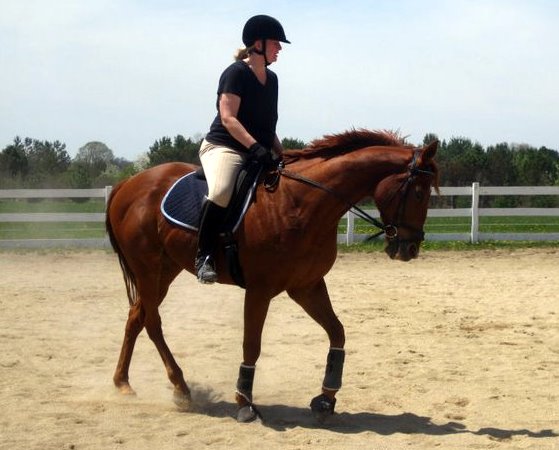
On Monday, I saddled up my old buddy Frank for a lesson.  As usual, before outfitting him in boots, I picked his hooves carefully, checked his shoes, and felt up and down each leg.  All looked good.  I put the saddle on, and tightened the girth a couple holes, and then led him out into the arena.  Frank is good at puffing up his belly when it comes time to tighten the girth, so I take a hole-by-hole, more gradual approach with him, in order to catch him when he exhales.   We walked a minute, and I dropped one of the stirrups – and boy, did I get an objection.  Frank pinned his ears and swished his tail, and then stood, with a very sour expression on his face.  This was not normal for Frank.

Christy asked if I had checked his back – and admittedly, I hadn’t – Frank’s back is the one part of him which hasn’t posed a problem in the past.  I went back into the aisle, and untacked him. Yep, he was tender along his top line.  Christy did some additional checking, and found that his hindquarters were tender, too.  We later learned that he had worked pretty hard the day before – and that was the likely culprit.

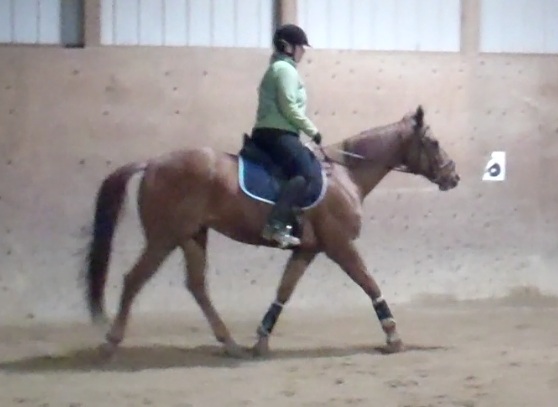
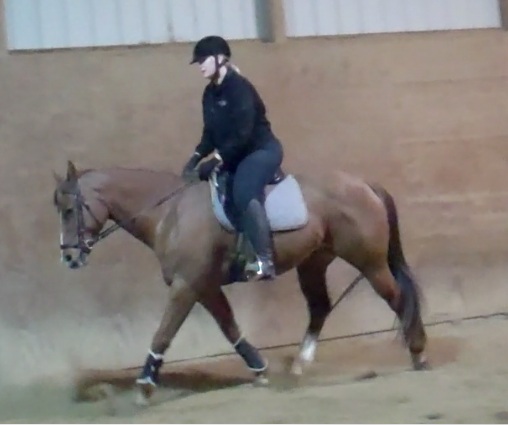
Last night was a variation on a similar theme.  We recently discovered that Oliver’s saddle is bridging and causing discomfort.  Christy made the discovery after Oliver became very resistant toward the end of a ride.   He’s a nice boy and is honest and uncomplicated.   Like Frank’s sourness, Oliver’s resistance was unusual.  After I untacked, Christy looked at the sweat marks on his back, and noticed that some spots under the saddle were quite a bit warmer than others, indicating that the saddle was putting pressure on a couple points on Oliver’s back, rather than evenly distributing the weight across the surface of the panels.   In this case, the first sign that something was amiss came under saddle in the form of unusual resistance.   Last night, Oliver was still sore, so I was unable to experiment with a different saddle to see if that gave him relief.

I don’t think that horses are brats.  Sure, some have behavioral issues and test boundaries, or have training gaps and can be rude on the ground, but I’m not ever willing to say that a horse is exhibiting a behavior simply because it’s ‘bratty.’   There’s always a reason for the behavior, and it’s up to us to be aware of changes, and to look for an underlying cause.  Failure to do so is not only unfair to the horse, but dangerous for the rider.

After all, we *are* training war horses here …

Oliver's first ride outside

I can’t claim the hilarious line that I used for this post’s title.  It appeared to great guffaws on one of the dressage discussion boards I frequent.  But when it appeared months ago while I was still riding Maddie it got me thinking about dealing with a distracted horse.

The historical roots of dressage are in fact based in the military training.  And it’s not difficult to imagine the utility of a highly responsive mount that is forward and willing when riding into battle.   A leg yield may very well evolved as a means to get a better angle for wielding one’s broadsword.

Christy and I talked about this one night when Mads was being a handful.  I had discovered – either by serendipity or accident – that riding a cloverleaf pattern of small (12m or so) loops was a great way to refocus the mare’s attention on me.   This was an important lesson for me – I learned that I had a lot more control over spooky situations than I thought I did.  I learned that if I just sat up and really rode, I could get through the mare’s moments.

There are a few reasons why this works, Christy explained.  First and foremost, horses look for leaders.  When you take charge unequivocally, you assert yourself as the leader, and the horse is very likely be happy to be relieved of the decision-making, and to follow willingly along.   Conversely, when you abdicate the leadership role to the horse, you also abdicate the decision-making to a lower-order animal who thinks that flight is a great solution to most problems.

Secondly, Christy noted that when I sat up and rode, I went from being more passive to being a  very active rider, truly riding every stride.  When I watch Christy, I can see that she’s riding every moment, every stride, constantly testing her connection, bending, softening, giving, taking, half-halting, driving — she’s never just cruising along. Riding every stride is something that I don’t yet do with consistency.  And it’s  a key differentiator between a good rider and one that’s less effective.  When I have had these moments, Christy has told me that I’ve never looked better – that the mare’s back was up, she was rounded and engaged end-to-end.  And I remember how good that felt – how that big mare transformed into a Ferrari, nimble and responsive.

These experiences and conversations gave me tools that I use frequently when dealing with a looky horse, and they came in handy yesterday when I took Oliver for his first ride outside in the outdoor arena.  It was a gorgeous, sunny day, breezy enough to keep bugs away.  Oliver was really good as I mounted and we walked around. However, I wasn’t letting him just dink aroud on a loose rein.  We started with stretching and bending, and walked in serpentines and circles to warm up, and get familiar with the surroundings.   For a while we were alone in the ring (though there is a turn-out right next to the ring, so we weren’t truly alone) and Oliver was a champ.  We kept working on stretching (and I focused on giving giving giving at the right moment) and Oliver really did well.

Bending, and staying on the bit. Good boy!

Some others came back outside just as we picked up a trot.  Oliver decided to do a tiny spook at the mounting block, which was ridiculous, and earned himself a smack on the butt with the crop, and trotting in the deeper sand.  Off we went, circling and working our way around the ring.  Determined to not let him get away with that monkey business, I really rode him – doing lots of bending and flexing, and keeping as on the bit and round as I could.  He tried to look at the mounting block again, but complied when I applied my inside spur and kept the outside rein firm.  He was more worried about the poles in far corner of the ring, so we spent some time working down there, halting near them, and eventually eating some dandelions from Christy’s boyfriend’s hand as we stood in that corner.

My assertive riding  was done with keeping looking and spooking to a minimum in mind – I really wanted Oliver to have a nice, confident, pleasant ride outside – but it came with another benefit.  I got better quality work from Oliver than I ever have.  Hopefully we’ll get some pictures – Peaches was out with her girls and they had a camera.  I’m eager to see what we looked like because it really felt good!

Humpty Dumpty Learns to Ride

Some nice trot work with Oliver

I was channeling Humpty Dumpty last night during my lesson on Oliver, and Christy had to work hard to put me back together again. But she got the job done, and Oliver produced some very nice moments, stretching into contact while almost tracking up, and starting to work over his back.

A key contributing factor to my issues last night was the saddle.  Just for fun, I rode in a Stubben Romanus – an old one.  It’s the opposite of the saddle I’m used to (a Wintec Isabell). Instead of a deep seat covered in grippy suede, this old Romanus was slick leather, with a much shallower seat.  And instead of air-filled panels, the Romanus panels feel like they’re foam-lined and filled with wool flocking.  They’re soft, and solid, and lack the shock-absorbing quality of the Isabell.

Christy’s new saddle is also wool-flocked, and she says she can feel a lot more movement in it than in her old Isabell.  I tease Christy about being the Princess and the Pea – she feels so much more than I do in the saddle.  I think she could read Braille with her butt, frankly.  The same cannot be said of me, but riding Oliver – who I’m getting to know fairly well – in the Romanus was an entirely different experience that my usual ride.  All of a sudden, I was being bounced out of the saddle at the trot.  And while Oliver has nice, solid gaits, he doesn’t produce a lot of suspension. (Yet!)  His trot is pretty flat.  I wasn’t prepared for this feeling and had to spend some time finding my balance.

Finally – with constant adjustments and encouragements coming from Christy – I started to get it together, and regained some semblance of independent hands which had left me entirely at the beginning of the ride.  Humpty Dumpty was patched up.

Something else that helped me get it together was asking Oliver to move forward.  This helped me in two ways.  First, once I got him going forward – and I was keeping him there – his rhythm improved – a lot.  If I let him go at his own pace, he speeds up, then slows down, and then spurts forward again.  Keeping him going forward is easier to ride because it cuts down on the variability in speed – and that variability makes it hard to stay balanced.  Secondly, the more forward, proper working trot is easier to ride from a balance standpoint. It’s easier to ride when you can use the momentum of the horse’s gaits in your favor.

Once I started to resemble someone with a bit of training rather than a sack of potatoes, Christy had me work on inviting Oliver to really stretch into contact, something that has been on my to-do list for a while, but I’ve not made much progress in this area.  She quickly diagnosed the problem – I’ve not been giving enough with my hands.

We’ve discussed “giving hands” before, which is another way to describe following contact, which allows the horse to stretch forward, and can also reward the horse with a decrease in rein pressure for the correct behavior.   I commented that Oliver’s unsteadiness in the bridle made it harder for me to give at the right time.
“And that’s why it’s even more important!” was Christy’s response. And she’s right, of course.  Oliver is new to dressage, and prior to Steph’s purchasing him, he was ridden in  a leverage bit with a tie down. He’ll never learn to go correctly into contact if he doesn’t get good guidance from the person on his back.  I redoubled my efforts, trying to keep my hands quiet and the contact steady.  Christy reminded me to activate my inside leg, using the spur when necessary to enage Oliver’s inside hind.

“Ride the back end, and leave the front end alone,” Christy suggested.  I envisioned side reins, and concentrated on simply holding steady contact on the reins – not messing around with softening or opening or asking for give.  I focused solely on keeping the contact quiet and holding on to the outside rein, and got busy with my leg aids.

The improvement was almost immediate.  I turned my heel inward, applied a little spur pressure, Oliver stepped neatly aside with his hind leg and his neck lengthened.

“Give give give give GIVE!” Christy commanded. “Again!”   We repeated the exercise, and I finally reacted quickly enough to get a nice stretch into contact for a few strides, after which I stopped riding, whereupon he hollowed his back and popped his head up.  You really do need to ride every stride.  We repeated the process several times, going each way.  At the end of the ride, we were both sweaty and puffing.

Oliver is figuring this out – and it gets easier as the horse develops strength and self-carriage. Oliver is just beginning to develop the new muscles necessary to carry himself correctly.   It’s fun and challenging to work through these moments with him, and he’s such a pleasant horse to work with.  It’s going to be a lot of fun to watch him develop!

Fluid dynamics, or the dynamics of fluid riding

This is an awfully fancy sounding title for a blog post, but I had a cool lesson last night that, among other things, involved my first few dinky baby steps of haunches-in and haunches-out. Or, in keeping with the fanciness – renvers and travers.  Say it with me “rhan-vair”  “trah-vair.” Dang, I sound good! (So do you!)

I was riding adorable little Tucker, who is very well trained and sensitive.  Christy was mounted on her newly off the track baby horse Remy, who is just starting to really use his back and is getting the dressage basics down quickly.   From the back of her green bean, as we discussed how aids need to be 1) distinct and 2) contextual, she gave me a short demo of how to move different horse parts around.   Under her guidance, Remy did one step of shoulder in one way, and repated it on the other side.  Then, again at he invitation, he moved his haunches a step in either direction.

As Christy talked through the movements, she highlighted how she uses her aids to block and channel the horse’s movement.  An outside rein can hold a shoulder, a foot slightly back blocks a haunch, while the aids on the opposite side invite, encourage and guide movement. I immediately thought of how water flows.  It finds the path of least resistance.  But water (like certain crafty Quarter Horses I know) is also good at evading the channels humans create for it.  It will take advantage of weak points.  Horses are the same. Indistinct or unconvincing aids open the door for evasions or incorrect movements.    Under Christy’s careful riding, Remy the green bean performed a few strides of both haunches in and out.  As Christy pointed out, you don’t train entire movements.  Horses don’t have magical buttons one can push to generate the renvers, or a half-pass, or a piaffe.  The movements are the sum total of the horse’s gaits + the rider’s aids.  And, frankly, the rider’s aids have a much larger coefficient in the total equation.

I started experimenting on Tucker.  I’ve ridden a lot of shoulder in at both the walk and trot, and can also manage its corallary, shoulder-out.  But deliberately controlling just one stride of each proved to be a lot tougher than I would have anticipated.   And that was the beauty of the exercise Christy had me do.  Because moving the horse’s shoulders one stride from a standstill requires precision and deliberation in order to move just the shoulders, and nothing else.

Tucker and I wove drunkenly around for a few minutes, until I got the feel for what I needed to do.  And then we did a nice little cha-cha-cha.  One step right, one step left.

Then I switched my attention to the haunches. More drunken weaving ensued. And eventually, I got the feel for what was needed to move his haunches one step right, one step left.  Tuck shook his cute chestnut booty.

Maybe I should have titled this post “Horse Hokey Pokey,” … you put your left haunch in, you put your left haunch out.  Wonder what the judges would think of that as a freestyle?  Ha.

Anyway, I digress.   Once I was moving horse parts around with more specificity, Christy had me try these while walking, pointing out the important fact that I need to hone these specific aids, because they are what I’ll use to control shoulders that pop out or haunches that drift.  These are tools I need to add to my kit.

I aced the shoulder in, and got the shoulder out, too.  I was on familiar ground.  The haunches in and out were a different story all together.   I did quite a bit of leg yielding instead of the desired movements.  I took some deep breaths, and concentrated.  I held my outside rein, I softened inside, I asked for a little bend inward, I slid my outside leg back a bit, to move the haunches out.  “There! That’s it!” Christy exclaimed, towering over Tucker and me from her vantge point high up on Remy.  I was beaming.  This was fun, it was cool – but it’s hard!

We experimented a little more and I had a few correct steps here and there.  The lesson really wasn’t learning about how to ride the renvers and travers – I’m far away from that point.  But it’s never too soon to learn how to more correctly influence the horse, and as Christy showed me with Remy, correct aids can generate the desired response – even from an uneducated mount.

Dispersal Sale of Thoroughbreds


THESE HORSES ALL FOUND NEW HOMES AND ARE SAFE.  NEWS OF THIS DISPERSAL CONTINUES TO CIRCULATE ONLINE BUT REST ASSURED THIS HERD IS OK. 

Howard E. Nelson, long time thoroughbred racehorse owner/breeder, passed away on April 8, 2011 after a long battle with cancer. His family is unable to keep his horses, and his entire thoroughbred herd must be sold. All reasonable offers will be considered.
– 2 Yearling Chestnut Colts
– Yearling Bay Colt
– Yearling Bay Filly
– 2 yr. old Chestnut Colt, started training
– 3 yr. old Liver Chestnut filly
– 4 yr. old Chestnut Gelding started retraining
– 5 yr. old ret. Bay Gelding started retraining
– 7 yr. old ret. Bay Gelding ready for retraining
– 8 yr. old Chestnut Broodmare w/foal by
Good Reward
– 9 yr. old Chestnut Broodmare
– 10 yr. old Bay Broodmare
– 13 yr. old Bay Broodmare in foal to Stephen
Got Even
– 15 yr. old Bay Broodmare
– 10 yr old Chestnut breeding Stallion


Ignorance is Bliss

Tonights canter on Frankie.

A while back, I commented to Christy that I didn’t realize how bad my riding was until I had been riding long enough to realize that sad fact for myself.    And while I do know that I’ve improved, I’m also still aspiring to ride a decent Training level test.  Walk, trot, canter.  Nothing too fancy. But a girl has to start somewhere.

And tonight I really realized where “somewhere” is for me at the moment – and it’s pretty close to square one!  The good news is that my confidence is returning.   The bad news is that being a wimp for the last month or so has had a deleterious effect on my ability to perceive what’s going on while in the saddle.  Specifically, I’ve become woefully comfortable riding nothing trots.  Dinky feels like we’re moving out.   I thought I was asking Frank to step out tonight, and he was barely tracking up. Gaah. It wasn’t even a decent working trot. Oy, vey ist mir.  There was one bright spot.  I did get him to stretch pretty well while trotting, which is not something I’ve done much, and so the fact that I was able to get the wiley old schoolmaster to stretch was a small win  for me.

Also on the up side, we cantered a bit, and it was fun, but not too pretty.  I need to start working on putting the horse together at the canter.  Starting with the upward transition, which needs a lot more grace and deliberation.

Oliver trotting easily, and accepting a little contact without resisiting.

I did have a fun and easy ride on Oliver tonight, too.  He was a very good boy, despite the fact they were in today. (It snowed this morning.) (I know!!!) We trotted nice and easy, both ways, and did lots of transition work, because he was feeling fine and fresh and didn’t want to listen to the human.  Trot walk trot walk halt stand no, you’re still standing walk and I mean walk with some purpose boy halt good boy walk trot keep trotting yep all the way down the long side past the spooky corner not a look good boy walk halt stand walk rinse repeat.

Oliver transitioning downward from my seat - I love how his back is up and he's stepping under himself. I'm staying out of his mouth.

The transition work did pay off – we had a couple nice downward transitions in which he didn’t fall onto his forehand, and instead brought his back up, stretched into the bit and stepped waay up under himself.  I hate my position in this picture (nice hunched shoulders!) but included it because I’m proud of Oliver.

Hopefully, I can get back on Atlanta soon – she’s recovering from a bout of back soreness, and I’ll really focus on working the stretchy trot on her – her topline has suffered for her time off, and she needs to work over her back more – and this will be excellent practice for me.

Thank goodness for friends with nice horses and busy schedules!  I’ll claw my way back to competence one of these days.

Green horse, grey horse.

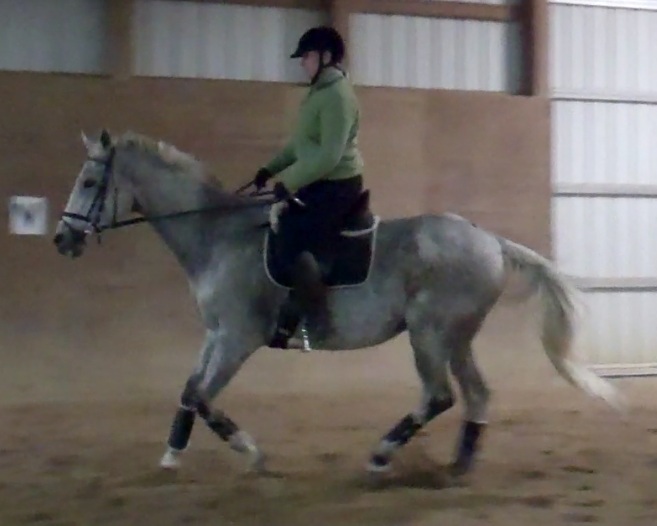
I got a real lesson in contrasts today, riding Oliver and Frank.  Both are total loves, and both are Thoroughbred geldings, but the similarities end there. Oliver is a green bean, but Frank knows more about dressage than me, having been trained to Second Level.

I rode Oliver first, and was hoping that I’d have a better ride than I did yesterday.  Oliver was hell-bent on testing me on Saturday, acting spooky and distracted, possibly because he had a little extra energy since the horses were stuck inside due to some awful weather.  I spent a lot of time growling at him, and it took a while for him to settle so we could really work.  Because he was being silly, I elected to get and keep his attention by doing lots of transitions and changes of direction.   In addition to being silly, Oliver also tried to convince me that he had forgotten everything he knew about transitions downward from my seat. Instead of responding to my half-halts by starting to bring his back up and stepping under himself – as he had been doing sooo nicely last weekend – yesterday he was ignoring the half halt – and the fact that my butt was planted in the saddle – and barreling on.

That would not do.

We did walk/halts (while spiraling in and out) until I got the crisp response I’d been seeking.  Then we moved back into trotting.  I started out just going down the rail, but wasn’t getting a satisfactory response.  Oliver had what Steph calls “OMG ears” and was actively looking for reasons to spook .   So I started riding figure 8’s – little ones at one end of the arena, and then larger ones, and then long flat ones, bisecting the arena down the centerline.

Things got better immediately, because I was keeping Oliver focused on me.  We worked on walk/trot/walk/trot transitions and he did pretty well.

Today was a different story.  Oliver was a total star.  We had our best trot work to date – I got him to move out, and we successfully completed laps of the arena trotting nicely both ways.  He was relaxed and just rolled along.  I also asked him more insistently to reach down, and while I wouldn’t say that he was round, he wasn’t wildly inverted.  I was proud of Oliver, and told him so!

We also had some very nice transitions from my seat, from trot to walk, and from walk to halt.  We worked on those while we also worked on steering – around the mounting block, figure-8s all over the place, you name it – and Oliver was a champ.  I was so pleased with him today!  I rewarded him with a hand grazing session (on top of lots of cookies) before I turned him back out to lounge in the sun.

After gulping some water, I went and fetched Frank.  My old buddy was feeling really good today, and surprised me by starting out at a smart pace when I picked up the trot after we warmed up.  I let him roll, hopping into two-point and getting a feel for this different feeling gait.  It has a lot more motion than the jog Frank offers when he’s feeling creaky.  He was getting a little strung out, so I decided it was time to help him out.  I started posting, took a feel on his mouth … and discovered that he wasn’t going to give it to me.  If I wanted Frank to round, he was going to make me work for it.

I was posting out of a half-seat, to stay off his back, and I increased my post, to make more “room” for a bigger stride.  I also got busy with my inside leg, engaging my core and making a point of holding my outside rein and asking Frank to soften with the inside rein.  Within a few strides, I got results.  Frank took the contact, stretched, and the trot started to feel a lot better. I tested my contact by seeing if Frank would follow my contact downward – if he didn’t, that would tell me that he was just going around with a fake headset. I invited a stretch, and got it.  I had true contact. Yay!  I could feel myself holding him between the inside leg and my outside rein. It’s been a looong time since I felt that!

This was the first ride in a log time I that I had generated proper contact.  As we went around the short side, I decided to throw in a circle to give another rider some room to maneuver.  And at that point, I got busted by the former school horse, who didn’t feel I was using my inside leg sufficiently, and ignored my inadequate request to do a 20 meter circle.  Crap!

I gathered myself and asked for another circle as we approached A.  it was ugly, because I forgot to close my fingers around the outside rein as I applied my inside leg (with more vigor this time.) Frank waggled his ears at me (I swear he did!) as he popped his outside shoulder out. Crap!

I sat myself up, made sure my feet were indeed where they belonged (at the girth, not curled back to Frank’s flanks) , held that damn outside rein, turned my left toe outward and deliberately applied my spur while also giving Frank a tap tap with my whip.   I got the “yes ma’am” response I sought, and we circled nicely, with decent contact and a quality trot.

We went down the long side, and as we headed into the short side, I gave Frank a little half-halt, to bring him more into hand.  We kept the little trot long the short side, then took a diagonal, which went quite well, since I 1) half-halted again down the short side and 2) looked where I wanted to go and 3) actually balanced the horse between my inside leg and outside rein, for a change.

We did another nice circle at C, with no shoulder popping or ear-waggling.  And then another down the long side for good measure.

I was panting and sweating – partially because I was dressed a bit too heavily, and partly because I’m in horrific shape after having been sick on and off for months.  But it felt great to really ride, even if Frank was channeling Christy and busting me when I got sloppy.  We cooled out, and then went to graze.

Two totally different horses, two totally different rides, and a completely satisfying day!

Two rides, two results.

I had two rides on Oliver recently – one on Saturday, and one tonight.  On Saturday he was unfocused and a bit tense, but I did very cruelly ride him right as the other horses were being brought in and fed, and Oliver registered his discontent by doing his best to ignore me, calling to other horses, and keeping his ears forward, pointedly not listening to me.  He was a little squirrely at the beginning of the ride, but I put him straight to work, and we ended up having a decent ride, but  he never truly relaxed for me.  Despite his total unhappiness with my delaying his dinner, we did book one important accomplishment –  I got him to spiral in and out, at the walk, in both directions.  He’s beginning to understand leg aids, and best of all, I was able to get him to move alway from my right leg when circling right.  So that was a definite win.

Tonight I showed up after dinner, and Oliver was back to his mellow self.  We had a very nice ride, and worked on a number of things.  First, as we warmed up, I worked on steering correctly – from inside leg and outside rein.  He’s not perfect, but he improves with each ride.  I rode shallow serpentines and figure-8’s and at the end of the warm up, he was turning nicely for me.  I went back to this exercise mid-ride during a walk break, and also got  good responses.  This is good progress.

We also did quite a bit of work trotting.  I had my spurs on tonight, and warmed up carefully, working on keeping my leg in position with my toes forward, and my foot at the girth, not curled back.  I did the balancing exercises that Christy has me working on, and was pleased to find that Oliver held a pretty steady rhythm for a change, and he is also accepting more contact from me, and stays relaxed.  This is also some nice progress.  He used to bear down and speed up whenever his rider touched his mouth.

However, I noticed that as we worked, he started to speed up randomly, often at a moment when I was giving him little or no real input.  Ha!  Busted! I think he uses speeding up as an evasion, so whenever he did that, I sent him forward and kept him there.  We just got a couple loads of sand in the arena, and the footing is deeper – and takes more work.  He started to tire and wanted to slow down, but I kept him moving forward to make the point that the human – not the horse – sets the tempo.  We did more serpentines and figure-8s while trotting, and lo and behold, the evasions stopped once he was convinced that I was paying attention.

We finished up the ride working on transitions.  His downward transition in particular isn’t as crisp as I’d like to see – he really needs to transition from the seat.  I started by saying “whoa” while giving him a big half halt with my seat, and closing my fingers on the reins, which increased the contact.  Gradually, as he got the hang of it, I dropped the “whoa,” and for the last few, I was *almost* able to abandon the reins. Almost but not quite.  However, he made good progress, and I could feel him stepping nicely under himself when I half-halted him, which is exactly the correct response to this important aid.  Good boy, Oliver!

We finished up working on relaxing and stretching. He is hard (for me at least) to stretch, and he’s still not working over his back enough to speak of – getting him to stretch into the bit is the next thing on my mental to-do list for Oliver, behind relaxing, building the strength to move rhythmically and steering correctly. At this point, I’m happy if I can get him to stretch into a decent working walk – on my terms and at my invitation. He likes stretching, but does it on his own, almost rooting (and makes  me wonder at times if he’s using this unbidden behavior to evade.)  He relaxed, and stretched a bit, and then halted promptly from my seat.  He earned his cookies tonight!

Love it, hate it

A key component of rebuilding my seat (and my confidence) involves balance. Christy is focusing on this in our lessons, and I’m spending a lot of time out of the saddle – standing, hovering in a half seat, and working in two-point.   And I have a lot more to go. Christy reminded me of an article in last month’s Dressage Connections about the repetitions required to establish new habits and muscle memory. The number is in the tens of thousands.

Argh. My leg is curling back, and my upper body is tipped forward. I must fix this.

I had a fun ride last night on an adorable little Quarter Horse named Tucker. He’s an exceptionally fancy QH, with nice gaits and lots of training. Tucker is mirror, reflecting his rider’s aids, and because he’s got so much training, he notices every message his rider sends – intentionally or otherwise. I can feel how off my timing is when I’m late on softening, or when I respond to slowly to one of his lightning quick little evasions – popping a shoulder out here, a hip inward there.

Tucker is a fancy little fellow.

I was sorely, sorely tempted to push all the buttons and ride this fun little horse to the best of my ability.  But the ride wasn’t pretty, and Christy pointed out that my aids probably weren’t as clear or well timed as they could be.  Oh, and by the way, my leg was curling back again.  So instead of pushing the fun buttons, I went back to cultivating a balanced seat.

Christy has me doing three exercises that are brutal, and brutally effective.  All tax the squishy muscles I need to develop, none are terribly fun, and all take direct aim at improving my lower leg position and stability.

Post – Stand – Post

The first exercise Christy has me use (and return to immediately if things go south) is posting two beats, and then standing two beats, post two, stand two, rinse and repeat.   It’s not terribly fun for me because when I stand for two beats, balance is a real challenge.  However, building the feel for balance is one of the key outputs of this exercise.  And the fact that as I stand, my leg invariably is in (and remains in) the correct positi0n is also helpful.   This is an exercise I’m going to be doing a lot, on every horse I ride.

Hover Post

The next exercise Christy has me do has much the same effect as the first, in that it tests my balance while building a steadier lower leg.  She has me ride a posting trot, but doesn’t allow my butt to touch the saddle.  I drop into a half-seat instead of sitting all the way down.  For extra fun, Christy will have me mix the two exercises.  I’m grunting and swearing by the time I complete one lap.

The lower-leg-curling habit is most evident when I want to use my leg.  I need to get it through my head that using my leg does not mean trying to reach back and poke the horse in the flank – it means applying pressure (or the spur) with my leg at or near “home” position – at the girth.  Using my leg correctly and building muscle memory is something else I need to practice, practice and practice some more.

Stand & Steer

To work on getting the feel of using my leg while keeping it in the correct position, Christy has me stand, and steer the horse from my leg.  I can’t curl my legs back when standing – this is a genius little exercise that I can’t evade.  As I stand, I experiment with using my inside and outside aids.  There’s absolutely no question in my mind that my leg aids are much more clear and distinct when I do this, because I get crisp responses from all the horses I ride – even Oliver, who has no dressage training to speak of.  As a bonus, this exercise requires balance, as well.

Riding Tucker was fun, and will only be more so when I recapture my ability to ride with a modicum of balance and precision.  In the meantime, I’m practicing, and recalling what George Morris said about building new habits: first it’s hard, then it gets easy, then it becomes habit, and, finally, it’s beautiful.  For what it’s worth, I’m firmly in the “hard” stage!

Close your fingers, for the love of God!

Break it down

A few posts ago, as I bade Mads farewell, I mused out loud about how doors open when others close.  At that moment, my time with Maddie was ending, and I wasn’t seeing very many other doors to walk through. Happily, a new and unexpected door has swung open.  With no horse, and no real agenda at the moment, we’re using this time to make me a more well rounded rider, adding new skills to my toolbox and instilling confidence as I build competence.

Through the kindness of friends (and their busy schedules at work) I’ve been given the golden opportunity to ride a variety of horses.  I’ve handed myself over to Christy, and we’re rebuilding my seat, borrowing some theory and practice from the hunter barns in Christy’s past, where riders rode all manner of horses – fresh off the track OTTBs, sour and crafty schoolies, hotrods and dead heads.  This is common practice – and it’s good practice.  You ride what you have, and you ride over poles, grids and courses.    The riders are all adept at riding in a balanced half seats, and rely on their balance – not the tack – to stay aboard when things get hairy.

Christy and I talked about this in the aisle a few days ago.   She had me stand with my legs apart and knees bent, with my back flat, hips behind me and shoulders forward – in “two point”.   Then, from there, she had me move my upper body around, to see how far I really had to move before I started to throw myself off balance.  It turns out I have quite a large range of motion when crouching in two-point in the aisle.

Then, she had me straighten up, adopting the posture of a dressage rider – knees slightly bent, standing erect.  She challenged me again to move my top half around, to the point were I started to become unbalanced.  My range of comfortable motion was much less.  When you’re upright, your body acts as a lever.  The only way you can hope to save yourself and rebalance is maximally engage your core muscles, and they better be super strong if this is going to save you from going ker-splat.

This was an illuminating little exercise.  We moved it to the saddle over the weekend, as I described yesterday.  Tonight, I took a lesson on Oliver, and we went another couple steps. I rode with my stirrups shorter, which really does feel like hell, and in an illuminating exercise, Christy had me work on bending and steering him with my legs, while standing.

It worked surprisingly well!  First and foremost, standing forces you to keep you leg under you.  I need to build muscle memory and break my bad habit of tucking my leg back and curling my heel up when I want to put leg on the horse.  I have to keep that leg at. the. girth. while I apply leg.  And Oliver really responded to what had to be a much clearer and more distinct aid.  He surprised me by neatly stepping under himself and giving nicely as I asked him to bend.    We were starting out going to the right, the direction in which I find Oliver to be resistant to correct bending – he wants to lean inward and I usually have to work hard to move him out when going that direction.  But during this exercise, I got the nicest bend and response from Oliver I’ve had to date.  I was thrilled!

We picked up the trot, and here’s where things always get interesting with Oliver.  He’s a newbie to dressage and hasn’t established a nice rhythm yet.  He goes fast, he goes slow, he strides out, he almost drops to a walk, he hops forward again.  His speed setting is locked on “wildly variable.”  I posted, but kept out of the saddle, going no further than a half-seat on the downward beat.  The variable speeds of Oliver’s trot were are a real challenge to stay with, but it’s great practice for me.  I hopped up into two point, trying to keep my weight out of the stirrups.  Oliver sped up. Oliver slowed down.  I adjusted and didn’t fall off.

When I had about had it, I sat on a down beat, sat up straight, and asked Oliver to walk, principally from my seat.  He’s getting better at listening to this, and the response came quickly.

Christy pointed out that because I had my legs correctly under me when I posted, when I sat, I was able to sit deep and be effective.  She made the link for me between that balanced seat I had at that moment, and the balanced seat that saw me safely through spooks and equine naughtiness.  The foundation of this important tool is correct leg position.  This was a great illustration of this principle.

We worked in the trot in both directions.  In addition to staying with the uneven rhythm, I also worked on gently bending Oliver and steering correctly from my outside rein.  I swear, if there’s one thing I hope I can help contribute to Oliver’s education, it’s better steering!  But he actually did really well tonight, and he’s a quick study. I got a couple little leg-yield steps here and there – he was stepping out from my leg correctly and giving me some nice bending.  We then did some figure 8’s and by the end, I was able to ask nicely and receive a reasonable response from the horse.   I was very proud of Oliver – he’s a smart one and learns quickly.

This was an illuminating lesson, because I was able to practice what Christy and I discussed in the aisle this weekend, as we crouched in a semblance of two-point and discussed balance, velocity and physics.  Set’s face it.  The tackiest leather, the stickiest full seats, the biggest blocks – all are of little use when hell really breaks loose.  Your ability to stay balanced is what will save your bacon.

Case in point: Seconds before I rode that crazy thunder-induced bolting spook a few weeks ago, I quite literally said to myself “green horse, weight your heels,” and had just stretched down into my stirrups when he spooked.  It must have been Divine intervention, because know the fact that I started from a balanced seat contributed mightily to my success in riding that spook long enough to dictate my dismount.

So the next month or two will be interesting.  It’s going to be a real challenge for me but I’m excited about becoming more well-rounded and an overall better rider.   There is one problem, though.  And it’s Christy. I don’t like the way she looks at me when she’s thinking – it’s how a lion sizes up a baby gazelle – and I can see her wheels turning.  Like tonight, when I was watching Atlanta’s owner Cathy finishing a fun ride by cooling out bareback.   Atlanta, a nice round Hano, doesn’t have razor withers or a protruding spine.  One could imagine riding her bareback with a degree of comfort.  I said as much out loud, within Christy’s ear shot.  Her eyes narrowed as she thought.  She looked at me.  She looked at Cathy and Atlanta.  She looked back at me.

I am so dead.