Why? Because I can.
November 22, 2011 1 Comment
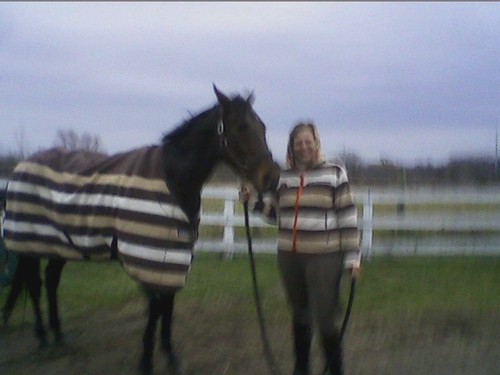
It’s a blurry cell phone pic but I love the optical illusion of my jacket and the fence. Almost as much as I love Horsewear’s striped fleece, but we’re not discussing that at the moment.
The training journal of a re-rider learning dressage
November 22, 2011 1 Comment
It’s a blurry cell phone pic but I love the optical illusion of my jacket and the fence. Almost as much as I love Horsewear’s striped fleece, but we’re not discussing that at the moment.
November 21, 2011 6 Comments
Within the last month or so, I feel like I’ve finally started to really, truly, legitimately have moments in which I’m riding a connected horse, back to front, in good balance – for the first time, ever. While still fleeting, I can recreate these moments fairly consistently on my own, without Christy micromanaging my every move which is what it took to get me to this point.
Well, that and a lot of riding – five to six days a week, for four years. Along the way, I also read a variety of books, educated myself going to clinics and shows, and (most importantly) am getting myself into better, stronger physical shape. Despite these efforts, I am still schooling training level, meaning that I’m probably lacking in the natural talent department (though Christy does note that I’ve started over three times, twice with horses that were very green to dressage, so I guess I feel marginally better.)
That said, I have progressed from simply godawful (no steering, no seat and no clue) to being able to put together a correct Intro level test, and over the last year (with Maddie) starting to delve into some more interesting things, like trot lengthenings and leg yields. I’ve also developed better feel, timing and a certain degree of instinctive responsiveness.
However, that work on Maddie – despite the fact it represents what was technically my most “advanced” work – pales in comparison to the awakening I’ve had over the last month. And after attending the Dressage Through the Levels symposium with Steffen Peters and Janet Foy this weekend, I think I can finally elucidate what I’ve experienced.
Simply put, generating correct gaits and (at my level at least) movements is easy – dead easy – when the rider is the correct, balanced position, and the horse is connected.
Mind you, getting to that point of correct balance is a bitch, at least for me. But during those fleeting moments when I’ve been properly aligned, I’ve felt some amazing things. I’ve felt Derby’s walk transform from a pokey shuffle into a fluid, rolling, swingy walk with overstep. It feels unlike any walk I experienced on Jag or Mads, and Maddie was a much fancier horse. I’ve felt him pushing from his hind, over his back, and into my hands at the trot, and I’ve felt that trot come uphill. I’ve had the odd lovely, quiet, prompt, balanced canter depart, and a couple days ago I felt his back come up when we were cantering, and almost fell off from surprise. I’ve done a leg yield that felt like floating, with the horse moving away from a quiet aid.
When I’m in that sweet spot, I don’t have to even think about muscling the horse into a movement. I don’t need to kick kick kick to get the work done – I can whisper, and he hears me. When I’m there, he’s there. Once I’m there, it’s easy.
When I’m not there, it’s hard. I struggle to keep the horse going and bending, and invariably, as I’m trying to muscle him into one thing, something else goes wrong – a haunch drifts in, a shoulder pops out. I’m getting better at recognizing those moments and responding correctly by fixing what’s wrong with me, rather than trying to correct the horse. Because when I’m out of whack, I can’t blame the horse when impulsion slows or a haunch drifts. What he does is in response to the ride I’m giving him at the moment.
At the Foy/Peters symposium, the second day started with a session on rider biomechanics. It wasn’t quite what I expected, but was marvelously illustrative nonetheless. Two lovely riders on lovely, well trained horses were the “victims” for this session. I say ‘victims’ because Janet Foy instructed the riders to adopt a variety of poor postures, enabling us to see the effect unsteady hands or uneven weights in the stirrups or posting with all your weight on your toes had on their horses. She emphasized the point that in most cases, the problem with the movement in the test was the direct result of a rider inadequacy – not the willful behavior of the horse.
So now I’m doubly aware of those easy moments that signal I’ve found the sweet spot. Challenge is to figure out how to live there, not visit infrequently.
November 15, 2011 2 Comments
I’ve been through the experience of rebuilding my seat – and requisite habits and muscle memory – enough to know intrinsically that things *will* get better. And already, I’m finding my “sweet spot” more quickly – almost automatically even – rather than requiring a full-body position re-org to get there. However, I was convinced I had forgotten how to bend. “We have to work on this!” I insisted to Christy, convinced that I had lost this basic skill.
Happily for me, Christy worked us through some serpentines that suggested the real issue was the fact that I wasn’t riding the bend, I wasn’t asking for it. But when I concentrated and rode it, I was able to do a decent serpentine with a decent quality trot.
Mind you, here’s what was going on in my head as we went into the first loop:
“Leg ON more trot now hold with abs HOLD ABS half halt no REALLY half halt hold onto the dang reins for the love of all that is good and holy *ELBOWS* thumbs closed, there you go, good girl ABS ABS FOREWARD for pete’s sake CORRECT TAP TAP TAP WITH WHIP okay, that’s forward, Good boy! now inside leg to outside rein come ON use that inside leg good good straighten a couple strides new inside leg now FORWARD ABS hold that rein….Wait, what? What’s wrong? You forgot to breathe? Okay then, breathe!”
You see my problem. It’s hard to keep all these balls in the air, because they aren’t yet habits. Remember George Morris’ “hard easy habit beautiful” construct? Well, I am firmly mired in “hard.”
Christy did spot – and fix – a key problem last night. The bend to the right was easy, and acceptable. The left? Not so much. I am a bit stiffer in that hip, but a technique she gave me really helped immensely – and immediately. Christy directed me to imagine that I was pushing that left hip toward my right hand. That did the trick. By lifting and pushing that hip toward my hand, I was able to give a clear and correct aid, rather than just nudging hopefully (but inconsequentially) with my leg. Can I just say that I love the fact that I have a trainer who is this picky, and can see these little things, and knows how to communicate the fix to me in a way that it actually sinks into my cluttered brain?
We did some work at the canter, and did produce some decent work. Importantly, I’m feeling more balanced and able to influence the horse from my seat at the canter, riding that gait, in effect, more purposefully. This means I’m going to have to start multitasking at the canter – and riding into the transition with more balance – and more contact. This is next on the list of concurrent tasks to manage. I’ll let you know how it goes!
November 9, 2011 2 Comments
Well, the crappy weather is upon us, and I donned my favorite cold weather britches tonight (Irideon Wind Pros), wool socks, turtleneck, fleece, jacket and stocking cap and headed out. The horses were stuck inside for a second day, due to the heavy rains that have turned their paddocks into seas of mud. Derby was really happy to get out of his stall, to say the least, and the rides we’ve been having lately are great motivation, even on awful nights such as this one.
The walk quality for the last couple days has been really good from the get-go – really powerful and swinging – which I attribute less to my riding and more to the fact that Derbs has been cooped up and has a lot of energy. I’m taking advantage of it, though, and am using the walk as a foundation for getting him really through and into the bridle. The contact I’m getting is so strong, and even – he’s really pulling into the bit, and I’m feeling his back under me consistently. Really consistently. I’m even starting to play with lateral work at the trot – shoulder-in and leg-yield – movements that are way head of the game for us, but helpful in engaging (and strengthening) his hind end.
I attribute our ability to generate shoulders-in and leg-yields directly to the this new-found solid contact. *This* is what a connected horse feels like! I had a few glimmers of this with Maddie, but wasn’t able to hold the feeling. Derby and I, on the other hand, have been able to hold it together pretty well lately.
We also have a fantastic free walk – Derbs will follow the reins down to the end of the buckle, and he’ll stay there. We’ve also experimented with stretchy trot, which is also growning pretty reliable. I can pick him up, stretch him down, rinse and repeat to my heart’s content.
It’s such an elementary thing but I know – from my own experience and from watching the Dover clinic – that contact is fundamental. It’s not a game, as some would have you believe, and it’s not an ephemeral state. It’s physical, it’s feedback, and it’s truly something the rider doesn’t take. The horse has to give you contact, and the rider has to create the environment that encourages and rewards the horse for doing so.
November 6, 2011 1 Comment
Just when things were getting really good, I have to take a (very) short break from riding. Short, as in two days. And really, I’m only “losing” one day, since Derbs gets his fall shots and dentistry on Monday, and would have the day off due to the vet work, whether or not I was in town. That said, the day is dawning sunny, and promises to be warm (for November.) It would be an awesome day to ride, but I’m on the way to the airport this morning.
While I don’t want to give the impression that all of my problems are solved – far far from it! – it has been a gratifying week. The work we did in my lesson (see “Tightening the Screws“) awakened me to the fact that I have been letting Derby steal rein – when I’m not just flat out throwing the reins at him – and I was putting him on his forehand. Since that lesson, I can feel when this is happening, and while I still need a few strides to organize, think, take hold, half halt and close legs and engage core and hold contact and go now, horse! go! …. the good news is that I can get remedy the situation.
Our last couple rides have been really nice. On Friday, the highlight was a nice, relaxed, rolling canter that felt balanced, and that I was able to influence. Yesterday, the highlight was more canter work – transitions on a 20m c ircle. We had a couple crap transitions that I knew were my fault, not Derby’s. So I put him on a circle, got a nice, balanced trot going, and then rode some transitions. As long as we stayed organized, they felt effortless. Clearly, I need to work on managing and maintaining quality and balance through and between gaits – obviously, since this is really kind of a key component to a successful test. I’m really happy with the quality of the gaits recently. My rides this week have been really fun – it’s tough to get on a plane to leave, even if it is just a short trip.
November 4, 2011 4 Comments

Christy has figured out an important fix to my position, and we’re working on developing my muscle memory for keeping my core really engaged, my legs softly back, my calves gently against the horse, my knees relaxed, my hips angles open and swinging and my leg long and draping. I’m definitely in the “hard’ phase of the “Hard, Easy, Habit, Beautiful” progression described by George Morris. It’s worth it, though. When I do manage to balance myself and get my knees off the saddle blocks, Derby’s gaits improve dramatically.

We might have been happy with this moment a month ago, but not now.
Tonight Christy upped the ante on me a bit, asking me to hold my contact and really push the horse into the bridle from behind, creating more uphill movement. In doing this she took dead aim at a bad habit of mine – I tend to give the reins when the horse pulls into contact, and I wind up dumping him on his forehand.
Here’s a stellar example: You can see clearly here how I’ve totally pushed my shoulders forward and straightened my arms, so even though my fingers are closed, I’ve given him a ton of rein. Derby has eagerly accepted, and has gone onto his forehand.
So while the trot quality is nice and the contact is solid, I’m failing miserably here to give Derbs the support he’s seeking, and I’m losing the opportunity to gather power an energy when I give away the reins like this.

Correcting ourselves and getting the horse off his forehand
At this point, Christy was most likely howling “Hold your reins! PIN YOUR ELBOWS TO YOUR SIDE!” I scrambled to put things back together. First, I half-halted, bringing my elbows back to where they belonged as I rebalanced the tolerant creature beneath me. I sat myself up straighter, and opened my hip angles, and started to lengthen my legs again by dropping my knees. You can see how the changes I made in about 3 strides have improved Derby’s carriage.
Once I had fixed the big issues, I was able to ask Derby to move forward, while (this time!) holding the dang contact. I’m still struggling with staying straight (and keeping the hip angles open) as you can see, but overall, the balance was much better and I finally, finally, finally got him fully connected, producing the nice moment you see at the very top of this post.
It’s the most amazing feeling, and gives me hope for our future in the ring!
November 2, 2011 Leave a comment
I consider the George Morris clinic I audited last fall to be one my top 5 equestrian experiences. He is an amazing horseman, period.
His emphasis on the importance of correct fundamentals -correct bend, working the horse over its back, suppling and use of the outside rein – also made an impression on me. Because in his sessions schooling high level jumpers, he talked about dressage a lot – directly and indirectly. Christy echos him when she says that dressage can improve any horse, and any rider. So does Liz, when she says that she wouldn’t be able to have Cloud out on the trails if she didn’t have the tools she acquired learning dressage.
Dressage – with its foundation in the cavalries of yore, and with its application in the jumper ring and elsewhere today – is about pinpoint, precision control of every aspect of the horse and rider. It’s about immediate response, and cultivating balance and power.
The video above, of George Morris having a fun ride on Catherine Haddad’s fantastic firecracker Winyamaro, is so fun to watch. Obviously, George knows his dressage and is an extremely sensitive and tuned-in rider. And Winyamaro is a fully fledged GP horse, and he’s a hot one, right up George’s alley. Piaffe, passage and a line of 16 one-tempis are no problem for George. I’d love to see him in a dressage ring! Who’s with me?
Catherine Haddad & Win hauling in a 74.8% in the Kur at last year’s World Cup:
George Morris suppling a horse (and doing quite a bit of basic dressage along the way)
October 30, 2011 1 Comment
A nice moment with Oliver
My farrier looked at Derby on Friday, and assured me that he wasn’t re-abscessing in his left hind. He had some minor remaining bruising but said that he was fine to ride. So, after a few days off due to my dithering and uncertainty, we tacked up and had an easy ride. Saturday I asked him for a bit more, getting a little resistance that I was able to overcome. And today, we did even more, and Derby was lovely.
I’m starting each ride with good walk work, concentrating on getting Derby into the bridle. However, I’ve decided that the warm up routine that works best for him is this: forward walk (no real lateral work) followed by a lap or two of trotting on a loopy rein to during which he sneezes and clears his pipes, then on to good solid forward trot – and then the work can begin. Lateral work at the walk is best done during walk breaks – which really aren’t “breaks” at all.
Anyway. Today Derby was clearly feeling pretty good and we got some fantastic work done – he was really round, his back was up, and he was really moving. Liz was hanging out, waiting for Cloud to dry after a bath, and she watched us, offering some feedback here and there and some nice compliments. 🙂
What was so nice about today is that I was really able to get Derby into the bridle, and once he was there, he felt so solid and responsive. I was able to regulate his stride easily, and I didn’t have the issues bending him when I had that good connection that I do when the contact is tenuous. He was also very forward, moving out very well and really covering the ground. It felt simply marvelous. We did shoulder-in both ways, and some decent leg yields too. I was especially pleased because I hadn’t been feeling great prior to the ride – but needless to say my mood was elevated and I felt pretty good when I dismounted.
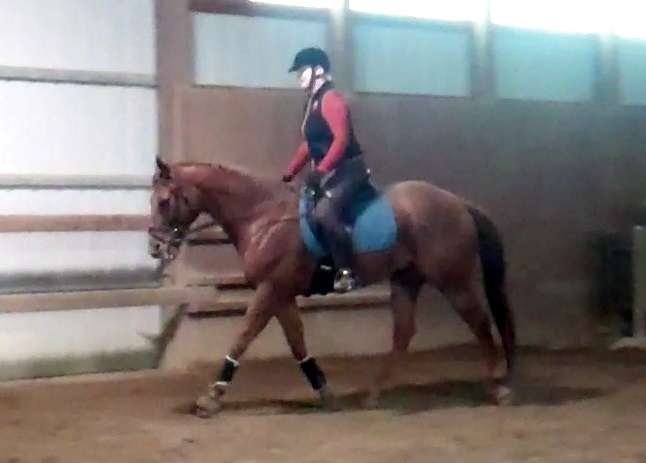
I wish I’d had a reservoir of energy today, because I just didn’t have it in me to ride Oliver, with whom I’ve been entrusted this weekend while Steph is away. For fun, I took a lesson on him yesterday, and got a real workout in riding the horse forward into contact. With Oliver, I’m trying to give him a longer rein, and then invite him to move forward into that contact, filling up the slack. This is tough, because he doesn’t move forward readily, and he likes to go around with his head up. Really up! I was hoping to do some canter work with him, but my agenda quickly refocused – first and foremost I wanted to get him to relax, and reach for the contact.
As you can see from the video clip below, we got there, but I literally had to manage almost every stride, putting leg on, on more, softening immediately to reward the correct behavior, and continually sending him forward and inviting him to fill up the the reins. I want him to be the one pulling on the reins, not me.
It was fun to ride Oliver again – he’s got better gaits than Derby and someday is going to be a very fancy fellow indeed. I’m going to bed early tonight, and hope to get another ride on him in tomorrow night, before my lesson on Derb. My ride on Oliver yesterday gave me some ideas, and my ride on Derby today reinforced the feelings of gait quality and contact. I’d love to be able to replicate that feel on Oliver.
October 27, 2011 1 Comment

Even though Emily Wagner has turned her head to talk to her coach, Wake Up is still round, on the bit and pushing powerfully from behind. This is an enviable walk.
Man plans, God laughs, and horses are in cahoots. After our breakthrough rides last week, it appears that Derby might be re-abscessing in his left hind. He’s sound walking but he’s really protecting that foot when trotting. I’ve recommenced soaking and wrapping. This hiccup is a real disappointment, but things happen for a reason. The horse needs to keep moving. So we’re walking.
This is a perfect opportunity for me to practice something I heard Robert Dover say over and over and over again in the clinic. “Walk perfectly,” he insisted, adding, “Everything is related back to walking well. You have to get the basics of being correct in the bridle. You have to be on the aids at the walk in order to be on the aids everywhere else.”
Christy often asks me “Is this the walk that has a canter in it?” and often my answer is no. Most of the time, frankly, I phone in walking. And that’s a bad habit. I’m letting the horse relax fully when walking, often dropping the reins.
Dover took the idea of the-walk-that-has-a-canter-in-it further, describing collected walk as being a state in which anything – any gait, any movement – is possible. He spoke frequently about how collection is additive – you add energy, rather than taking it away. While collection is absolutely months and months away for Derby and me, building energy isn’t. Listening to Robert, I became more fully aware of how important creating that energy is. Without forward energy, you don’t have contact, engagement and roundness. Without forward energy, you don’t have dressage. Period.
So I decided to spend this time when we’re in walk only mode working on walking perfectly.
As I warmed up last night, I made a point (as I always do) to find my seatbones, and balance myself from there. I know I”m doing it right when Derby abandons his shuffle and strides out properly. After I found that moment, I next asked him to stretch into a free walk. It didn’t happen, due to the fact that I had no real contact. I regrouped, balancing myself, picking up contact, encouraging the horse to stay forward, and then getting a little stretch. Just a little.
Hmmm.
I decided to try an exercise Christy had me do with Maddie that helped me get the mare onto the bit. Walking, I flexed Derby left, and then right, from my seat, holding the reins quietly. This was better but still not great.
Hmmm.
While I thought I stood up in my stirrups, practicing balancing myself standing straight up. Derby plodded on, I held myself in balance standing with loop in the rein, and thought and thought.
As we walked around the arena, I could feel Derby’s walk changing. His back started to swing, he was pushing from his back end, and I could feel his stride really lengthening. This was a niiice walk. Really nice.
Gently, breathlessly, I sat back into the saddle. Derby’s stride immediately shortened, losing energy. Okay, I had an idea what was causing this – my hip angle. I had worked on this before. Taking my legs off the horse, I felt my seatbones. Keeping my legs off the horse, I followed his motion, and the stride started to lengthen. All right. Progress. I picked up the reins, closed my legs …. and lost the energy again.
Dang. I decided to seek professional help. After I dismounted, I told Christy that I wanted lessons after all, and that we were going to work on the walk.
So tonight we did just that. I told Christy all about last night. She reminded me of one key thing I had forgotten to do – to emphasize keeping my hip angle open while in the saddle. How to achieve this? We repeated an exercise she had me do previously – after finding my seatbones, she has me lengthen from the hip, being sure to unclench my knees, and with my calves softly against the horse. This is Christy’s way of getting me – sore knees, tight hips, weak ankles and toes that want to point straight out to the sides – to relax and soften my legs so they can drape around the horse.
From there, she reminded me to open my hip angle, by making a point of sitting tall, lifting my chest. It felt like I was leaning way, way too far back. But no, despite the exaggerated feel, Christy assured me I was sitting straight.
The change underneath me was instant and significant. With my hip angles open, Derby strode forward nicely. This was progress. Christy had me pick up contact and close my legs, encouraging him to go even more forward. He trotted off (though his back was up and it felt pretty nice!) but that wasn’t the result we we intended. Christy had spotted the problem, however. In that moment, I hunched my shoulders forward (I’m told) which totally weakened my position, causing me to lean my body forward. We tried it again, this time with emphasis on holding the reins (like side reins, Christy suggested) and keeping my shoulders still and back.
At that point, I had an ah-ha moment. Derby was striding forward and pulling strongly into the contact. This is what I had been seeking! This was the nice, connected walk I had admired in others. This was the sort of walk that had a canter in it. Or a halt. Or, for that matter, anything.
I worked on developing that feel and memory during my lesson. I lost the nice walk, and regained it, over and over. Tomorrow night I hope we’ll add some lateral work. We made some real progress tonight.
October 23, 2011 1 Comment
Derby and I tagged along with Liz and Cloud today for a trail ride. It was a beautiful day and Liz’s hard work with Cloud has really paid off – he was a relaxed lead horse and she was able to give him a loopy rein. Derby was really good too, navigating the little ditch behind the paddocks, narrow alleys between trees, a swale with tall grass and the rocky edge of a cornfield with no problem. However, as we approached the road – a small country highway that we need to walk along for about a quarter mile to reach the trailhead – things started to fall apart. The dual culverts we have to face drew a look, a sidestep and a snort. A fleet of motorcycles passing didn’t help matters. Derby became very tense. Up until that moment he had been perfect, but now I felt like I was sitting on a powder keg.
Sheepishly I asked Liz if we might turn back. I will admit to having a bit of a phobia about the road and between Derby’s tenseness and my own trepidation, I didn’t want to push it. Even though Cloud was being totally perfect, Liz indulged me and back we went. Completely uneventfully.
We went into the indoor for some real work – the trail excursion had really been just a warm up – but when I asked Derby to trot, he felt significantly off and was very unwilling – swishing his tail and humping his back , neither of which are normal for him. I hopped off, felt his legs, and picked his feet. I didn’t find any real heat, nor did I find a stone.
I waffled back and forth between the vet’s assurances that the horse was fine and just needed to be worked through the muscle stiffness and lingering effects of the abscess (and the lameness that caused) and the fact that the horse had been nice and forward for the most part, but not so on Thursday, fine on Saturday, and not great today. I decided to listen to the horse. We’ll see what we have tomorrow.

 Collecting Thoroughbreds