Head games – or don’t play games with your head

“Learn to expect the unexpected.  Safety has nothing to do with skill level.”  Courtney King-Dye,  Riders4Helmets

I am a helmet nerd.  I wear one when I ride my bike – always – even when I’m riding off  the road, on easy forest trails.    I wear a helmet anytime I get on a horse – even on gentle old schoolies or when I’m hopping on just to sit in a saddle and see how it feels. I will sometimes wear one when I longe a horse, and recently took some guff when I donned one to handwalk a new horse that I wasn’t familiar with during a thunderstorm.  I don’t care. Fact is, horses are unpredictable.  And being around them – mounted or on the ground, is inherently dangerous.  I elect to wear a helmet – always when I ride, and often when I don’t.

And because I’m in the habit of wearing helmets, I no longer notice when I have one on – they’re not uncomfortable, and they’re part of my routine.

 Your decision to not wear a helmet affects everyone

It’s easy to say that wearing a helmet is an individual choice.  But we helmet-wearers also pay a price when a non-helmet wearer is injured.  Riding-related injuries raise the insurance fees our barns and shows must pay, which ultimately comes out of our own pockets, and head traumas are some of the most expensive to treat, and contribute to the stats insurance companies use to set fees.  Wearing a helmet won’t prevent all injuries but doing so does definitely limit severe trauma to the noggin.   And if you’re a trainer or a rider others look up to, not wearing a helmet can compound the situation by influencing others to skip wearing one.  Negative news headlines scare off potential new riders, reducing the footprint of equine-related businesses, which increases costs and reduces choice for you and your cohorts that ride.  And the same negative news headlines worry family member, and may cause non-horsey folk to seriously question your sanity.

My own story – we were just going to walk ….

On a cold day just after Christmas in 2009, I was having a lesson on Jag.   Because the temperatures were below zero, we were walking only – the footing was too hard for anything else.  I had forgotten my small spurs, and had borrowed a pair from my trainer that were much larger than my own pair.  One thing lead to another, and Jag wound up bolting.  I’m sure I stuck him with those big spurs during that bolt, which undoubtedly egged him on.  For a minute I thought I would be able to ride that bolt, because despite the speed, Jag was just running down the arena rail.  Then, mid-stride, he executed a catty side-step which sent me headlong – right into the mounting block.
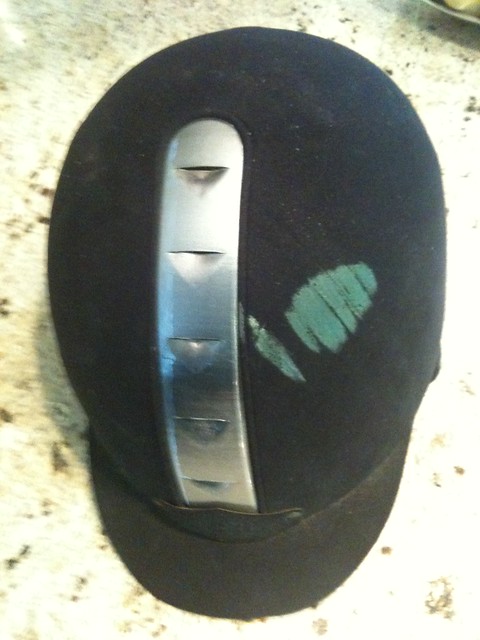
My helmet had a smear of green paint from the mounting block where I landed.  I broke a hand, had some really hideous bruising, and had a decent concussion.  But looking at that helment, I feel lucky.

Remember – my plan that day was just to walk.  As Courtney says, with horses, you have to expect the unexpected.

It’s not too hot to wear a helmet! Tips for keeping cool while staying safe:

The Tipperary Sportage helmet is well ventilated and cool even on hot days.

I know it’s hot.  But take it from me, an inveterate helmet-wearer.  It’s possible to stay comfy while wearing a riding helmet in the summer.  Here are my favorite tips:

  • Buy a vented helmet.  In warm weather, I wear a Tipperary Sportage.  It’s cheap (about $60) and has vents everywhere.
  • Line your helmet to keep it from getting wet and stinky.  (This will also keep your forehead from breaking out, too.)  You can buy fancy helmet liners from your tack shop or online.  A cheaper and very effective alternative I prefer are generic, unscented, cheap-o panty liners.  They stay put, are cheap and do a great job, staying put and absorbing just a shocking amount of sweat.  The box just days “Liners” and that’s what I use them for – so who cares?  Not me, at least!   On hot days, or if you sweat more on the sides of your head and not just the forehead, you can use two or three, end to end, to provide more protection.
  • If you can’t stomach the liners suggestion, try a bandana instead.  I actually forego the liners on the hottest days, opting instead to use a bandana.  I fold it in half, into a triangle. Then  place the center of the long side against your forehead.  Tie the bandana around your head, being sure to tie it loosely enough that you can work the knot down onto the nape of your neck, you don’t want it under your helmet.  Then pull the tip of the triangle gently back, over your head.  You can tuck it under the knot if you want.  Plop your helment on your head, and off you go.   Change bandanas after each ride.

If you don’t wear a helmet, I hope you’ll watch the video above, and then go buy one. If you sometimes wear a helmet, I hope you’ll change your mind and wear one, always.  Safe riding, folks!
We’re on our way!

Awaiting the farrier

Things are looking up for Derby.   He seems to be settling into his herd, establishing himself as the low man on the totem pole.  However, when I watched him interact with the three geldings with whom he shares turnout, they seemed to be settled into a groove, moving each other around with a nasty look – no real violence.

The bumps and bruises (and sore muscles) that unfortunately accompany introduction into a new herd seem to be subsiding.  This week I rode Derby a couple times, and he moved out pretty well.

Because he had the winter off, Derby isn’t terribly fit.  He’s in good condition – sleek and shiny – but needs to develop more strength, flexibility and endurance (as does his rider, frankly.)  Right now, rides are short – I’m doing 10-15 minutes of warm up at the walk, working on his suppleness during that period.  While we walk, I ask him to follow a direct rein, which he does nicely, turning his head quietly when I ask.  I also move him around from my seat, using one seatbone, and then the other, to move in a shallow serpentine.  He’s good at this and very responsive, which bodes well for us!  Finally we do some shoulder in.

Trot work is a great way to build condition on a horse, and that’s where we’ll be focusing for a while.  Right now, we’re doing about 3 laps of the indoor, both ways.  Happily, Derby has a nice, rhythmic cadence to his trot, so we don’t have to work on that.   As he gets fitter, we’ll emphasize stretching into contact, and moving out into a bigger gait.  For the moment, though, what’s really important is building strength and correct muscle, to protect against injury and support our development together.

On Wednesday night, I got some very decent stretch from Derby, and he was working nicely over his back.  Building top line is a key priority, and this is the way to do it.

On Thursday, I took the day off work, and Derby had his first farrier appointment since arriving at Silver Fern. It was a non-event – he’s a good boy, and stood nicely the whole time.   Later that afternoon, we had our saddle fitting appointment with Kate Lamacki, the Master Saddler from Barrington Saddlery.  We tried a few saddles on Derby, and I rode him in an Albion that we both really liked.   It’s reasonably priced and hopefully we’ll be able to get one ordered soon.  In the meantime, we determined that the Schleese I had on trial wasn’t a good fit, so that one went back.  I’ll continue to ride in my Wintec Isabell until the new saddle arrives.

I’m going to be away for the next few days.  Hopefully, Christy’s schedule will enable her to do a training ride on Derby.  And then, on to next week, when the consistent work will begin!

WakeUp Graces Lamplight, Wins Young Horse Selections

WakeUp and Emily in the warm up.

On Sunday Christy and I ventured out to Lamplight, a gorgeous show ground outside of Chicago, to see the young horse selections (and some other rides).  In particular, we wanted to see WakeUp, a six year old stallion, and one of the top young horses in the world – he just missed making the finals in the 5 year old championship in Verden last year.   WakeUp, ridden by Emily Wagner, took top honors this weekend too – you can read about it on Dressage Daily.

Because he’s still a youngster, WakeUp was shown in a snaffle, and the six year old test doesn’t ask for upper level movement.   It does ask for collection and extensions in all gaits, however, which was really fun for me to watch.  I don’t yet know enough yet to be able to spot details like late changes behind in a line of tempis, for example, but I am starting to develop my eye for gait quality.

WakeUp is a “wow” mover.  He’s so through, supple and suspended that he makes other horses – other lovely, lovely, horses – pale in comparison.

What was really interesting is the fact that WakeUp, according to some reports I’ve seen, is 17 hands tall.  I was surprised when I read that fact this morning, because he doesn’t look it.  He’s so well balanced and works so beautifully within himself that he appears smaller.  There’s nothing hulking or gangly about this horse.  He just might be perfect.

A ten walk, or close to it, leaving the warm up.

This was the first time I’ve ever seen a ‘big time’ horse that is competing at the top of the sport internationally.  And it was fun to hear my fellow spectators – some of whom didn’t know who that black stallion in warm up was – exclaim at his beauty and presence.

“Who is that!?”

“I just found my mare’s husband!”

Their comments affirmed and validated my own reaction to watching this gorgeous horse.  WakeUp is a truly exceptional horse.

It was a treat and a privilege to watch Scott Hassler, the US Young Horse dressage coach, put WakeUp and Emily through their warm up paces.   And it was fun to see Emily’s big smile and hear her say “I’m ready!” at the end of the warm up, minutes before turning in a performance Dressage Daily called “nearly flawless.” WakeUp was bred in Kansas, and is registered with the American Warmblood Registry – proof that you don’t need an import to play at the highest levels of our game!

Dispersal Sale of Thoroughbreds


THESE HORSES ALL FOUND NEW HOMES AND ARE SAFE.  NEWS OF THIS DISPERSAL CONTINUES TO CIRCULATE ONLINE BUT REST ASSURED THIS HERD IS OK. 

Howard E. Nelson, long time thoroughbred racehorse owner/breeder, passed away on April 8, 2011 after a long battle with cancer. His family is unable to keep his horses, and his entire thoroughbred herd must be sold. All reasonable offers will be considered.
– 2 Yearling Chestnut Colts
– Yearling Bay Colt
– Yearling Bay Filly
– 2 yr. old Chestnut Colt, started training
– 3 yr. old Liver Chestnut filly
– 4 yr. old Chestnut Gelding started retraining
– 5 yr. old ret. Bay Gelding started retraining
– 7 yr. old ret. Bay Gelding ready for retraining
– 8 yr. old Chestnut Broodmare w/foal by
Good Reward
– 9 yr. old Chestnut Broodmare
– 10 yr. old Bay Broodmare
– 13 yr. old Bay Broodmare in foal to Stephen
Got Even
– 15 yr. old Bay Broodmare
– 10 yr old Chestnut breeding Stallion