Joy, Pain & the Outside Rein

Today was truly a day with ups and downs, starting right off the bat with a text from the barn – Derby had been kicked.  It wasn’t an emergency, but he did have some scrapes and the location – the lower part of his chest – isn’t ideal.  The barn owner and her daughter (an ER nurse, and a nurse-to-be) did some triage and cleaned things up.  He’s tender but sound.  Happily, Derby and the other low man in the group who also gets picked on a lot are being moved tomorrow.  This is a relief to me – clearly Derby (and Remy) weren’t in a compatible group – and horses can be tough on each other.

I did an easy ride on Derby tonight, wanting to be sure he was okay after his ordeal this morning, and he was.  We rode outside and he was moving well and willingly.    It sure felt better than yesterday – I had a hideous ride, due (I’m sure) to the lingering effects of the weekend.   My riding muscles were screaming, it was hot, and I think we lasted about 20 minutes.

Today was decidedly better, but I still wasn’t terribly happy with myself.  I could feel myself tipping forward, and letting my leg curl back, so I did some laps in two-point and also did a good exercise Christy taught me – standing two beats and then posting two beats, over and over.  It helps build balance and steady the lower leg.  We did these exercises with loop in the rein – I wanted to be sure that I didn’t accidentally pop him in the mouth if I bobbled.

After we had been moving around for a while, I worked on Derby’s responsiveness to my leg.  I’m still wearing tiny spurs (until my legs are stronger and steadier) but a larger pair have been purchased.   For now, I have to turn my toes all the way out and poke very deliberately if I want to put some spur on.  Which I did, when Derby declined to heed my request (delivered via the inside leg) to step his fine self over, and fill up my outside rein.  He bent outward, effectively counterbending a bit.  I turned my heel in and *poked*.  A ha!  He stepped over!

I’m being very, very careful not to nag with my aids.  My legs are either on or off at the moment – I’m trying to avoid grey areas.  And after a few pokes with the spur, Derby stepped nicelyunderneath himself, and somewhat  into my outside rein when I asked with just some calf pressure.  I say “somewhat” because Derby resists contact a bit, but I’m pretty sure it’s partially a  training issue but primarily a rider issue – he’s better when he’s 1) warmed up and 2) I really ride.

I finished the ride practicing working from my seat – steering Derby with my leg and seat aids, and halting from my seat.  It’s all a work in progress but this sweet boy is a quick study.

After I put Derby away, it was time for my lesson.   Cathy is away this week, and has handed me Atlanta’s reins.  After a rough patch this spring with sore hocks and some farrier issues, Cathy has gotten to the bottom of Atlanta’s issues, and the mare is going magnificently.  I had such fun riding her, and can’t wait to get back on tomorrow and do more.

Christy had seen my ride yesterday which I know wasn’t pretty, and asked me what we were working on tonight.  I told her that I suspected it would be more of the seat and balance issues, but once we got going  … well, things went pretty well.  It was great to ride a big, proper trot again, and while Christy agreed that my stamina has waned, she told me that my form was looking pretty good.  Hooray!  I don’t suck after all!  After hearing that, as I cruised around on Atlanta, I felt nothing but joy.

So the focus turned away from my postion, and instead to the outside rein, and moving the mare around with my seat.  We did an exercise I remember doing with Maddie, when Christy needed to get.me.off.the.inside.rein already.  She had me bend the mare to and fro, from just my seat, keeping my hands still.  Then – and tonight with Atlanta – the effect was immediate – the mares both softened and stretched into the contact, backs up and engaged.

We also did some transition work, because I forgot entirely how to ride a graceful downward transition.  By half-halting the mare as I posted, and gradually slowing Atlanta, I was able to produce a nice, smooth, relatively engaged transition. This will be a particularly good exercise to work with Derby on as he gets stronger – half halts are an area of communication we need to improve.

Speaking of Maddie ….

We got some exciting news this weekend about my former mount, Maddie.   She and Heather (her new owner) competed in their first HT this weekend – a rated show up at Silverwood.   They went out at BN (Maddie is just learning to jump) and … they won!  Heather is clearly the perfect person for Mads, who looked enthusiastic and happy in the videos I got to see.  It was thrilling watching my old girl out on XC and in the stadium.  I’m so proud of her!  Congrats to Heather on a job very well done, indeed.  🙂

Meet Derby

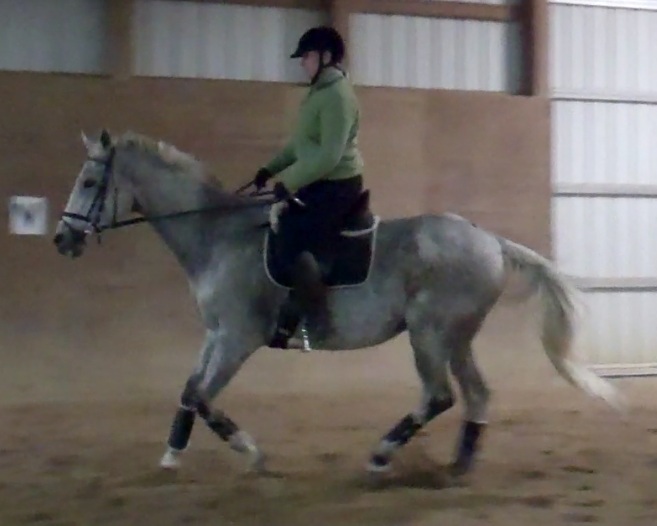
Our second ride, first time outside, cantering to the right

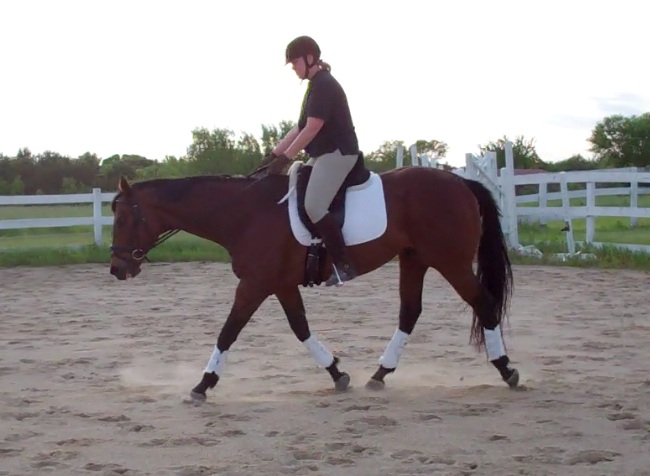
Big news, folks – there’s a wonderful new horse in my life! Meet Derby, an 11 year old OTTB that moved in this week.  I’m doing a lease-to-buy on this nice boy, and I have to tell you, I’ve fallen hard for this one.  I knew after one ride that he was the horse for me –  I felt happy and confident when I went for the test ride.    He arrived on Tuesday, and we had our first ride last night – which was totally uneventful.   The strange indoor arena didn’t phase him in the least.  Tonight we rode outside, and once again, Derby was a total star.

Working a stretch

Christy took some video of the ride, which, frankly, I’m embarrased to share with you.  I’ve been riding so inconsistently lately that my strength and balance are pretty much shot.  I feel like a flopping fish and don’t look much better!

Some nice bend

Derby also needs to get in shape.  He was on vacation over the winter, and while he’s in good condition and weight, he needs muscle.  So, we’ll spend the next few weeks doing a lot of conditioning work.  I also need to regain my independent seat and steady my leg.  Happily, this is a horse I can see myself doing a lot of no-stirrup work.  However, before we go there, I want to get Derby’s top line built, and find a saddle that I’m sure fits him well.

I’m still feeling very out of synch and discombobulated with Derby, but we have had some nice moments that leave me eager and impatient to get over this conditioning hump and get my riding legs back.

I also need to figure Derby out.  He has a lot of training but is very resistant to contact.  You can’t just push him into the outside rein and get to work.  He needs to warm up on a loopy rein.  Actually, given the current state of my riding, this isn’t a bad thing.  Riding with pronounced loop in the reins forces me to use my legs and seat to influence the horse. And once I put him to work, Derby is much better about accepting contact.  I’m pretty sure that once I get my strength and balance back, my hands will be steadier and more independent, which will help Derby too.   For now, I love the fact that this is the sort of horse that can go around on the buckle in a new environment.  He is the very soul of a good boy, and I’m crazy about him.

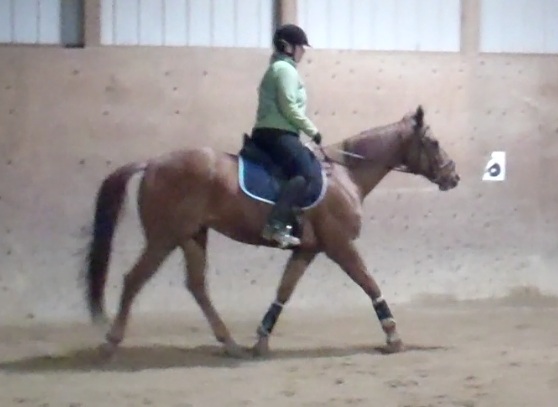
Cantering to the left.

Before my energy totally waned, we got some nice canter both directions, but not before I had to send Christy back to the barn for a whip.  Derby is very responsive to voice aids – a chirp will send him forward, but I’d like him to be lighter and more responsive to my legs and seat, and I’ll be making that a priority over the next few weeks.

We finished up the evening with another grooming session, hand grazing and cookies.   I’m beyond thrilled with this sweet, fancy horse.  Next ride should be on Saturday.  Stay tuned!


Humpty Dumpty Learns to Ride

Some nice trot work with Oliver

I was channeling Humpty Dumpty last night during my lesson on Oliver, and Christy had to work hard to put me back together again. But she got the job done, and Oliver produced some very nice moments, stretching into contact while almost tracking up, and starting to work over his back.

A key contributing factor to my issues last night was the saddle.  Just for fun, I rode in a Stubben Romanus – an old one.  It’s the opposite of the saddle I’m used to (a Wintec Isabell). Instead of a deep seat covered in grippy suede, this old Romanus was slick leather, with a much shallower seat.  And instead of air-filled panels, the Romanus panels feel like they’re foam-lined and filled with wool flocking.  They’re soft, and solid, and lack the shock-absorbing quality of the Isabell.

Christy’s new saddle is also wool-flocked, and she says she can feel a lot more movement in it than in her old Isabell.  I tease Christy about being the Princess and the Pea – she feels so much more than I do in the saddle.  I think she could read Braille with her butt, frankly.  The same cannot be said of me, but riding Oliver – who I’m getting to know fairly well – in the Romanus was an entirely different experience that my usual ride.  All of a sudden, I was being bounced out of the saddle at the trot.  And while Oliver has nice, solid gaits, he doesn’t produce a lot of suspension. (Yet!)  His trot is pretty flat.  I wasn’t prepared for this feeling and had to spend some time finding my balance.

Finally – with constant adjustments and encouragements coming from Christy – I started to get it together, and regained some semblance of independent hands which had left me entirely at the beginning of the ride.  Humpty Dumpty was patched up.

Something else that helped me get it together was asking Oliver to move forward.  This helped me in two ways.  First, once I got him going forward – and I was keeping him there – his rhythm improved – a lot.  If I let him go at his own pace, he speeds up, then slows down, and then spurts forward again.  Keeping him going forward is easier to ride because it cuts down on the variability in speed – and that variability makes it hard to stay balanced.  Secondly, the more forward, proper working trot is easier to ride from a balance standpoint. It’s easier to ride when you can use the momentum of the horse’s gaits in your favor.

Once I started to resemble someone with a bit of training rather than a sack of potatoes, Christy had me work on inviting Oliver to really stretch into contact, something that has been on my to-do list for a while, but I’ve not made much progress in this area.  She quickly diagnosed the problem – I’ve not been giving enough with my hands.

We’ve discussed “giving hands” before, which is another way to describe following contact, which allows the horse to stretch forward, and can also reward the horse with a decrease in rein pressure for the correct behavior.   I commented that Oliver’s unsteadiness in the bridle made it harder for me to give at the right time.
“And that’s why it’s even more important!” was Christy’s response. And she’s right, of course.  Oliver is new to dressage, and prior to Steph’s purchasing him, he was ridden in  a leverage bit with a tie down. He’ll never learn to go correctly into contact if he doesn’t get good guidance from the person on his back.  I redoubled my efforts, trying to keep my hands quiet and the contact steady.  Christy reminded me to activate my inside leg, using the spur when necessary to enage Oliver’s inside hind.

“Ride the back end, and leave the front end alone,” Christy suggested.  I envisioned side reins, and concentrated on simply holding steady contact on the reins – not messing around with softening or opening or asking for give.  I focused solely on keeping the contact quiet and holding on to the outside rein, and got busy with my leg aids.

The improvement was almost immediate.  I turned my heel inward, applied a little spur pressure, Oliver stepped neatly aside with his hind leg and his neck lengthened.

“Give give give give GIVE!” Christy commanded. “Again!”   We repeated the exercise, and I finally reacted quickly enough to get a nice stretch into contact for a few strides, after which I stopped riding, whereupon he hollowed his back and popped his head up.  You really do need to ride every stride.  We repeated the process several times, going each way.  At the end of the ride, we were both sweaty and puffing.

Oliver is figuring this out – and it gets easier as the horse develops strength and self-carriage. Oliver is just beginning to develop the new muscles necessary to carry himself correctly.   It’s fun and challenging to work through these moments with him, and he’s such a pleasant horse to work with.  It’s going to be a lot of fun to watch him develop!

Fluid dynamics, or the dynamics of fluid riding

This is an awfully fancy sounding title for a blog post, but I had a cool lesson last night that, among other things, involved my first few dinky baby steps of haunches-in and haunches-out. Or, in keeping with the fanciness – renvers and travers.  Say it with me “rhan-vair”  “trah-vair.” Dang, I sound good! (So do you!)

I was riding adorable little Tucker, who is very well trained and sensitive.  Christy was mounted on her newly off the track baby horse Remy, who is just starting to really use his back and is getting the dressage basics down quickly.   From the back of her green bean, as we discussed how aids need to be 1) distinct and 2) contextual, she gave me a short demo of how to move different horse parts around.   Under her guidance, Remy did one step of shoulder in one way, and repated it on the other side.  Then, again at he invitation, he moved his haunches a step in either direction.

As Christy talked through the movements, she highlighted how she uses her aids to block and channel the horse’s movement.  An outside rein can hold a shoulder, a foot slightly back blocks a haunch, while the aids on the opposite side invite, encourage and guide movement. I immediately thought of how water flows.  It finds the path of least resistance.  But water (like certain crafty Quarter Horses I know) is also good at evading the channels humans create for it.  It will take advantage of weak points.  Horses are the same. Indistinct or unconvincing aids open the door for evasions or incorrect movements.    Under Christy’s careful riding, Remy the green bean performed a few strides of both haunches in and out.  As Christy pointed out, you don’t train entire movements.  Horses don’t have magical buttons one can push to generate the renvers, or a half-pass, or a piaffe.  The movements are the sum total of the horse’s gaits + the rider’s aids.  And, frankly, the rider’s aids have a much larger coefficient in the total equation.

I started experimenting on Tucker.  I’ve ridden a lot of shoulder in at both the walk and trot, and can also manage its corallary, shoulder-out.  But deliberately controlling just one stride of each proved to be a lot tougher than I would have anticipated.   And that was the beauty of the exercise Christy had me do.  Because moving the horse’s shoulders one stride from a standstill requires precision and deliberation in order to move just the shoulders, and nothing else.

Tucker and I wove drunkenly around for a few minutes, until I got the feel for what I needed to do.  And then we did a nice little cha-cha-cha.  One step right, one step left.

Then I switched my attention to the haunches. More drunken weaving ensued. And eventually, I got the feel for what was needed to move his haunches one step right, one step left.  Tuck shook his cute chestnut booty.

Maybe I should have titled this post “Horse Hokey Pokey,” … you put your left haunch in, you put your left haunch out.  Wonder what the judges would think of that as a freestyle?  Ha.

Anyway, I digress.   Once I was moving horse parts around with more specificity, Christy had me try these while walking, pointing out the important fact that I need to hone these specific aids, because they are what I’ll use to control shoulders that pop out or haunches that drift.  These are tools I need to add to my kit.

I aced the shoulder in, and got the shoulder out, too.  I was on familiar ground.  The haunches in and out were a different story all together.   I did quite a bit of leg yielding instead of the desired movements.  I took some deep breaths, and concentrated.  I held my outside rein, I softened inside, I asked for a little bend inward, I slid my outside leg back a bit, to move the haunches out.  “There! That’s it!” Christy exclaimed, towering over Tucker and me from her vantge point high up on Remy.  I was beaming.  This was fun, it was cool – but it’s hard!

We experimented a little more and I had a few correct steps here and there.  The lesson really wasn’t learning about how to ride the renvers and travers – I’m far away from that point.  But it’s never too soon to learn how to more correctly influence the horse, and as Christy showed me with Remy, correct aids can generate the desired response – even from an uneducated mount.

Ignorance is Bliss

Tonights canter on Frankie.

A while back, I commented to Christy that I didn’t realize how bad my riding was until I had been riding long enough to realize that sad fact for myself.    And while I do know that I’ve improved, I’m also still aspiring to ride a decent Training level test.  Walk, trot, canter.  Nothing too fancy. But a girl has to start somewhere.

And tonight I really realized where “somewhere” is for me at the moment – and it’s pretty close to square one!  The good news is that my confidence is returning.   The bad news is that being a wimp for the last month or so has had a deleterious effect on my ability to perceive what’s going on while in the saddle.  Specifically, I’ve become woefully comfortable riding nothing trots.  Dinky feels like we’re moving out.   I thought I was asking Frank to step out tonight, and he was barely tracking up. Gaah. It wasn’t even a decent working trot. Oy, vey ist mir.  There was one bright spot.  I did get him to stretch pretty well while trotting, which is not something I’ve done much, and so the fact that I was able to get the wiley old schoolmaster to stretch was a small win  for me.

Also on the up side, we cantered a bit, and it was fun, but not too pretty.  I need to start working on putting the horse together at the canter.  Starting with the upward transition, which needs a lot more grace and deliberation.

Oliver trotting easily, and accepting a little contact without resisiting.

I did have a fun and easy ride on Oliver tonight, too.  He was a very good boy, despite the fact they were in today. (It snowed this morning.) (I know!!!) We trotted nice and easy, both ways, and did lots of transition work, because he was feeling fine and fresh and didn’t want to listen to the human.  Trot walk trot walk halt stand no, you’re still standing walk and I mean walk with some purpose boy halt good boy walk trot keep trotting yep all the way down the long side past the spooky corner not a look good boy walk halt stand walk rinse repeat.

Oliver transitioning downward from my seat - I love how his back is up and he's stepping under himself. I'm staying out of his mouth.

The transition work did pay off – we had a couple nice downward transitions in which he didn’t fall onto his forehand, and instead brought his back up, stretched into the bit and stepped waay up under himself.  I hate my position in this picture (nice hunched shoulders!) but included it because I’m proud of Oliver.

Hopefully, I can get back on Atlanta soon – she’s recovering from a bout of back soreness, and I’ll really focus on working the stretchy trot on her – her topline has suffered for her time off, and she needs to work over her back more – and this will be excellent practice for me.

Thank goodness for friends with nice horses and busy schedules!  I’ll claw my way back to competence one of these days.

The sharper the knife, the less you cry

Cooks have a saying:  the sharper the knife, the less you cry.  Sharp knives are easier to handle and less dangerous than dull blades – they slice effortlessly through veggies and meat.  A dull knife, on the other hand, is more dangerous, because it requires more effort of the user to achieve the desired effect.  And like a sharp knife is easier to use, a responsive horse is easier to ride effectively.

This saying came to mind tonight as I was leading Maddie back to the barn after a lesson, and grinning like a fool because it had been a good ride.    I told Christy that I wanted to work on my lower leg aids, namely, my ability to use my spurs accurately. I had strapped them on last night for the first time in months, and some irritated behaviors from the mare told me that I had inadvertently banged her with them a couple times. While my leg position is much improved, I still revert to my old  “toes out” posture when I get tired.   Developing awareness and acuity with the spurs requires me to continue to improve my leg position and stability.

So as I warmed up, I practiced deliberately putting my lower leg on,  releasing, putting my spur on and releasing.  However, as I did this I wasn’t getting much of a response from the mare.  I was also having trouble dropping my heals and holding a good position – my hips were tight, and probably a bit tired from two strenuous rides yesterday, and my earlier ride today on Oliver.   After promising Christy that I’d continue to work on my flexibility and strength, I took the spurs off.

So the lesson changed course. As we worked on my leg position and aids, which were partly successful some of the time, Christy told me that I was reverting to my bad habit of curling my heel upward, sticking it in the horse’s side and leaving it there.  I focused on being more deliberate with my aids.

However, I wasn’t getting the response I was seeking.  Unsure of whether or not I was eliciting a response because I guess I forgot what a correct leg yield felt like, I asked Christy watch for response while I attempted to leg yield out on a circle.   I got a big  fat nothing. We talked about it a bit and I told Christy that I wanted the horse that I started riding last May.  Mads was so light and sensitive then, and would respond instantly to any aid.  And I’ve dulled her responses.

So we started working on redeveloping a response,  We started at the walk.  Christy asked me to back up any requests I made of the horse with the whip, but advised me to treat any response – a head toss, a break to trot or canter, as good and to praise it, and to ride it.  My first opportunity came quickly as Mads ignored me when I tightened my leg against her.  I gave her a little whack with the whip and she hopped into a trot.  “That’s fine,” Christy said, as I half-halted and brought Maddie back to a walk.  We repeated this a few times, and within a few minutes, we produced a nice little leg yield down the quarter line!

Christy had us move into a trot.  I got the mare moving in a nice forward gait with good contact.  I asked for a leg yield on a 20 meter circle, and didn’t get a satisfactory response.  I gave the mare a little swat, and she propped and swished her tail – and went strongly forward. “That’s fine,” Christy called to me. “You need to get her in front of your leg!”

We continued on the circle at an energetic and connected trot.  “You have her undivided attention now,” Christy said as we breezed around her.  And she was right.  The mare had one ear back on me, and was steady in the bridle. I asked for the leg yield again, and … Maddie floated outward.  There it was!   I was thrilled.

I went to change directions, and as we moved off in a trot, Christy asked me what I thought of the upward transition.  There was no denying it, it was pretty crappy.   We half-halted and walked, and I asked for the trot, reinforcing it with a tap of the whip.  The mare stepped off immediately.   This was better.  We tried it again, and I asked for more enthusiasm, by being a bit more emphatic with my leg aids, but not touching the whip.  She went straight forward, into contact, with no head shaking or nonsense.  “That’s good!”  said Christy, as I let the mare trot on.  “Now, how light can you make your aids, but still keep that immediate response?”

We walked, and after a minute, I closed my legs softly on the mare’s sides.  She struck off in a nice trot right on the spot.

This was a seminal lesson,and an empowering one.  I can fix my forwardness and responsiveness issues if I align my mental intent and my aids, and take care to reinforce my aids with whip or spurs if (and only if) necessary.  I was amazed at the progress we made in one short ride.  I can’t wait to get back in the saddle, and continue to hone and sharpen my aids, and Maddie’s responses.  One thing I need to remember though is to stay consistent.  To do otherwise is unfair to the horse.  I need to ride every transition crisply, encouraging and rewarding prompt response, and reinforcing my aids clearly when needed.

Go forward. NOW.

Well, I got my butt kicked tonight.  And that’s just fine – don’t get me wrong, I’m not complaining.  In my lesson tonight, Christy set out to illustrate to me the degree to which I have a lack of forward.   After we warmed up, Christy ratcheted up our trot work, tightening the screws with every turn of the arena.  It wasn’t until Maddie spooked that I got some decent, forward trot.  As I took a quick walk break, Christy pointed out to me how hard I had been working.  “I saw you kicking. I heard you clucking.  You got nothing from her, except ‘the hoof!’ ”  (which is our euphemism for a horse giving you the bird.)

Christy was right – I was working hard to get anything – bend, contact, leg yield – from the mare.  And the biggest problem was the fact that I didn’t have her moving sufficiently forward.  As a result, everything was more difficult.

Panting, we did some more trot work. Mads continued to be spooky and stupid at one end of the arena, so I put her to work, doing smaller, 12M circles and figure-8’s.  As I got after her, I could feel her back come up, and the noises from the middle of the arena took an approving tone.

“There! Nice!” said Christy.  I was remembering to use my half-halt, to balance the trot. “That’s a round horse!”

I was also using the whip.  It’s been a while since I even touched Mads with it.  Tonight, I gave her a couple good smacks when my requests for more forward were ignored.  She hopped forward, and maintained the increased pace pretty well.    But, as Christy noted, Mads has become as dull as a doorknob.   Reminding her that I have the whip, and will use it, will be necessary as we re-establish our forward gears.

Tonight’s lesson was a great illustration of how lax I’ve allowed Maddie to become.   Though we’ll probably have the next few days off due to super-frigid temperatures, I’m hoping to ride Friday, and get back to work.  It’s time to move forward!

20 minutes, 30 minutes, 40 minutes …

Oh YAY!

I finally got back on a horse tonight – after a two week hiatus since our last ride – a good one which spawned the “Balancing Rein” post.  To say I was happy would be really understating things.   Mads felt great, and we got right to work once I had stretched out a bit and reconnected with all the muscles I hadn’t used while grounded.

We had a lesson with Christy,  who threw down the gauntlet by saying “Wouldn’t it be nice if we could pick up where we left off?”  I made non-committal noises.   I usually ride like a sack of freaking potatoes after time away from the barn.   That said, I had taken some measures against complete atrophy while I was away.  When I wasn’t laid up with the flu, I worked out,  and did lots of squats with my toes turned slightly inward, to stretch and strengthen my hip muscles – those same muscles I’ve been working on developing in the saddle to support my new, improved seat.

And it paid off – somewhat.  My legs felt good and looked great, according to Christy.  I wasn’t poking my toes out to the sides — I was keeping my leg softly against the side of the horse.  That was good.   However, after the first set of trot work, I was starting to feel winded.  I stole a glance at the clock!  7:20! I had been riding just 20 minutes!

Oh, Lord. I was going to be a long night. I couldn’t believe it.

But at least we were managing to pick up close to where we left off.  We practiced spiral in and spiral out, working on managing Mads when she leans on one rein.  Christy had me soften the inside rein repeatedly while really holding the outside rein.   We had some nice moments, but this still needs some work.   I need to use my leg more actively to get the mare into the outside rein, and be faster with releasing when she softens on the inside.

Anyway, I kept sneaking glances at the clock.  Christy caught me this time. It was just 7:30, and I could feel my face reddening and my shirt growing more damp under my fleece.

By 7:40, I was done.

I suppose this is good from the standpoint that at least we know I’m really riding, using my whole body, and not merely going along as a passenger. And I now ride like this out of habit.   So that’s cool.

But man, it’s discouraging to be so wiped out after such a short ride.    Onward and upward.  The mare got a few extra alfalfa cubes in her mare mush.  Hope she’s ready to go tomorrow!

My plan for the rest of the week?  Cruise around in two-point and do lots of posting tomorrow night, and really try to get some endurance back.  Subject myself to Christy for lessons on Wednesday and Thursday.

A good ride!

We had a good lesson tonight, which saw another two firsts – we started to work in a slightly higher frame, raising Maddie’s poll.  And we also had the beginnings of a stretchy trot!  Things were good right out of the gate – it was chilly and Maddie was more forward from the get-go.   She felt great – light, responsive, and on the bit.  I love how supple she’s becoming – I can bend her gently while trotting simply by tightening one hip flexor.  This is useful, because it enables me to quickly flex her this way and that, while staying out of her mouth.   I can also bend her pretty quickly into the outside rein if I need to re-establish contact.

So things were looking good straight away. Even warming up, Mads was steady, even and enthusiastic, before I even asked for much.

Christy took advantage of the nicely forward horse, and we worked on adjusting within the gait, and especially on covering more ground with our “big” trot. We used the short sides to rebalance, using half halts to shorten Maddie’s stride.  Then, on the long side, Christy had me focus on increasing the scope of my post, working in a slight pause at the top of my post.  Doing so, according to Christy, gives the mare more time to cover ground. I think we’re getting close to an extension. Dare I hope?

Developing a reaching, ground covering trot

Christy also had me work on shortening my reins just a bit (I have a bad habit anyway of riding with them too long) and raising Maddie’s front end.  We’re not simply cranking her nose in – I’m working from my seat, and working to create a more uphill frame.   This was the first time in recorded history that we’ve looked this pretty:

Good mare!

Maddie fussed a bit as we worked uphill, and Christy advised me that I’ll need to pay attention to letting her stretch on my terms.  She also reminded me that this work is hard for Mads, who isn’t used to carrying herself this way.  I’m going to be taking more weight in the reins – and I’ll need to hold it.  And I’ll have to work more stretch work into our schooling, to reward and rest my hard working buddy. So, we started to practice stretching at the trot – again, something totally new.

This was a brilliant lesson, and a great confidence builder, moving me out of my comfort zone in terms of riding more forwardly, and in terms of stretching.  I was reminded of  another friend who when working on stretching her mare at the trot and canter was told to “be vulnerable.”  That’s certainly what it feels like to me… but that stretch work feels pretty good.


The difference between a semi and a Maserati

Maddie and I are working hard at establishing a good connection at the trot, and doing this has required me to do a few things.  First and absolutely foremost, I’ve had to master the inside-leg/outside-rein dynamic.   Sometimes bending into the outside rein is still difficult, but I’m getting it.  And improving the use of my outside rein also means that I have to get off my inside rein.  Mads likes to hang on the inside rein sometimes, which complicates things for me, because my instinct is to hang back.  And the horse will always win that sort of argument – so avoiding it is important.  This brings me to the third thing I’ve been working on improving – my responses.  I understand that horses operate in the moment, and responding at a specific moment – whether you’re adding or relieving pressure – is key to riding successfully. Not only do you get a better response – encouraging the horse to round by giving your hands, or discouraging a behavior by driving the horse forward, for example – you also create a better horse – because every time you ride, you’re also training the horse.  The closer you can get to offering the appropriate response to the moment, the better of you’ll both be.

Here’s a good look at how not to do it.  This picture shows Maddie braced against the inside rein, and I’m hanging back.  Her nose is tipped inward, but there is no bend, no softness, no suppleness here.  Her right shoulder is popping out, she’s not working over her back,  and you can also see that the quality of the trot is pretty poor – I’ve put her onto her forehand, and she’s nowhere near tracking up – this trot lacks energy.   In a word, it’s  mess, and it doesn’t feel good to ride.  When we’re this disconnected, it feels like Mads is a semi on a slick road – the front part of the truck is heading one direction, and the rear end isn’t necessarily following.

So, as I mentioned, we’ve been working on developing good contact, and tonight we had it.  She was giving me really solid  contact in both reins (for the most part), which we developed using serpentines, changing the bend frequently.  Suddenly, I had even weight in both reins, her back came up underneath me, and she rounded like I had never felt her round before.   This trot felt powerful, balanced and responsive.  We had energy, and she was tracking up.  It felt like driving a sports car, because this big horse (she’s every bit of 16.3) was connected end to end – from her haunches, over her back, through her neck, into the bit, and into my hands.

“That looks really good!” my trainer Christy called from the center.  “When you come out of the corner, do a couple steps of shoulder fore, then leg yield to the wall.”  I closed my fingers on the outside rein, and tightened the muscles of my inside leg.  I pushed Mads with my left hip flexors, and she curved gently around my inside leg, continuing on a straight track down the quarter line.  Breathlessly – and still holding firmly to the outside rein – I tightened my lower leg against Maddie’s side, and gave her a little nudge with my heel.  Over we floated, without losing contact or cadence.   “Yes! That’s it!’ came the cry from the middle of the ring.  But this was one time I didn’t need Christy to tell me that we had done it right.