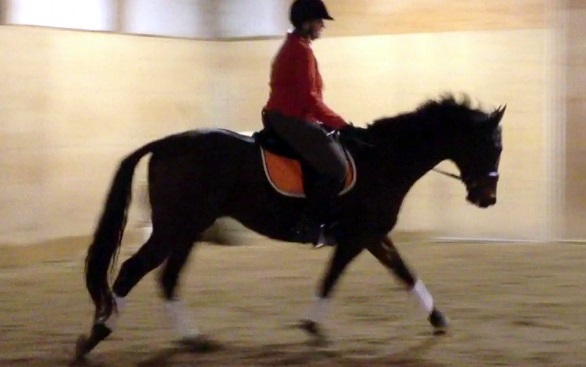
Two light bulbs

Learning to sit, effectively

My holiday hiatus over, I was looking forward to getting back out to the barn last night for my lesson.  However, though the mind was willing, the body wasn’t.  One of my knees was killing me and the motion of posting was painful.  So Christy reshuffled her deck, and announced that we’d do more warm up work in two point, and then work on sitting trot.

We’re using two point to build my leg strength, so I can start carrying my weight more correctly, instead of relying solely on my stirrups.  As I went around, I lightened my feet in the stirrups, taking more weight on my upper thighs. Then Christy upped the ante, asking me to take some contact and make the horse round. While in two-point.

Now, this took some doing for me. I’ve not done much in terms of influencing the horse while working in two-point.

“Think side reins,” said Christy.  I closed my fingers, and steadied my hands.  Derby started to pull into the contact, and rounded.

“Good. Now send him forward,” said Christy.  Still in two-point, I squeezed my knees.  Nothing.  Determined not to cheat, I squeezed my knees again.

“This trot’s getting worse, not better!” Christy observed.  “Send him forward!”  After another minute of pop-eyed knee-squeezing, I asked Christy exactly how one sends a horse forward when in two-point.

“You can use your legs and your core while you’re in two point,” she said. When she said that, the first light bulb clicked on. I realized that I hadn’t been using my lower leg at all – and the go button is best activated with the calves.   I tightened my core, which magically connected my body to my legs (um. duh.) and eased my knees, letting my calves drape around the horse a bit more, despite maintaining the two point position.  The horse rounded, and when I closed my calves, he went forward.

“There you go!” Christy approved.  So that was my first light bulb moment. From then on, I was able to ride the horse more forwardly, while maintaining some roundness, in a two point.  It was definitely a first.

From there, we took a walk break.  Christy had me focus on feeling the motion with my seat, paying attention to which foot was falling where.  Then she had me swing my hips, telling me to swing the horse up into a trot, and then continue following the motion with my seat.

After a few rough starts, Christy noted that I was starting to curl forward, and was tensing up in an effort to stay light on the horse’s back.  The result was a tooth-rattling ride that wasn’t any fun for the horse, either.

“Lean back, and point your seat bones towards the front of the saddle, ” she told me.  My next try was much more productive.  I was able to feel a few moments where the sitting trot felt really good and connected.  Best of all, the horse was pretty happy throughout.  Derby was staying fairly round – not popping his head up and going hollow.  I fed him some extra rein, as my hands were still bouncing around a bit, and I wanted to focus on staying with the motion.  Eventually, though, I was actually able to take and hold some contact while sitting, and Derby stretched into the contact, holding it nicely.  I was stunned. While I wasn’t really moving Derby out in any semblance of a working trot, nonetheless, this was the first time I’ve ever maintained any semblance of contact and roundness while sitting the trot.   One night, and two light bulb moments! Can’t wait to get out to the barn tonight!
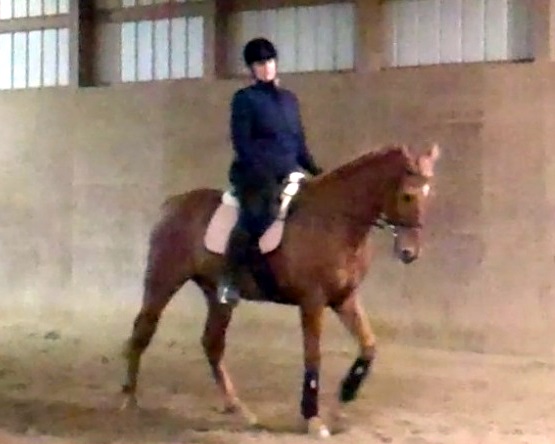
The best horse I’ve ever ridden.

Learning from Liam

I arrived at the barn early tonight, and went into the arena where Christy was riding Liam.  We started talking about our plan for my lesson, given the fact that I was a bit sore and stiff (but not back enough to keep me out of the saddle! Woo!) One thing led to another, and we started talking about my issues bending.  I surmised that my difficulties stem from the fact that I’m still working on developing acuity with my new position.

“Go get your helmet,” Christy said.  “We’ll see.”

Okay. My new year’s resolution, which I’m starting early, is to say “Yes Ma’am” when Christy wants me to do something. I have to at least try. I put my trepidation and excuses away, and donned my helmet, put on my gloves, and took the reins on the horse that have admired for years, and who I love almost as much as I love Jag.

Liam is Christy’s exclusive territory.  Her boyfriend Mark sometimes hops on and walks around on him, and on a couple occasions, Christy’s had one of her students get on, but by and large, Liam is Christy’s ride 99.99% of the time.  He’s ridden by a pro, and he is finely tuned and delicately honed.  Together they’re schooling things like canter half passes and tempi changes.  Liam is very sensitive, and very fit.  He’s a super good boy, but he’s still a little intimidating, to me, at least.

This experiment, she told me, would reveal whether or not I was giving bending aids correctly.  She had me walk him in a circle, coaching me through the delicate, delicate aids to which Liam was trained to respond. She had me keep all my aids very quiet, and then once I had contact, she had me push gently with my inside seatbone.  In a heartbeat, Liam bent gently around my leg.  We walked on, and we maintained the bend with just the quietest contact and aids.

“No, that’s too much, that was a leg yield,” Christy noted once. I swear that I had merely raised one of my eyebrows.

“Now go for feather light contact,” she said, as we walked around holding the bend.   I softened the contact, and Liam held it, staying attuned to these soft, quiet aids. We spiraled in and spiraled out, guided by just the slightest shifts in my weight.

“Wow,” I said, repeatedly.  This was a whole new ball game.  Riding Liam gave me a whole new perspective, both for the responsiveness that can be trained, and also, the immense control Christy has over herself when she rides.

Over the next few minutes, she had me change the bend, and then do some leg yields, shoulders in and, incredibly, haunches in and haunches out.  And it was effortless. A slight push with a seatbone, brush with a calf, or shift in weight was all it took to guide Liam. through these movements.

I can’t really describe how illuminating this little exercise was.

“Don’t sell yourself short,” Christy told me.  “You know how to do all of this work just fine.”

I  then tacked up Derbs, and warmed him up, and then Christy got on, and some important truths were revealed.  Derbs wasn’t responsive – at all – to her seat.  So she took the opportunity to install some buttons for me, and talk me through it.  She first flexed him right and left, while standing, and he gave very nicely to the rein pressure.  So that was a good start.  Then she moved him off, walking, and tested his response to her seat, specifically, whether or not he moved over when she pushed a seatbone into the saddle and asked him to step over.  She got nothing, so she quickly addressed Derby in terms he understood, backing up the seatbone aid with an opening rein and a spur, and then quickly graduating to an indirect rein, and the seatbone aid, and then just the seatbone.  It was really interesting watching Derby respond and as she worked him, his walk got better and better.

Then I got back on, and voila, I had a new button to push. I was able to re-create Christy’s work, and move Derbs around with my seat.  The visual we use is “the canter pirouette seat” – which creates a mental image (for me, at least) of sitting straight and deep, and liiiiffting the inside seatbone while channeling the haunches with an outside leg.  This little mental mnemonic device devised by Christy has been really helpful in helping me visualize and then execute the correct aids.

Christy made the point to me (and it’s one she’s made before) that I shouldn’t have to work hard to get these basic movements.  Derby has been training me.  It’s time, she said, for me to think more about training him.

So it’s cool that I passed my pop quiz on the schoolmaster with flying colors.  But it’s daunting that I need to think as much about training Derbs as I do myself.  One more twist on the dressage journey path, I guess!

There’s always something

A nice moment. We're working a small stretch, he's staying uphill, and that inside hind is engaged.

Christy and I had an interesting moment tonight, as I was working on developing and keeping Derby really engaged on a circle.  She started talking about softening my aids, specifically my spur.  Huh?  I wasn’t spurring and said so.

Diplomatic silence from the middle of the ring, accompanied by a raised eyebrow.

Crap.

Well, God love her for having a high enough opinion of my riding to assume that I am in full control of my extremities.  Sorry to disappoint, Christy.  I’m not.   We stopped what we were doing and zeroed in on my leg.  It turns out that I’ve been egging Derbs on with my spur almost constantly, when I was happily under the illusion that I was keeping my aids quiet and deliberate.

Um. Awesome.

Looking at the videos, I cringe. I’ve got my spurs in Derby’s side more often than not.   Sure, they’re rounded, but they still don’t feel good.   The last thing I want to do is make him dead to my aids, and it sure looks like I’m on my way to desensitizing him to my spur. Yikes.  I’m putting the Tom Thumbs back on.  Developing a steady leg capable of delivering ONLY deliberate aids is now job one.

The posting-with-too-much-weight-on-my-foot problem still persists, and it’s contributing significantly to the unsteadiness in my lower leg.  It’s not reasonable for me to think that this issue would have been fixed a scant week since I started tipping my butt up into two point, letting my stirrups rattle on my feet as I hold my weight with my thighs, but that doesn’t make it any less annoying.

My review of tonight’s ride did reveal a couple bright spots.  For the most part, my posture has really improved.  I’m keeping my hip angles open, and doing so is now coming more easily.  I don’t need to constantly catch and correct myself, at least, not to the degree I did even a week ago.  That’s a step forward.

This sort of moment gives me hope, He's really moving, he's uphill, I'm sitting straight and am keeping it together.

In other good news, Derbs is over the muscle soreness.  He was moving out well and evenly tonight.  We cantered on a circle both ways,  and the quality of the canter was good – he held the leads and was stepping under himself – so clearly, the soreness is abating.  Canter transitions on the circle are at the top of our homework list – they’re great work for his hind end, and require me to get our collective ducks in a row – forward, contact, bend, sit sit ask – and give me the time I still need to organize everything.

So, overall, a good night.  Problems persist, but that is no surprise.  There will always be something to work on!

Well, that didn’t go as planned.

After working so hard yesterday, I was eager for my lesson today, and I arrived at the barn early to deal with the very muddy horse I assumed I would find.  Derby, however, was pretty much pristine, despite the soupy conditions out in the paddocks.  He had been alone today, as his pasture mate Remy had to have a shoe replaced, and evidently he didn’t move around much.  There were no spatters on his tummy, he was just dirty from the fetlocks down.

As pleased as I was to not be confronted by a horse that was liberally coated with goo, in retrospect, it would have been better if he moved around a bit more today.  Once we got going – barely going – in our lesson, it was evident that something was wrong. I hopped off, and fetched a longe line.   As I came back into the arena, Christy handed me the reins and palpated Derby’s rump.  Gentle pressure caused him to really flinch.  Derbs was afflicted with a very sore patootie.

I was pretty surprised by this.  Yes, we worked hard yesterday.  But I wasn’t doing a lot of transitions, and we are so not anywhere close to doing anything collected.   However, Christy reminded me that we have upped the ante, and both Derby and I are doing a lot more these days.

On the longe Derby loosened up, and promptly surprised us both by flashing some really fancy trot – by far the nicest we’ve seen from this horse.   As I was standing there slackjawed, Christy said, “Well, your horse definitely isn’t broken!”

I got back on, and Christy decided to give the horse a bit of a break, and to torture me instead.  I had told her that Iwas having problems keeping my lower leg still – I’m still carrying too much weight on my stirrups, and as a result, my lower leg moves around a lot when I post.   On Sunday when I encountered this, I alternated posting  with standing a couple beats, then posting a couple, then standing …. doing so helps me “feel” the correct spot for my leg.  However, since I was squarely in Christy’s cross hairs, and because this is a problem caused by lack of strength on my part, Christy had  me get into two point, keeping my weight on my inner thighs. My test for whether or not I’m doing this correctly is letting my stirrups “rattle” on the bottom of my boot – they can’t rattle and move around if I’m really leaning on them.  I did a lap of that before calling uncle.  Christy then had me post from a half-seat, keeping my legs engaged and butt out of the saddle.    This is my homework for the next few days.  We’re going to move to posting without stirrups in short order.  It’s not fun but I’m going to bear down and get it done.

We did have an interesting moment right at the beginning of the ride, as I was just starting to warm up.   Christy wasn’t happy with what she saw, and had me drop my stirrups and stretch.  Fortuitously, she grabbed :51 of video which illustrated something pretty important about the problems I’m having.  Here it is:

At the beginning of the video, watch me carefully.  Do you see my hips moving?  No. You don’t.  Instead, I’m moving my shoulders.  The horse’s movement is not being absorbed by my seat. It’s “coming out” my shoulders.  My body is essentially acting like a lever.  Now, look at Derby’s walk.  It’s tending toward lateral. (Nice.) His back isn’t swinging.  Other than his cute lime green saddle pad and clean shiny self, there’s not a lot to like.

At about the :28 mark, I start to make the adjustments Christy suggests.  I still my shoulders, and start to let my hips really follow the horse’s movement.  Almost instantly, you can see Derbs take a larger stride with his hind legs.  His back comes up a bit, and he develops a nice, 4-beat cadence.     I think Christy caught kind of a profound moment in this little clip, and I’m glad she did.  That little change made a big difference for the horse!

So, onward and upward.  Tomorrow we’ll do some nice stretchy work, and I will spend some quality time in two-point.

Momentus moments.

I can die happy. A moment of suspension, on the bit. Thank you, Lord. And Derby. And Christy.

Tonight as I warmed up for my lesson, Christy and I talked about what Liz had captured when she shot some video (unknown to me) a few nights ago.  For your reference here it is – three minutes of fairly uninspired riding.

A few things are apparent from this video.  First and foremost, I’ve lost the position I’ve been working on – my hip angles are closing a bit, and I’m pitching forward, which on Derby is like stomping the brakes.  Secondly, the contact is really inconsistent –  we’re only round and on the bit oh, maybe 30% of the time. At about 2:00 I do manage to correct myself (somewhat) but at this point it also becomes apparent that I’m acceptng a pretty ho-hum trot from Derby.  Forward is still an issue.

Argh.

So Christy set some new priorities for us, starting with forward, which will help with both the consistency of our content and gait quality. She also threw trot poles into the mix, to encourage a more dynamic trot.   We got some good work going to the left and got some fancy footwork over the poles. Then we took walk break, talking through a few things, and I picked up the reins to go back to work.  Derby, on the other hand, was checked out.  He was done, or so he thought.  Bless his furry little soul, he was wrong.  We still had a good 20 minutes to go in our lesson.

To say that forward was a problem would be an understatement. After getting no response when I asked him to move forward, I booted him into a canter.  As you can see in the video above, I had to pop him with the whip a few times to keep him going.  After that canter interlude, however, we got some really good work, right before the 3 minute mark.  From that point onward, I was able to keep Derby forward with consistent contact.

Uphill trot.

What was different?  A few things.  First and foremost, I rode proactively, making corrections, half halting – essentially managing every stride. Secondly, I really tried to maintain a balanced position.  And finally, I really kept my core engaged.  Wow, what a difference. Around 2:55 in the video, we start to get some of our best work ever.  Derby is uphill – we even generate some suspension.

“THAT is your working trot!” Christy exclaimed. “That’s the show ring trot!”   I have to make this the new normal.

PS: This is for those who say that riding isn’t hard work. Look at the steam roll off me after living through my lesson with Christy!

Four leaf clover

Good news, we're not broken, nor have we taken leave of our senses

I squeezed another lesson into Christy’s schedule to deal with the issues that cropped up on Monday night.  I’m happy to report that we had a nice ride, Derbs thought about looking at nothing once but we dealt with it, but that was it.

I suspect two issues contributed to my right-lead difficulties on Monday.  First, I need to do a better job of producing good bend.  I’m simply not asking for it.  I need to practice generating bend whilst maintaining my new-and-improved position – which is kind of hard for me – Christy noted that I was letting my knees creep up, effectively closing my hip angle.  Hmm.  No wonder my forward gears were petering out.  Christy observed that Derby is a ‘seat ride’ and is very responsive to little things – such as when I close my hip.  On the up side, this does give me instant feedback, so I am alerted that there’s something I need to fix.

The other issue is actually horse-related.  I’ve really upped my riding recently, and Derbs is working harder.  He was getting tired on Monday night. I need to build his fitness, and respect the fact that as I up the ante, I need to work him within that context.    We need to get those sadde pads wet.

For last night’s lesson, Christy had me ride a big four-leaf clover.  It was an ideal exercise to practice bending one direction, especially for where I’m at, because it includes moments of straightening which I needed to reorganize.  To ride the clover leaf, I essentially rode a loop in each corner.  So to start, you’d ride from A to C, turning right at C, and then turning right again at B, bisecting the arena and riding straight to E, turning right and doing a loop in that corner, turning right again at C, riding straight to A, turning right at A, doing a loop, turning right at E, riding straight to B, turning right … you get the idea.  It rides nicely and affords lots of bend/straighten/bend practice.   Rinse and repeat going the other direction.

One other thing came to the fore last night – I’ve been letting Derby sucker me into a less good-quality trot.  Christy got us back on track last night, telling me to ride like I was doing a lengthening.  “Now that’s your trot!” she exclaimed as we powered down the long side.  My challenge here is to keep my knees down and hips open, to guard against losing that forward impulsion.


Wrong lead? Nah! It’s counter canter!

Counter canter! Yeah! That's what we're doing! Counter canter!

Well, tonight’s ride only went partially as planned.  I was looking forward to my lesson, and showing Christy what I’ve been working on for the last few days.  We did earn some nice kudos – the left lead canter was really good – we had a decent transition, and I was able to show Christy how I’m getting better at really riding the gait – keeping the horse forward, getting him to step out and under himself, and holding the contact and getting him to move forward into it.   We got a gold star on our homework for that chapter, but we turned around and flunked the next one.

The weirdness started when we switched direction.  I had been getting some nice work this direction recently and felt that I was making real progress on the canter depart … but tonight wasn’t the night.  I was doing something new and strange – we couldn’t pick up the right lead to save our souls.


Okay, we did get it a couple times, including an unscheduled walk-canter depart (seriously, where’s the fruitbat?) but more often then not, I was putting him onto the wrong lead with alarming consistency.

We had some decent moments. I'm pretty happy with this canter attempt.

We worked at it, and revisited bending, and Derby grew more and more resistant on the right rein.  I knew then that somewhere, something was wrong with how I was riding, and I got confirmation of that fact when Derby started to resist naughtily, spooking at a corner and refusing to to bend.  I put him on a small circle, and doubled back, inching him back towards the corner – but I was getting tired and didn’t have the strength to really kick him over.  Then he tried to pull some of the same crap on the long side.  I smacked him with the whip, sent him forward, and we did some small 10M figure 8’s at the other end of the arena, and then headed for the end where he had spooked, bending on a serpentine.  No avail, he did it again.  I turned him in tight circles, keeping his feet moving, and was furious with myself and I’ll admit it, with him.  At this point, I was almost exhausted, so after he walked and halted nicely I called it a day.   However, ideally, that wasn’t the right time to end.  I have squeezed myself into Christy’s schedule tomrrow night, and we will revisit these issues!

Multitasking in Motion

I’ve been through the experience of rebuilding my seat – and requisite habits and muscle memory – enough to know intrinsically that things *will* get better.    And already, I’m finding my “sweet spot” more quickly – almost automatically even – rather than requiring a full-body position re-org to get there.  However, I was convinced I had forgotten how to bend.  “We have to work on this!” I insisted to Christy, convinced that I had lost this basic skill.

Happily for me, Christy worked us through some serpentines that suggested the real issue was the fact that I wasn’t riding the bend, I wasn’t asking for it.   But when I concentrated and rode it, I was able to do a decent serpentine with a decent quality trot.

Mind you, here’s what was going on in my head as we went into the first loop:

Leg ON more trot now hold with abs HOLD ABS half halt no REALLY half halt hold onto the dang reins for the love of all that is good and holy *ELBOWS* thumbs closed, there you go, good girl ABS ABS FOREWARD for pete’s sake CORRECT TAP TAP TAP WITH WHIP okay, that’s forward, Good boy! now inside leg to outside rein come ON use that inside leg good good straighten a couple strides new inside leg now  FORWARD ABS hold that rein….Wait, what? What’s wrong? You forgot to breathe?  Okay then, breathe!

You see my problem.  It’s hard to keep all these balls in the air, because they aren’t yet habits.  Remember George Morris’ “hard easy habit beautiful” construct?  Well, I am firmly mired in “hard.”

Christy did spot – and fix – a key problem last night.  The bend to the right was easy, and acceptable.  The left? Not so much.  I am a bit stiffer in that hip,  but a technique she gave me really helped immensely – and immediately.   Christy directed me to imagine that I was pushing that left hip toward my right hand.  That did the trick.  By lifting and pushing that hip toward my hand, I was able to give a clear and correct aid, rather than just nudging hopefully (but inconsequentially) with my leg.  Can I just say that I love the fact that I have a trainer who is this picky, and can see these little things, and knows how to communicate the fix to me in a way that it actually sinks into my cluttered brain?

We did some work at the canter, and did produce some decent work.  Importantly, I’m feeling more balanced and able to influence the horse from my seat at the canter, riding that gait, in effect, more purposefully.   This means I’m going to have to start multitasking at the canter – and riding into the transition with more balance – and more contact.  This is next on the list of concurrent tasks to manage.  I’ll let you know how it goes!

Tightening the screws

Christy has figured out an important fix to my position, and we’re working on developing my muscle memory for keeping my core really engaged, my legs softly back, my calves gently against the horse, my knees relaxed, my hips angles open and swinging and my leg long and draping.   I’m definitely in the “hard’ phase of the “Hard, Easy, Habit, Beautiful” progression described by George Morris. It’s worth it, though.  When I do manage to balance myself and get my knees off the saddle blocks, Derby’s gaits improve dramatically.

We might have been happy with this moment a month ago, but not now.

Tonight Christy upped the ante on me a bit, asking me to hold my contact and really push the horse into the bridle from behind, creating more uphill movement.  In doing this she took dead aim at a bad habit of mine – I tend to give the reins when the horse pulls into contact, and I wind up dumping him on his forehand.

Here’s a stellar example:  You can see clearly here how I’ve totally pushed my shoulders forward and straightened my arms, so even though my fingers are closed, I’ve given him a ton of rein.  Derby has eagerly accepted, and has gone onto his forehand.

So while the trot quality is nice and the contact is solid, I’m failing miserably here to give Derbs the support he’s seeking, and I’m losing the opportunity to gather power an energy when I give away the reins like this.

Correcting ourselves and getting the horse off his forehand

At this point, Christy was most likely howling “Hold your reins! PIN YOUR ELBOWS TO YOUR SIDE!”     I scrambled to put things back together.  First, I half-halted,  bringing my elbows back to where they belonged as I rebalanced the tolerant creature beneath me.   I sat myself up straighter, and opened my hip angles, and started to lengthen my legs again by dropping my knees.  You can see how the changes I made in about 3 strides have improved Derby’s carriage.

Once I had fixed the big issues, I was able to ask Derby to move forward, while (this time!) holding the dang contact. I’m still struggling with staying straight (and keeping the hip angles open) as you can see, but overall, the balance was much better and I finally, finally, finally got him fully connected, producing the nice moment you see at the very top of this post.

It’s the most amazing feeling, and gives me hope for our future in the ring!

Walk Perfectly.

Even though Emily Wagner has turned her head to talk to her coach, Wake Up is still round, on the bit and pushing powerfully from behind. This is an enviable walk.

Man plans, God laughs, and horses are in cahoots.  After our breakthrough rides last week, it appears that Derby might be re-abscessing in his left hind.  He’s sound walking but he’s really protecting that foot when trotting.  I’ve recommenced soaking and wrapping.   This hiccup is a real disappointment, but things happen for a reason. The horse needs to keep moving.  So we’re walking.

This is a perfect opportunity for me to practice something I heard Robert Dover say over and over and over again in the clinic.  “Walk perfectly,” he insisted, adding, “Everything is related back to walking well. You have to get the basics of being correct in the bridle.  You have to be on the aids at the walk in order to be on the aids everywhere else.”

Christy often asks me “Is this the walk that has a canter in it?” and often my answer is no.  Most of the time, frankly, I phone in walking.  And that’s a bad habit.  I’m letting the horse relax fully when walking, often dropping the reins.

Dover took the idea of the-walk-that-has-a-canter-in-it further, describing collected walk as being a state in which anything – any gait, any movement – is possible.  He spoke frequently about how collection is additive – you add energy, rather than taking it away.   While collection is absolutely months and months away for Derby and me, building energy isn’t.  Listening to Robert, I became more fully aware of how important creating that energy is.  Without forward energy, you don’t have contact, engagement and roundness.  Without forward energy, you don’t have dressage. Period.

So I decided to spend this time when we’re in walk only mode working on walking perfectly.

As I warmed up last night, I made a point (as I always do) to find my seatbones, and balance myself from there.  I know I”m doing it right when Derby abandons his shuffle and strides out properly. After I found that moment, I next asked him to stretch into a free walk.  It didn’t happen, due to the fact that I had no real contact.  I regrouped, balancing myself, picking up contact, encouraging the horse to stay forward, and then getting a little stretch.  Just a little. 

Hmmm.

I decided to try an exercise Christy had me do with Maddie that helped me get the mare onto the bit.  Walking, I flexed Derby left, and then right, from my seat, holding the reins quietly.  This was better but still not great.

Hmmm.

While I thought I stood up in my stirrups, practicing balancing myself standing straight up.  Derby plodded on, I held myself in balance standing with loop in the rein, and thought and thought.

As we walked around the arena, I could feel Derby’s walk changing.  His back started to swing, he was pushing from his back end, and I could feel his stride really lengthening.  This was a niiice walk.  Really nice.

Gently, breathlessly, I sat back into the saddle.  Derby’s stride immediately shortened, losing energy.  Okay, I had an idea what was causing this – my hip angle.  I had worked on this before.  Taking my legs off the horse, I felt my seatbones. Keeping my legs off the horse, I followed his motion, and the stride started to lengthen.  All right.  Progress. I picked up the reins, closed my legs …. and lost the energy again.

Dang. I decided to seek professional help.  After I dismounted, I told Christy that I wanted lessons after all, and that we were going to work on the walk.  

So tonight we did just that.  I told Christy all about last night.  She reminded me of one key thing I had forgotten to do – to emphasize keeping my hip angle open while in the saddle.  How to achieve this?  We repeated an exercise she had me do previously – after finding my seatbones, she has me lengthen from the hip, being sure to unclench my knees, and with my calves softly against the horse.  This is Christy’s way of getting me – sore knees, tight hips, weak ankles and toes that want to point straight out to the sides – to relax and soften my legs so they can drape around the horse.  

From there, she reminded me to open my hip angle, by making a point of sitting tall, lifting my chest.  It felt like I was leaning way, way too far back.  But no, despite the exaggerated feel, Christy assured me I was sitting straight.

The change underneath me was instant and significant.  With my hip angles open, Derby strode forward nicely.   This was progress.  Christy had me pick up contact and close my legs, encouraging him to go even more forward.  He trotted off (though his back was up and it felt pretty nice!) but that wasn’t the result we we intended.  Christy had spotted the problem, however.  In that moment, I hunched my shoulders forward (I’m told) which totally weakened my position, causing me to lean my body forward.  We tried it again, this time with emphasis on holding the reins (like side reins, Christy suggested) and keeping my shoulders still and back.

At that point, I had an ah-ha moment.  Derby was striding forward and pulling strongly into the contact.  This is what I had been seeking!  This was the nice, connected walk I had admired in others.  This was the sort of walk that had a canter in it.  Or a halt.  Or, for that matter, anything.

I worked on developing that feel and memory during my lesson.  I lost the nice walk, and regained it, over and over.  Tomorrow night I hope we’ll add some lateral work.  We made some real progress tonight.