Coiling power – learning to really half-halt

My half-halts are really quarter-halts.  I can use the half-halt to rebalance the horse, a bit, but my half-halts don’t add power.   So Christy has put us to work, retraining both of us to ride (and respond to) half halts properly,  which means focusing on generating, and then retaining and channeling, power.

The half-halts are instrumental in improving gait quality, because when done correctly, they engage the horse’s hind legs.   This is something I need to improve, so Christy set me to work on transitions, with the intention of developing my half halt.

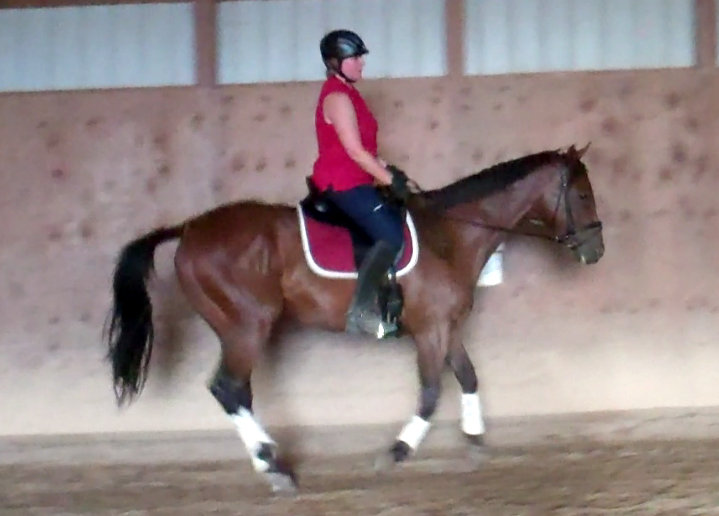
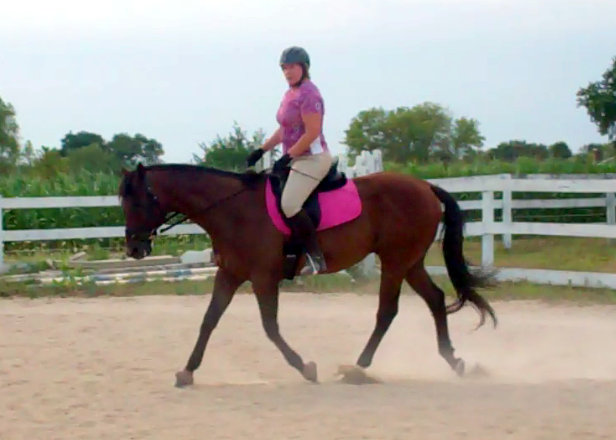
We started out looking like this: pleasant, but not engaged.

Pleasant, but not engaged at all.

Doing transitions on a circle helped me get and maintain bend, while also starting to get a real feel for maintaining power through transitions.  Things started to improve.

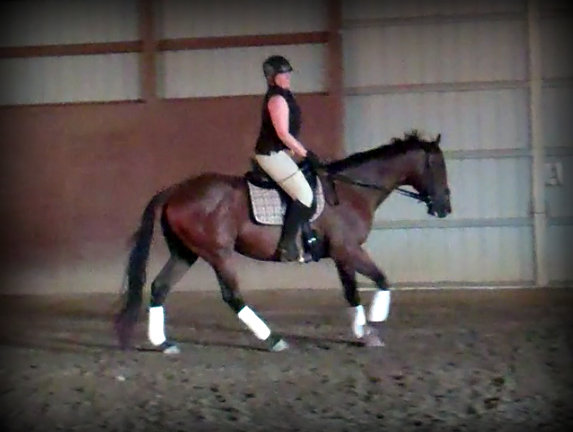
More engagement. Derby is using his hind legs more actively. He’s still a bit on his forehand, though.

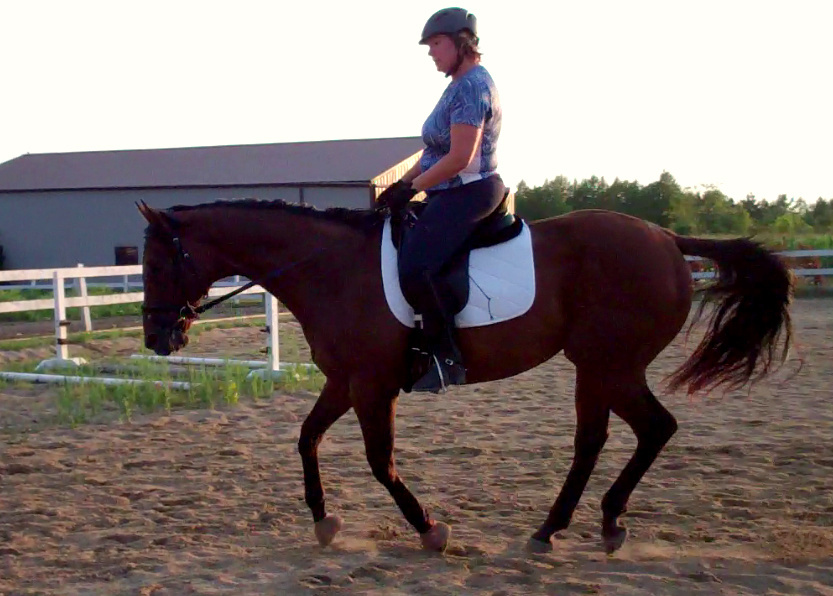
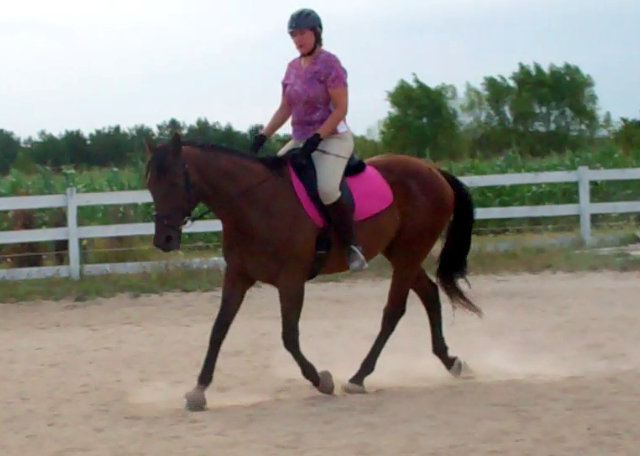
After quite a bit of work, we finally got the half-halt working the way Christy envisioned, producing our best work of the day, with Derby nicely connected over his back, off his forehand and moving with energy:

There’s a lot more work on this to do, but at least I’m starting to get a feel for a real half-halt, not the energy-draining downshift I had been using.

Upward spiral

He’s a good buddy.

I have to start today’s post with a little silly horse bragging.  Tuesday’s vet appointment was first thing, and there was a real chill in the air.  Between the crisp temperatures and the fact that everyone else had been turned out, Derby was a bit wound up.  So I put him in the outdoor arena to work off some steam before the vet showed up.  Work it out he did – running, bucking and farting – before finally having two good rolls in the sand. Then he went and grazed the clover and tufts of grass growing along the edges.  Out of the reach of the mower, and recently rejuvenated by some rain, the edges of the arena provided some good eatin’.

After 15 minutes or so, the vet rolled in.  As they were unloading their things, I went up to the gate and called Derby to me.  He picked up his head and sauntered across the area to me.  My vet’s assistant happens to be Derby’s old owner.  She was amazed that Derby – who is very food motivated – would leave grass when I called.   He’s such a good boy!

Now on to the vet visit.  The good news is that the scoping showed zero inflammation of the airway, and zero lesions.   But there was some bad news too.  Derby has started to aspirate food into his airway.  This is the very last thing I wanted to hear, because aspirating food into the trachea can lead to choke and pneumonia.  Scary stuff.

We talked about surgery, but in the meantime, because the matter appeared to be hay, the vet told me to soak his hay.   She also told me not to worry too much – the coughing he does clears the airway.  That explains why I’ve been experiencing more coughing lately.

I focused on using my inside leg to engage Derby’s hind legs, getting him to step up under himself and engage.

On Tuesday night, I rode after Derby had his evening feed.  It was a beautiful, cool night, and he felt great – a little coughing at the beginning of the ride, but then he was pretty quiet.   Last night was the same story.  The wet hay really seems to be helping!  Our hay has been very crumbly – the flakes almost fall apart.  This is due to the drought -the plants are short, dry and stunted.  So instead of having nice, long blades of grass and other plants, the hay has little scraggly bits.  And he must be sucking those into his airway.   So hopefully we’ll dodge a bullet by continuing to soak his hay!  That beats the socks off tie-forward surgery, which is big surgery (the horse is fully out, on his back) and carries no guarantees.

In our lessons this week, we’re focusing on two things – maintaining strong, forward gaits, and activating Derby’s hind legs.  As I’ve mentioned before, these are two historically weak areas for me.    On Tuesday, the focus was really on bend and getting those hind legs to step under.  On Wednesday, it was more of the same, but we added extra focus on gait quality.   I caught myself twisting in the saddle again on Tuesday, causing the horse to fall inward, and forcing me to refocus on my position.  Christy helped me through this by telling me not to worry about fixing my legs (which I was – my outside leg would creep forward, and my inside leg back – ugh) but instead had me focus on my seat and leading with my inside seatbone.  That was the solution to the problem.   We were able to spiral in and leg-yield out nicely.

We’re working on engagement at the canter. The nice moments are coming more frequently, but we’re not yet maintaining the “niceness” all the time.

The canter is still very much a work in progress. I’m looking forward to the day when I have the same influence over the canter as I do the trot.  Right now I have two canters – crappy and decent.   While “decent” is a start, it’s not “working.”  I’m still developing my seat at the canter, and at the same time, I’m starting to think about getting the horse to move more forwardly, soften and engage his hind end.  We have quite a way to go in this gait!

Last night’s theme was “decide to do it.”  I had mentioned to Christy that I had difficulty maintaining a big, forward trot on a circle with correct bend and engagement.  After putting us through our paces, Christy diagnosed that (again!) the issue was with the pilot, not the pony.

“Pretend Robert Dover is watching you,” she said, hearkening back to the clinic, in which we saw what happened when riders were asked to expect more of themselves, and their horses. “Decide how you’re going to ride and then do it.”   So, I did.  I closed my legs, and was fast with a thump of a heel or tickle with the whip if he started to stall out.  Christy was right – it was more about making a decision and following through.   We finished the ride with few laps of big, forward, connected trot after all the work on the circles, and Derbs felt great throughout.

All in all, despite the scary interlude with the airway issues, I feel like we’re managing to spiral a little upward (in addition to in and out, in and out.) 🙂

The “Maserati”

Starting to get some real throughness.

Back when I was riding Maddie, I actually got to the point where I was starting to really ride correctly, developing real connection and that powerful closed loop of energy you get when your horse is really pushing with its back legs, is on the bit and working over its back and you’re holding correct contact.  I remember how it felt the first time on Maddie – when that big, 16.3 hand mare suddenly felt like she grew a finely tuned sports suspension.   All the parts of the horse are working in unison.  There are no trailing hindquarters or popping shoulders.  The horse is through.  Its back is up, it’s on your aids and connected and paying attention. It’s a wonderful feeling of power married with pinpoint control.

I’m starting get that feeling of throughness with Derby, too.  Our work has really improved recently – due in large part to our newfound forwardness.  I’ve been able to generate and keep the “Maserati” feeling at the trot during my last few rides.  It’s so much more than roundness.  It’s amazing.

Bad and naughty pony!


I’ve also been focusing on maintaining my forward gears.  We now have a nice medium walk that is our default.  No more shuffling.  The trot is also completely respectable.  I still need to do more work in the canter, however.  And I had to remind him tonight, which elicited the buck you see above.

Happily, I stayed on, and even more happily, wasn’t even phased.  After the bucking incident, we had a better ride and more forward canter.  At one point I even got him to lengthen a bit, and could feel the difference.  I have a lot to do in the canter – developing roundness and adjustability for starters – but I feel like we’re making progress.  I’m actually influencing the gait.

I’ve added a couple more lessons to this week’s usual remit.  We have some momentum and I really want to keep the pedal to the metal right now.

Finally forward (update + video)

A better canter is easier to sit on correctly. My posture looks much better.

Today temperatures got back up into the 90’s, and Derbs was sweating just standing in his stall.  Because he’s often at his laziest on hot days, I was curious to see if last night’s focus on ‘forward’ would translate to tonight’s ride.

It did! Right off the back Derby stepped into a good trot, and he didn’t require any sharp reminders with the whip.  I didn’t have to do any Pony Club booting either. We had a really nice ride.  I was thrilled.  Importantly, I think I can perserve these forward gears.

I was motivated by watching some recent videos and not being happy with how we looked.  When Derby is behind my leg, I have to work hard, which is totally exhausting, and it’s terrible for my posture. When I’m trying to push him forward, I essentially push with my whole body – tipping forward and closing my hips, which puts the brakes on Derby’s forward gears.

The quality of his gaits improved across the board.  We have a legtimate, swingy medium walk, a very nice free walk stretching into contact, and a rhythmic canter.  When he’s behind my leg, his canter gets lateral. It’s awful. Tonight, it was pretty nice.

I’m hoping to work another lesson in tomorrow. I want to keep this momentum going.

Update:

Here’s a clip of our canter work.  I was thinking about last night’s ride again this morning, and forgot to add one more observation – that a more forward horse is in steadier contact.  Anyway, in this clip I’m starting to influence the canter here and there, getting him to lengthen stride and round (albeit sporadically, but it’s a start!)

Hard stuff.

I’ve had two overnight trips to New York inside the span of a week, which has limited my time in in the saddle lately.  I had a good lesson on Monday night, and then an even better ride tonight.

In the interim, Christy got on Derby while I was away, and reported back to me that he felt very disconnected.  He doesn’t use his body as a whole.  He may soften to the rein, but he pops a shoulder out or a hip in when doing so. I need to get him into the outside rein, and I need to get control of all the parts.

We started out working on that tonight, which required me to really use my legs and seat, and to also ride Derby’s shoulders, not steer his face.  I practiced at the walk, trying desperately to feel what Christy felt, and to feel the difference when I got it right.  We discovered that when I used the “pirouette” mental image, in which I’m imagining that I’m riding a pirouette, I can move Derby’s shoulders pretty well.  However, the exercises I did tonight are going to be incorporated into my warm up, because this is definitely not habit yet.

Then we moved into doing some patterns.  A line of five trot poles was lined up down one of the quarterlines, so Christy had me start practicing riding the shoulders at the trot by doing a serpentine down one long side, a trot-halt-trot transition at the ends, and then trotting through the trot poles down the other side.

Trot-halt, mind you.  Something I’ve not schooled. Happily for me, we already have a good downward, and Derby takes half-halts well.  We got trot-halt down quickly.  However, the halt-trot upward – which is something that is required even at Intro and that I have schooled, wasn’t great.  After enduring several less than inspiring attempts, Christy upped the ante, asking me to do canter transitions in the corners, just a couple strides after the halt, and then bringing it back to a trot down the long side.  We managed this new addition well, and afterward – when Derby was finally in front of my leg – the halt-trots improved.

Then Christy said she wanted to do some test practice, so she put the poles away to clear some space for us.  In the interim, I was a good girl and dropped my stirrups, doing rising trot until Christy was ready.

Christy informed me that she would be calling movements to me as I rode, so I needed to have the horse in front of my leg and on the aids.  All right.

We started out at the working trot, tracking right after our salute, and then circling at B.  I had an inkling of what was up when we changed rein across the diagonal, and sure enough, as I neared C I heard Christy ask for the canter between C and H.  We made the transition accurately, and rode a decent canter circle before transitioning downward.  I lost my connection a bit, and the next movement, the stretchy circle, wasn’t great.  As we followed Christy’s directions, I was pretty happy with how we fared.  We were pretty accurate, and though the ride lacked polish, it was respectable.

“Was that old Training 1?” I asked her when we were done.

“Nope.  That was new Training 2,” came the reply, along with a pleased grin. “You’re not going to improve at Intro by schooling Intro.  You’re moving up!”

This is so exciting for me.  I’m hoping to get out to another schooling show in September, before giving the IDCTA dressage schooling show championships a try in October.  It would be really fun to ride a training level test yet this year!

Incremental improvements

Better posture.

While the new seatbones and leg position changes aren’t yet habit (I repeat the mantra “Lengthen lengthen,” going into each bend and corner) it’s already helping improve my position, because my core in more engaged.  Two days on from the discoveries about my issues and the subsequent fixes, my seat at the canter has improved – I’m sitting much straighter.   I’d still like to see myself elevate my ribcage more, and my hands are creeping back into my lap (I don’t have a straight line from elbows to hands to bit) but I can see improvement from earlier this week, which I’ll take.

I have to do a lot more work at the canter – and trot/canter transitions – but we’re heading in the right direction.

Working some stretch

Overall, my balance and contact is improving day by day, as well.  Derby and I are going around much more consistently, and I’m mixing in bits of stretchy trot here and there to test my contact (and work on that movement too, of course.)

Better core engagement is also helping in the w/t and t/w transitions.  While my downwards are getting pretty reliable, keeping Derby round and on the bit in the upwards can still be spotty.

I’m up early this morning watching the first day of team dressage at the Olympics, and hope I have enough gas in the tank for a good ride tonight.  I petered out after about 40 minutes – which included a long warm up.  From a cardio standpoint I’m doing fine, but I’m still struggling with muscle endurance.   I’m paying attention to my diet (plenty of protein, and healthy carbs before I ride) but suspect that I’m just in need of more wet saddle pads.   The problem is most evident after canter work, which tells me something.

Olympics watching note: 

If you would prefer to watch dressage with some good commentary, or if you can’t access NBC’s live streams on their web site, here’s how you can watch the rest of the Olympics by accessing the BBC’s live feed: Go to VPNAuthority.com and spend $7.50 for one month of VPN access. This will allow you to get around the fact that the BBC Olympic streaming is blocked for the US. Follow set up instructions and be sure to select a European server instead of a US server. The set up is very easy. Just follow the instructions. Once connected to the net via VPN Authority, you can go straight to the BBC.co.uk site, where you can access their Olympic stream.


A Funny Thing Happened on the Way to C

Christy is a dressage biomechanics nerd, and her research, practice and discoveries have directly benefitted me, and no more than they did tonight. My lesson took an unexpected turn and we wound up identifying – and solving – a big and persistent problem I’ve been having.  Be warned, what follows will be granular and bio-mechanically oriented.

Our plans for the lesson went off the rails when, warming up at the walk, I caught myself in a bad habit.  I complain a lot about getting “twisted up” in the saddle.  Well, it turns out, I really and truly was doing exactly that.  As I walked Derby in a shallow serpentine, I was using my seatbones to guide his bend.  However, my left seatbone (always the offender) ended up almost on the cantle after I had tried to muscle Derby into bending left.  I caught myself doing it, and was able to realize that I’d gotten myself into a pretty untenable position in the saddle.

“Christy! I’m doing it! This is my problem! When I get “twisted up,” I end up with my left seatbone up almost on the cantle!”  Derby and I staggered toward her, maintaining this horrific state of affairs so she could see. The wheels in her head went into hyperdrive (I swear I could see them spinning) and she got to work.

We started by re-acquainting me with my seatbones and sitting straight. Seems obvious, but this is the very root of my problems. I tend to collapse pretty significantly to the right.  Clearly, I’ve developed this crazy twisting, seat-bone-pushing habit to try to compensate.  (It doesn’t work very well.)

So, sitting straight in the saddle, Christy had me walk.  She observed that I use my hips differently – our first clue.  My right hip, she said, follows the motion of the horse.  The left hip, she said, tends to push outward, rather than forward, with the motion and looks more stiff.  Well, she’s right.  My left hip is stiffer, and it’s a bit arthritic.

Making a point of following the motion, she watched carefully while she had me do a variety of different things.   Then she proceeded to install a new (and more correct) bending aid.  It worked beautifully at the walk, but I struggled at the rising trot.  Putting the changes into motion (and avoiding the temptation of reverting to my old habits) was tough.  To stay focused on implementing the changes she made to my seat, Christy had me focus on what specific muscles on my left side were doing.  At one point, as I accidentally enaged my quads instead of my hip flexors, Derby bobbled, which she saw just as I said “Dang! Wrong muscle!”

This little mishap led me to vocalize my concern that all my strong pushing, pushing, pushing on that left side (to the point where I have worn holes in breeches under my left seatbone, mind you) had desensitized Derby.   Christy reminded me, however how sensitive Derby is (and most other horses are, for that matter) to changes in balance,  and to think in terms of creating the space for the horse to go.

I was eventually able to figure out which muscles I needed to be using at the same time I was using my core.

“Your horse is a mirror of you,” Christy said. “If you’re not connected, your horse won’t be, either.”

As I became more attuned to the new muscles I was using, things started to click into place.  Though I wasn’t really asking (and we weren’t really moving) the horse started to round of his own accord.  The turns were soft and quiet.  And most amazingly, because I wasn’t driving my hip and leg into Derby’s side, my leg was quiet – and available to give other aids.

It was a seriously illuminating lesson and I can’t wait to get back in the saddle tomorrow night.

This is a canter we can work with!

Finally! We’re developing roundness at the canter. Yay!

I’ve really been busting my hump lately, and tonight we took another couple steps forward.  I was able to replicate the fleeting roundness at the canter I felt over the weekend, and I even held it together.   A round canter feels ENTIRELY different.  It is dreamy!  So that’s what the fuss is all about.  I get it! 🙂  And I was thrilled when Christy said “Now this is a canter we can work with,” and then started talking about getting out at Training.  This year.

Squee.

Much remains to be done.  Everything needs to be smoother, more balanced, and more consistent. But there were a few other high points this evening.

Round downward canter-trot transition

Starting the transition downward

Two strides later – no upflung head!  We stay round, steady, forward and quiet.

Starting to push the working trot out:


Oh! And stretchy trot. Forgot to mention we did that too! Woot!

So, this was an awesome ride. One of my best ever. And there was a secret ingredient.  Forward.  The horses were in all day today, and Derbs was fresh.  Having ready access to forward gears made everything work better.  I have to continue developing (and riding and encouraging and reinforcing and rewarding) forward thinking behavior from the Derbster.

Here’s a look at some video from late in the ride.  I was really running out of gas and it shows.  However, we still got some nice moments.  It’s a definite improvement.

I’ll take six pounds, please.

My list of things I must do in order to ride effectively is getting longer with each lesson.  But, happily, my riding is getting better so I’m not complaining.

Derbs and I have been busting our butts despite the heat.  Tonight we got a little relief, riding outside as a storm was blowing in. The temps were dropping and the strong breeze felt great.

At the outset, though, we were a bit stuck.  Derby was strung out, on his forehand, with his nose poking determinedly out. Like a cute little hunter.   See?

Looking like a hunter. Not a dressager. (Trashy pink outfit notwithstanding.)

After watching us go around ineffectually, unable to really change our way of going, Christy zeroed in on the problem du jour.  “Feather light contact is for finished Grand Prix horses and finished Grand Prix riders.  At the lower levels, you need a lot more contact.  If it feels like you have 2 lbs on the reins right now, increase it.  Take 6 lbs of contact.”

So I did.  Yes, I shortened the reins, but no, I didn’t crank Derby’s head in.  That’s not the way we roll at Rettger Dressage.  With my reins the appropriate length (over the withers, and not in my lap, for a change), I closed my fingers, and resolved to keep them closed. Moving off into a trot, I kept my elbows softly by my sides, not allowing them to creep forward.  At the same time, I checked my position to ensure I wasn’t blocking Derby’s movement, and I used my inside leg to get the back legs to really move.  The effect was immediate and profound.

The contact was steady, Derby rounded nicely and and was responsive, bending very nicely and correctly when asked.  The improvement was night and day.  Here’s a video clip Christy grabbed right after I made the change to taking more contact on the reins:

So, without further ado, here is my revised riding checklist:

  • Use the inside rein.  If he doesn’t respond to a softening of the inside rein, and continues to hang, get busy with the inside leg while insisting with the inside rein (e.g. a direct rein).  My desire to not hang on the inside rein has gone a bit too far.  I am allowed to use it.
  • When Derby feels “stuck” and braced against me, I need to mix it up.  Flex him, do serpentines and leg yields – anything to get that neck unbraced and softer.
  • Do as little as you can do but as much as you need to do to get the response you want – but be mindful.  If the horse doesn’t respond when I ask nicely, I have to next ask not-so-nicely.  Accepting no response results in a dull horse that’s dead to the aids.
  • Ride with my core engaged, and my leg long and draping around Derby’s sides.
  • Take – and hold – plenty of contact.  And don’t give it away by riding with loose elbows.

More core.

New green duds

I’ve spent a fair amount of time watching Christy ride her horses, and while I always learn a lot, watching her develop Remy over the last year has been especially informative, chiefly because in taking the skinny young OTTB from the track to the dressage ring required her to instill rhythm, contact and cadence in the horse.  Within a few months of his arrival, Christy had Remy going well, and I especially enjoyed watching her work the long-legged boy at the trot, improving his use of his back.  They would go around the arena, doing circles and serpentines at a spanking gait, with Remy staying round and yielding nicely when Christy asked for bend.   I memorized what that looked like.  And I’m trying to emulate it.

I know that she really had to work for that nice gait on Remy when he was greener, and part of that work was finding – and holding – her balance.  While Derbs is no Remy, he is similarly sensitive to my position, providing me instant feedback on how I’m sitting.  The degree of his forward motion varies directly with my balance and position on his back.

So instead of “trotting like Remy,” really, I need to be thinking “sit like Christy” in order to produce the big, forward, flowing gaits I seek.   And I got a bit closer to getting there this week.

Thursday night’s lesson focused on many of the same things I noted in my post on Wednesday, and once we got warmed up, I had a very decent working trot going that Derby was pretty much sustaining.  But I have struggled with maintaining that gait when we do anything other than go down the long side.  So I was paying particular attention to my position (and the horse’s feedback) in my lesson.

As we continued working, things improved, until finally, we were doing a very nice 20m circle around Christy, who had become effusive in her praise.  I had contact, I had forward, I had bend — and it was all pretty easy, I didn’t have to work to hold it. What had I done?  Well, in addition to the checklist I noted in my blog post on Wednesday, I had added one more thing.  Core engagement.  When I engaged my core, I could feel my hip angles opening as my leg lengthened and I sat up taller.  Derby immediately responds to this – when I finally put myself into the right position, he rewards me immediately by rounding and carrying himself nicely.

So here’s my updated checklist:

  • Use the inside rein.  If he doesn’t respond to a softening of the inside rein, and continues to hang, get busy with the inside leg while insisting with the inside rein (e.g. a direct rein).  My desire to not hang on the inside rein has gone a bit too far.  I am allowed to use it.
  • When Derby feels “stuck” and braced against me, I need to mix it up.  Flex him, do serpentines and leg yields – anything to get that neck unbraced and softer.
  • Do as little as you can do but as much as you need to do to get the response you want – but be mindful.  If the horse doesn’t respond when I ask nicely, I have to next ask not-so-nicely.  Accepting no response results in a dull horse that’s dead to the aids.
  • Ride with my core engaged, and my leg long and draping around Derby’s sides. 

In other words, sit like Christy!