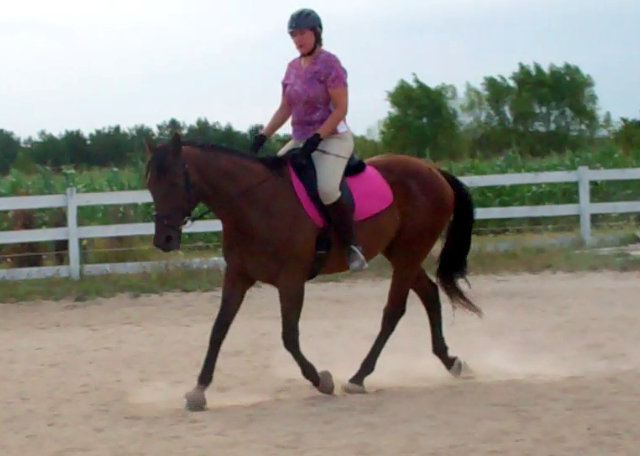
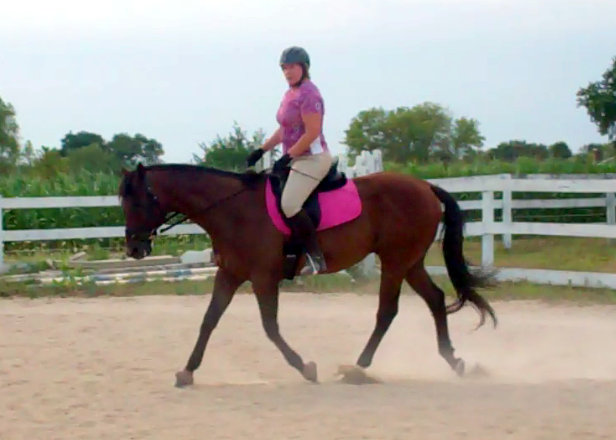
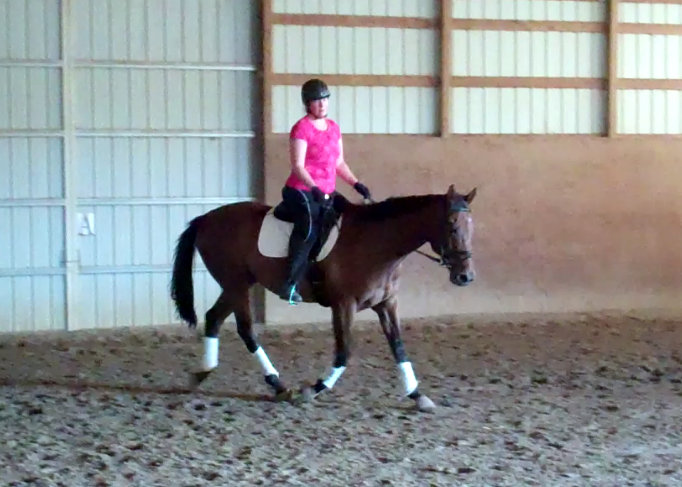
A Funny Thing Happened on the Way to C

Christy is a dressage biomechanics nerd, and her research, practice and discoveries have directly benefitted me, and no more than they did tonight. My lesson took an unexpected turn and we wound up identifying – and solving – a big and persistent problem I’ve been having.  Be warned, what follows will be granular and bio-mechanically oriented.

Our plans for the lesson went off the rails when, warming up at the walk, I caught myself in a bad habit.  I complain a lot about getting “twisted up” in the saddle.  Well, it turns out, I really and truly was doing exactly that.  As I walked Derby in a shallow serpentine, I was using my seatbones to guide his bend.  However, my left seatbone (always the offender) ended up almost on the cantle after I had tried to muscle Derby into bending left.  I caught myself doing it, and was able to realize that I’d gotten myself into a pretty untenable position in the saddle.

“Christy! I’m doing it! This is my problem! When I get “twisted up,” I end up with my left seatbone up almost on the cantle!”  Derby and I staggered toward her, maintaining this horrific state of affairs so she could see. The wheels in her head went into hyperdrive (I swear I could see them spinning) and she got to work.

We started by re-acquainting me with my seatbones and sitting straight. Seems obvious, but this is the very root of my problems. I tend to collapse pretty significantly to the right.  Clearly, I’ve developed this crazy twisting, seat-bone-pushing habit to try to compensate.  (It doesn’t work very well.)

So, sitting straight in the saddle, Christy had me walk.  She observed that I use my hips differently – our first clue.  My right hip, she said, follows the motion of the horse.  The left hip, she said, tends to push outward, rather than forward, with the motion and looks more stiff.  Well, she’s right.  My left hip is stiffer, and it’s a bit arthritic.

Making a point of following the motion, she watched carefully while she had me do a variety of different things.   Then she proceeded to install a new (and more correct) bending aid.  It worked beautifully at the walk, but I struggled at the rising trot.  Putting the changes into motion (and avoiding the temptation of reverting to my old habits) was tough.  To stay focused on implementing the changes she made to my seat, Christy had me focus on what specific muscles on my left side were doing.  At one point, as I accidentally enaged my quads instead of my hip flexors, Derby bobbled, which she saw just as I said “Dang! Wrong muscle!”

This little mishap led me to vocalize my concern that all my strong pushing, pushing, pushing on that left side (to the point where I have worn holes in breeches under my left seatbone, mind you) had desensitized Derby.   Christy reminded me, however how sensitive Derby is (and most other horses are, for that matter) to changes in balance,  and to think in terms of creating the space for the horse to go.

I was eventually able to figure out which muscles I needed to be using at the same time I was using my core.

“Your horse is a mirror of you,” Christy said. “If you’re not connected, your horse won’t be, either.”

As I became more attuned to the new muscles I was using, things started to click into place.  Though I wasn’t really asking (and we weren’t really moving) the horse started to round of his own accord.  The turns were soft and quiet.  And most amazingly, because I wasn’t driving my hip and leg into Derby’s side, my leg was quiet – and available to give other aids.

It was a seriously illuminating lesson and I can’t wait to get back in the saddle tomorrow night.
It’s not a fluke

My two rides over the weekend were both really nice.  We’re riding in the outdoor every moment possible – the footing is better and it shows in the horses’ gaits.  The footing is also a bit deeper – similar to what we see at shows – and provides some extra conditioning too.
I was disappointed when Derby came up back sore on Thursday, but I wasn’t entirely surprised.  I’ve been working him more over his back in the last week than I have in a long time, and while I’m not killing him with work by any stretch of the imagination, he is working differently.  So on Thursday we simply longed, and Friday Derby had the day off.  Saturday found him much improved, and we had a nice ride in which I was able to generate and hold correct roundness and connection almost from the beginning, and I got it in the canter, too.  I am noticing that Derby is starting to try to lean a bit on my hands, but that’s corrected pretty simply by sitting up and applying leg.

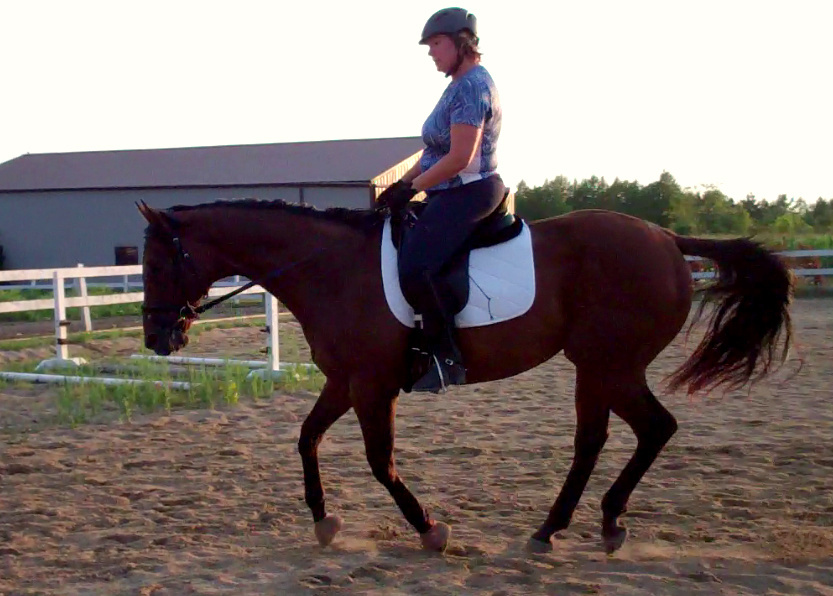
On Sunday, we rode late in the day, after coming home from watching Christy show. It was cool and breezy, and an afternoon rain shower had dampened the footing outside just enough to hold off the dust.  We got going and Derbs felt good but when I asked him to move out at the trot, I got an ‘eh’ response.   So I gave him a smack with the whip – and got a little buck and then canter.  While I didn’t love the buck response, forward was the right answer, so I let him canter.  Derby found the energy he thought he lacked previously, and we did a lap going forwardly, and then on the circle I asked him to round and come into my hands – and he did.  Actually influencing the canter is still so new to me, I can’t believe I can do it! It’s not a fluke after all. 🙂

So work starts again with Monday’s lesson, and we’re looking at getting out to a show mid-August.  Stay tuned!


This is a canter we can work with!

Finally! We’re developing roundness at the canter. Yay!

I’ve really been busting my hump lately, and tonight we took another couple steps forward.  I was able to replicate the fleeting roundness at the canter I felt over the weekend, and I even held it together.   A round canter feels ENTIRELY different.  It is dreamy!  So that’s what the fuss is all about.  I get it! 🙂  And I was thrilled when Christy said “Now this is a canter we can work with,” and then started talking about getting out at Training.  This year.

Squee.

Much remains to be done.  Everything needs to be smoother, more balanced, and more consistent. But there were a few other high points this evening.

Round downward canter-trot transition

Starting the transition downward

Two strides later – no upflung head!  We stay round, steady, forward and quiet.

Starting to push the working trot out:


Oh! And stretchy trot. Forgot to mention we did that too! Woot!

So, this was an awesome ride. One of my best ever. And there was a secret ingredient.  Forward.  The horses were in all day today, and Derbs was fresh.  Having ready access to forward gears made everything work better.  I have to continue developing (and riding and encouraging and reinforcing and rewarding) forward thinking behavior from the Derbster.

Here’s a look at some video from late in the ride.  I was really running out of gas and it shows.  However, we still got some nice moments.  It’s a definite improvement.

Responsibility

About six months ago, after riding Derby for me while I was away, Christy commented to me that he “felt just like Jag.”   We train our horses every time we ride, and it stands to reason that they quickly reflect how they’re ridden in how they go.  In this case, Christy was saying (among other things) that Derby wasn’t terribly responsive to aids, because I wasn’t requiring immediate, crisp responses.

I’ve ridden enough different horses to know what she’s talking about.  Generally speaking, horses that Christy has trained (like Liam and Maddie) are unbelievably fun to ride – they are so light and so responsive that that it almost feels like they’re reading your mind.  They respond immediately to the the most gentle of aids.

On the other end of the spectrum are wily lesson horses and horses ridden by beginners.  These horses are good at defending themselves against inconsistent riding, unsteady hands and other rider errors that are uncomfortable for the horse.  They aren’t terribly fun horses to ride.  You have to really work hard to get them to relax and work correctly. In my case, I dulled Derby’s responsiveness and dialed back his forwardness.  I’ve been working on improving my riding – and what upping my expectations of him.

Today we had a fun ride.  Christy and I met at the barn in the morning, to ride before going to Lamplight to watch the freestyles.   It wasn’t terribly hot, so we took advantage of the weather and rode outside.   Keeping my lessons in mind, I focused on keeping Derby on the bit, and holding the contact in order to define clearly where I wanted him to go.  Over all, he made me work here and there but it was a pretty decent ride.  We rode pieces of patterns and transitions, and I was getting nice work and good responses.  We also had some good canter work, doing 20 M circles and then laps.  And during one of those canters, I decided to apply what I’ve been doing in the trot – closing my fingers and closing my legs to hold the contact and encourage the horse forward.  And for a moment – a fleeting moment, he rounded and his back came up.  And that fleeting moment, felt great.   I’ve not been working much at all on the canter, and it was neat to influence the gait.

We cooled out a bit, and then I took Derbs in to untack.  I bent down to remove my spurs before taking him to the wash rack … and found that I’d forgotten to put them on!   His responsiveness is absolutely improving.  That was a nice ride, especially without the added emphasis of spurs.

Christy is going to get the chance to get on Derby again in September.  I hope she can feel an improvement in him this time around!

Separately, the show was interesting.  We watched a number of rides, from First through Fourth, and then a couple FEI freestyles.   As is always the case with a rated show, everywhere you look you see serious equine eye candy.  But only a scant handful of rides showed real connection and throughness.  We saw a lot of leg movers, gaping mouths, tense backs and lateral walks (a serious fault.)  Sure, when you’re watching, you have no idea of the extenuating circumstances the riders are dealing with when they go down the centerline.  I get it – a lot of horses (Derby included) are far different at shows then they are at home.  Still, we saw a lot of upper level and pro rides, and we could see the problems that stem from not really having the horse through.  Tempis didn’t have jump, extensions didn’t have reach and thrust.  Obviously, I’m light years from riding these movements, and I’m not saying this to impugn the riders I saw today.   But I did come away from the show with a new appreciation for how important connection and throughness are for a good ride.

I’ll take six pounds, please.

My list of things I must do in order to ride effectively is getting longer with each lesson.  But, happily, my riding is getting better so I’m not complaining.

Derbs and I have been busting our butts despite the heat.  Tonight we got a little relief, riding outside as a storm was blowing in. The temps were dropping and the strong breeze felt great.

At the outset, though, we were a bit stuck.  Derby was strung out, on his forehand, with his nose poking determinedly out. Like a cute little hunter.   See?

Looking like a hunter. Not a dressager. (Trashy pink outfit notwithstanding.)

After watching us go around ineffectually, unable to really change our way of going, Christy zeroed in on the problem du jour.  “Feather light contact is for finished Grand Prix horses and finished Grand Prix riders.  At the lower levels, you need a lot more contact.  If it feels like you have 2 lbs on the reins right now, increase it.  Take 6 lbs of contact.”

So I did.  Yes, I shortened the reins, but no, I didn’t crank Derby’s head in.  That’s not the way we roll at Rettger Dressage.  With my reins the appropriate length (over the withers, and not in my lap, for a change), I closed my fingers, and resolved to keep them closed. Moving off into a trot, I kept my elbows softly by my sides, not allowing them to creep forward.  At the same time, I checked my position to ensure I wasn’t blocking Derby’s movement, and I used my inside leg to get the back legs to really move.  The effect was immediate and profound.

The contact was steady, Derby rounded nicely and and was responsive, bending very nicely and correctly when asked.  The improvement was night and day.  Here’s a video clip Christy grabbed right after I made the change to taking more contact on the reins:

So, without further ado, here is my revised riding checklist:

  • Use the inside rein.  If he doesn’t respond to a softening of the inside rein, and continues to hang, get busy with the inside leg while insisting with the inside rein (e.g. a direct rein).  My desire to not hang on the inside rein has gone a bit too far.  I am allowed to use it.
  • When Derby feels “stuck” and braced against me, I need to mix it up.  Flex him, do serpentines and leg yields – anything to get that neck unbraced and softer.
  • Do as little as you can do but as much as you need to do to get the response you want – but be mindful.  If the horse doesn’t respond when I ask nicely, I have to next ask not-so-nicely.  Accepting no response results in a dull horse that’s dead to the aids.
  • Ride with my core engaged, and my leg long and draping around Derby’s sides.
  • Take – and hold – plenty of contact.  And don’t give it away by riding with loose elbows.

The Path

Derby and I have finally broken through a plateau, and I’m really excited about my lesson tomorrow night.  Last week we finally started producing a show-ring quality trot with real bend, roundness and connection.  We’ve just passed our one-year anniversary together, and we’re putting in some good work – finally.

Saturday and Sunday I rode on my own (not in a lesson.) I swore to myself that I would build on my progress over the last week, focusing on maintaining energy and roundness simultaneously.  I’ve also been working on sharpening Derby’s responsiveness to my aids,  which takes a lot of very deliberate and focused riding from me.

I got out the barn early on Saturday.  All the horses were inside due to some storms that rolled through earlier, and Derby had quite a bit of extra energy to burn.  I actually considered longing him at the outset, but then decided that I needed to work on dealing with extra energy, like I have to do at shows.  Could I get him to focus on me, stay on the aids and work correctly?

The answer is yes.  I put Derbs to work immediately, instead of walking around on the buckle.  I loosened his jaw, poll and neck, moving him around and flexing him right and left.  We stretched down.  We spiraled in and out.  We did serpentines.  And pretty soon, I had a nice, responsive horse.  Once that was achieved, I focused on the trot work, riding lots of patterns and maintaining the energy and forward, while also working in some torture in two-point and some sitting trot too.  Derby’s back was up for the most part and things felt pretty good.

Sunday I was tired, and I’ll admit it, a bit hung over after a late night out with some friends.  The sun was beating down and I wasn’t very motivated, but we ended up having a really good ride.  After warming up inside, I took Derbs to the outdoor, to see if we could replicate our work outside, in a different and more distracting environment.  I put him straight to work in the outdoor, not taking a minute to walk around and look at things.  We didn’t have the energy we did on Saturday, but it was hot as Hell out there in the sun, and I settled for round, steady contact, and we achieved it pretty quickly. We did several laps and some excerpts from some tests, and Derby’s back stayed up, and the contact was steady.  Between the heat and the deeper outside footing, I didn’t push it.  We hit the showers after accomplishing what I set out to do.

It’s been a process to get to this point.  And now that I’m starting to get correct work, I know the next steps will be to take the time to build the correct muscling that will enable Derby to carry us nicely into Training level, while building the trot and then repeating everything for the canter. So, a lot remains to be done, certainly, but the path doesn’t look as steep and bumpy as it did three weeks ago.


More core.

New green duds

I’ve spent a fair amount of time watching Christy ride her horses, and while I always learn a lot, watching her develop Remy over the last year has been especially informative, chiefly because in taking the skinny young OTTB from the track to the dressage ring required her to instill rhythm, contact and cadence in the horse.  Within a few months of his arrival, Christy had Remy going well, and I especially enjoyed watching her work the long-legged boy at the trot, improving his use of his back.  They would go around the arena, doing circles and serpentines at a spanking gait, with Remy staying round and yielding nicely when Christy asked for bend.   I memorized what that looked like.  And I’m trying to emulate it.

I know that she really had to work for that nice gait on Remy when he was greener, and part of that work was finding – and holding – her balance.  While Derbs is no Remy, he is similarly sensitive to my position, providing me instant feedback on how I’m sitting.  The degree of his forward motion varies directly with my balance and position on his back.

So instead of “trotting like Remy,” really, I need to be thinking “sit like Christy” in order to produce the big, forward, flowing gaits I seek.   And I got a bit closer to getting there this week.

Thursday night’s lesson focused on many of the same things I noted in my post on Wednesday, and once we got warmed up, I had a very decent working trot going that Derby was pretty much sustaining.  But I have struggled with maintaining that gait when we do anything other than go down the long side.  So I was paying particular attention to my position (and the horse’s feedback) in my lesson.

As we continued working, things improved, until finally, we were doing a very nice 20m circle around Christy, who had become effusive in her praise.  I had contact, I had forward, I had bend — and it was all pretty easy, I didn’t have to work to hold it. What had I done?  Well, in addition to the checklist I noted in my blog post on Wednesday, I had added one more thing.  Core engagement.  When I engaged my core, I could feel my hip angles opening as my leg lengthened and I sat up taller.  Derby immediately responds to this – when I finally put myself into the right position, he rewards me immediately by rounding and carrying himself nicely.

So here’s my updated checklist:

  • Use the inside rein.  If he doesn’t respond to a softening of the inside rein, and continues to hang, get busy with the inside leg while insisting with the inside rein (e.g. a direct rein).  My desire to not hang on the inside rein has gone a bit too far.  I am allowed to use it.
  • When Derby feels “stuck” and braced against me, I need to mix it up.  Flex him, do serpentines and leg yields – anything to get that neck unbraced and softer.
  • Do as little as you can do but as much as you need to do to get the response you want – but be mindful.  If the horse doesn’t respond when I ask nicely, I have to next ask not-so-nicely.  Accepting no response results in a dull horse that’s dead to the aids.
  • Ride with my core engaged, and my leg long and draping around Derby’s sides. 

In other words, sit like Christy!

You get what you ask for…and what you accept

We worked on bend tonight, and made some progress.

I’m finally getting my strength back to the point where I can start worrying about other things than not banging the saddle when I post or steadying my hands.  Gait quality has been better of late, but I’m still allowing Derby to go around with his nose poked out like a little hunter.  So staying round, through, bending and forward are very much on my mind these days.

Christy really zeroed in on a couple key issues tonight when it comes to bending and staying round and on the aids.  I’m either not asking for the response I want, or I’m accepting a “meh” response from the horse.   In other words (and this sure sounds familiar) I need to “fix it now.” Some key takeaways from tonight that I must remember:

  • Use the inside rein.  If he doesn’t respond to a softening of the inside rein, and continues to hang, get busy with the inside leg while insisting with the inside rein (e.g. a direct rein).  My desire to not hang on the inside rein has gone a bit too far.  I am allowed to use it.
  • When Derby feels “stuck” and braced against me, I need to mix it up.  Flex him, do serpentines and leg yields – anything to get that neck unbraced and softer.
  • Do as little as you can do but as much as you need to do to get the response you want – but be mindful.  If the horse doesn’t respond when I ask nicely, I have to next ask not-so-nicely.  Accepting no response results in a dull horse that’s dead to the aids.

This video from my lesson captures some of Christy’s advice to me.  By the end of the lesson I was getting much better and faster responses from Derby, and we really started to get it together.  This clip is still chock full of the uglies but I love it because it captures Christy’s advice, and shows that when I follow it, I get the responses that I want from the horse. Until, at least, I stop riding in the last seconds and collapse …

I had to work my butt off but by the end of the ride we managed to get ourselves together more consistently.  Overall, I’m happy with the progress recently, especially with the improvement in the horse’s gaits.  We had a really nice canter tonight that felt fresh and forward, and the trot work across the board has also improved.  I’m putting myself into almost-full training and am excited about my ride tomorrow.  Progress is so motivating. 🙂


Reset

My riding has been on hiatus for a few weeks.  Derby was back sore after the last show, and then I went away for more than a week. Between the two of us, we’ve had a bit of a vacation from work.  Excruciatingly hot weather last week derailed my plans for Derby – I was going to put him into full training while I was away.  But a week of 100+ temperatures really slowed down Christy’s schedule. So while I loafed on the beach, Derby spent his days sunbathing and enjoying attention from Caitlin and Hanna, who groomed him and gave him refreshing showers while I was away.

Thankfully, temperatures have swung downward, and today was a beautiful, breezy day in the mid-80’s. I started the day with a visit to Jag, who really enjoyed the vigorous currying and brisk shower I gave him.  Then I met Christy at the barn to go look at some Thoroughbreds that are coming off the track.  We saw some real beauties and some solid-citizens in the making.  We were like kids in a candy store!

Finally, we made it back to Silver Fern.   I fetched Derbs, cleaned him up and hopped on.  There’s something to be said for taking a little break from riding – it helps still the chattering voices that tend co accompany most rides.  I simply focused riding Derbs forward and out into the contact.  That was it.  I kept my hands still, and made a point of staying out of his face, focusing instead on inviting him to stretch into the bit.  His back came up and we had a pretty decent ride.  We cantered a bit too, and I almost got a canter-walk transition (Derbs threw a single trot step in) when I half halted and asked for the downward.  I took it easy, only riding about a half-hour, to ensure we both have plenty in the tank for our lesson tomorrow.

Even though today was a lot cooler than it’s been, it’s clear that the heat has taken a toll on the horses.  Jag, who has been in full dappled bloom, has lost some weight.  So has Derby, to the point where I had the vet out to look at him and pull blood. Everything looks normal, so she’s having me keep him in at night, and keep up the supplemental feeding (extra hay, beet pulp, soaked alfalfa, etc.).  We’re set to have cooler temperatures all week.  I’m looking forward to riding, and I think we’ll all enjoy the more moderate weather.